
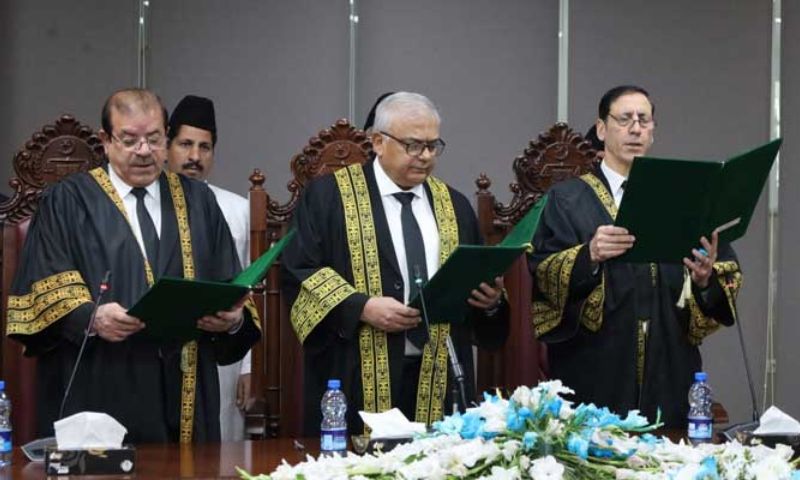



ISLAMABAD: Pakistan’s Federal Constitutional Court (FCC) became fully operational on Monday after the oath-taking of two additional judges under the recently enacted 27th Constitutional Amendment.
FCC Chief Justice Aminuddin Khan administered the oath to Justices Rozi Khan Barrech and Justice Arshad Hussain Shah during a ceremony held in the Islamabad High Court (IHC) conference room, bringing the total strength of the newly formed court to seven judges.
The ceremony followed the swearing-in of Justice Muhammad Kareem Khan Agha on Saturday. Earlier, Justice Syed Hasan Azhar Rizvi, Justice Aamer Farooq, and Justice Ali Baqar Najafi had already taken oath as FCC judges.
The 27th Amendment established the FCC with the mandate to ensure equal provincial representation and shifted several crucial constitutional powers from the Supreme Court to the new judicial body.
These include the authority to hear constitutional cases and the power to take suo motu notices — now exercisable by the FCC upon petitions.
Although Supreme Court Chief Justice Yahya Afridi remains the country’s top judge until the completion of his three-year tenure, the amended framework provides that the senior-most judge among the Supreme Court and FCC will assume the top judicial office thereafter.
As part of the judicial restructuring, the Supreme Court’s constitutional benches have been dissolved, while a three-member committee — comprising the chief justice, the senior-most judge, and a nominated judge — will now determine the formation of benches under the Supreme Court Practice and Procedure (Amendment) Bill 2025. Decisions will be made through majority vote.
FCC judges will retire at 68 — three years later than Supreme Court judges, who currently retire at 65.
Chief Justice Aminuddin has constituted three FCC benches. Bench 1 comprises Chief Justice Aminuddin Khan, Justice Ali Baqar Najafi, and Justice Arshad Hussain Shah.
Bench 2 includes Justice Syed Hasan Azhar Rizvi and Justice Muhammad Kareem Khan Agha, whereas Bench 3 consists of Justice Aamer Farooq and Justice Rozi Khan Barrech.
The FCC officially commenced proceedings in IHC’s Court Room No. 2, presided over by Bench 1. Courtroom adjustments are underway, with IHC Chief Justice Sarfraz Dogar scheduled to hear cases in Court No. 1 and FCC Chief Justice Aminuddin in Court No. 2.
Several IHC courtrooms have been reassigned to accommodate the new judicial setup, while the cause list for Justice Muhammad Asif and Justice Khadim Hussain Soomro was cancelled for the day.
The establishment of the Federal Constitutional Court is being viewed by legal experts as a significant step toward strengthening Pakistan’s constitutional framework.
By shifting constitutional matters from the already overburdened Supreme Court, the FCC is poised to reduce delays and ensure faster resolution of critical constitutional issues that often impact governance and public policy.
FCC judges will focus exclusively on constitutional interpretation and related disputes, enabling greater consistency, clarity, and depth in constitutional jurisprudence.
With equal representation from all provinces, the FCC is structured to reflect the country’s federal spirit. This is expected to build greater trust among provinces and ensure that constitutional decisions account for regional sensitivities and diverse perspectives.
By taking over constitutional cases and suo motu jurisdiction, the FCC will free the Supreme Court to prioritize appeals and non-constitutional matters, improving efficiency across the entire judicial system.
The court adds an additional institutional layer dedicated to safeguarding fundamental rights, reviewing executive actions, and upholding constitutional boundaries — thereby reinforcing democratic governance.