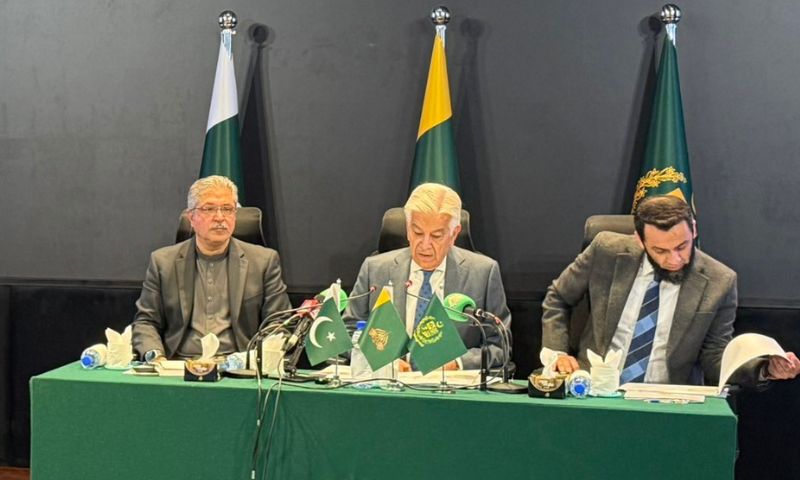



ISLAMABAD: Pakistan’s Defence Minister Khawaja Asif on Tuesday rejected reports of a military operation in northwestern Khyber Pakhtunkhwa’s Tirah Valley, adding that the ongoing migration was a routine seasonal practice linked to harsh weather conditions in the valley.
“There has been no operation in Tirah Valley for many years. These are all assumptions,” the minister said while addressing a press conference in Islamabad.
Information Minister Attaullah Tarar and Special Assistant to the Prime Minister for Information and Khyber Pakhtunkhwa Affairs Ikhtiar Wali Khan were also present alongside the defence minister at the press conference.
Tirah Valley lies in a mountainous region near Pakistan’s border with Afghanistan. Security officials say the terrain allows terrorists to infiltrate easily and blend into the local population.
According to Pakistani security officials, terrorist groups have used Afghan soil as a base to carry out attacks inside Pakistan.
Pakistan’s security forces are conducting intelligence-based operations against terrorists and have killed hundreds of terrorists in recent months.
Khawaja Asif went on to say the migration from Tirah and other valleys along the Pakistan-Afghanistan border was a routine, annual process during the winter season.
“During snowfall, people migrate from valleys located along the Pak-Afghan border. Migration from the Tirah Valley also takes place every year,” he said.
“The armed forces deployed in that area have nothing to do with it. This is an arrangement between the jirga and the provincial government, and as a result of that, this notification was issued,” he added.
“The army has abandoned operations in favour of Intelligence Bases Operations for a long time … There is no question of an operation there [in Tirah Valley]. The migration there is routine,” Asif reiterated.
Khawaja Asif said members of the banned Tehreek-i-Taliban Pakistan (TTP) had been residing in Tirah with their families. “They are around 400-500 in number,” he said.
He also criticised the KP government’s performance, pointing to the absence of basic public facilities in the valley, including hospitals, schools and police stations.
The minister said there was a “complete absence of civilian law enforcement agencies” in Tirah, adding that no police station existed in the area.
He further stated that if the KP government was willing to work for the welfare of the people of Tirah, the federal government would provide the necessary resources.
The information minister supported the defence minister’s position and referenced an official gazetteer from the 1880s, which stated that “the Afridis of Khyber and Akakhel are different from other tribes. They descend and migrate to other regions during the winter months and come back to Tirah in the summers.”
Meanwhile, the rescue and relief operation led by the Pakistan Army is continuing in the snowfall-hit areas of Khyber Pakhtunkhwa and Balochistan.
Pakistan Army is also providing basic necessities, including food and medical assistance to the rescued people and tourists.
Likewise, in Tirah Valley, the soldiers of the Pakistan Army are actively engaged in relief efforts amid heavy snowfall, without caring for their own safety.
The Pakistan Army remains steadfast in its commitment to protecting the lives and property of the public and providing immediate assistance during natural disasters and emergencies.