


ISLAMABAD: Pakistan’s ambassador to the United States has warned that US weapons left behind in Afghanistan are being misused by terrorist groups to carry out attacks inside Pakistan, raising concerns over growing security threats emanating from the Afghan soil.
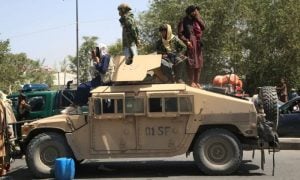
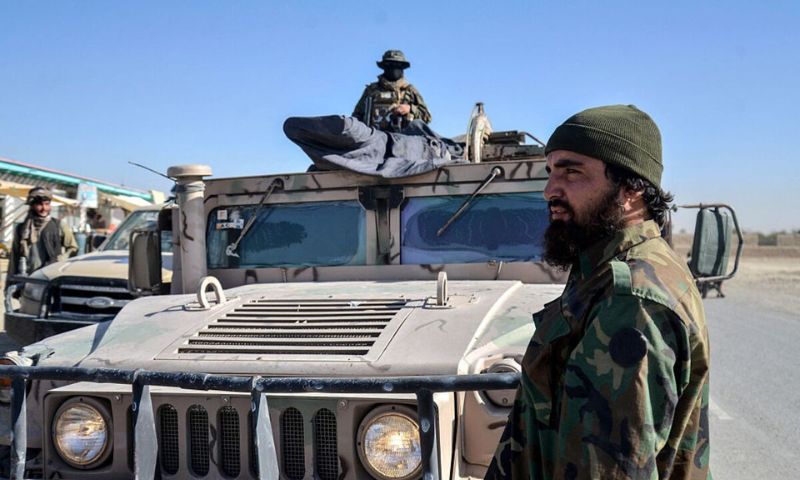
A recent report by the Special Inspector General for Afghanistan Reconstruction (SIGAR), a US government watchdog, revealed that the Americans abandoned billions of dollars’ worth of weapons and military equipment during the 2021 withdrawal from Afghanistan.
Parallel findings from UN monitoring teams and a Washington Post investigation indicate that some of these weapons have already filtered to the banned Tehreek-e-Taliban Pakistan (TTP), strengthening a group responsible for escalating attacks inside Pakistan.
Half a million weapons obtained by the Taliban in Afghanistan have been lost, sold, or smuggled to terrorist groups, the BBC reported in April last year.
The Taliban took control of around one million weapons and pieces of military equipment, which had mostly been funded by the US, when it regained control of Afghanistan in 2021, according to a former Afghan official who spoke to the BBC anonymously.
In a report in February, the UN stated that al-Qaeda affiliates, including Tehreek-e-Taliban Pakistan, the Islamic Movement of Uzbekistan, and the East Turkestan Islamic Movement, were accessing Taliban-captured weapons.
Threat to regional, international peace
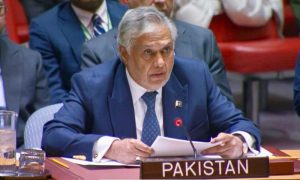
Ambassador Rizwan Saeed Sheikh raised the issue during a meeting with Representative Brian Mast, Chairman of the US House Foreign Affairs Committee, where the two discussed regional security, bilateral relations, and prospects for future cooperation, according to a statement issued by the Pakistan Embassy in Washington, D.C.
The ambassador said terrorism originating from Afghanistan poses a serious threat not only to Pakistan’s security but also to regional and international peace.
He informed Mast that terrorist attacks in Pakistan increased by 40 percent in 2024 and rose by a further 25 percent in 2025, attributing the surge to terrorist groups operating from Afghan territory.
Always a pleasure to meet Chairman HFAC @RepBrianMast. Extended best Wishes for 2026 and thanked him for his leadership and continued support during a year of positive trajectory in Pak-US relations.
Noted that 2026 must be a Year of Action – moving from good intent to concrete… pic.twitter.com/wxxpzdPMou
— Amb. Rizwan Saeed Sheikh (@AmbRizSaeed) January 7, 2026
He also invited Mast to visit Pakistan, saying such a visit would help strengthen parliamentary engagement and people-to-people ties between the two countries.
He thanked Mast for his leadership and support in strengthening Pakistan–US ties and referred to Secretary of State Marco Rubio’s commitment to transforming bilateral ties into a long-term, sustainable partnership with a strong focus on economic cooperation. In this context, Sheikh proposed declaring 2026 a “year of action” for the relationship.
The ambassador also called for the early initiation of a high-level economic dialogue, underscoring the importance of expanding engagement in key sectors such as energy, defence, minerals, information technology, and artificial intelligence.
He said Pakistan’s low-cost, high-quality manufacturing capacity could help meet rising demand in the US market.
Sheikh further highlighted Pakistan’s globally recognised surgical instruments industry, noting that a favourable trade environment could significantly boost exports, including textiles.
He also pointed to the use of footballs manufactured in Sialkot in the past five FIFA World Cup tournaments as a testament to Pakistan’s strength and reliability in sporting goods production.
Afghan Taliban support for TTP
A UN panel recently reported that the Afghan Taliban continue providing logistical and operational support to the TTP, while the Washington Post has documented that dozens of US-origin weapons are now surfacing in Pakistan in the hands of terrorists targeting the state.
SIGAR attributes part of this spillover to the abrupt loss of visibility after the Taliban takeover in Afghanistan.
“Due to the Taliban takeover, SIGAR was unable to inspect any of the equipment provided to, or facilities constructed for, the Afghan National Defence and Security Forces (ANDSF) following the Afghan government’s collapse,” the report states.
The US Department of Defence, however, has confirmed that approximately $7.1bn worth of American-provided equipment was left behind — including thousands of vehicles, hundreds of thousands of small arms, night-vision devices and more than 160 aircraft.
The consequences of this transfer are already manifesting in Pakistan.
According to the Washington Post, serial numbers of at least 63 seized weapons inside Pakistan match those originally supplied by Washington to Afghan forces.
The Washington Post report cited Pakistani officials as saying that some of these rifles and carbines are “significantly superior” to the weaponry commonly used by TTP fighters before 2021.
UN monitoring reports echo this concern. The 36th Monitoring Report (2025) estimates that the TTP maintains a force of around 6,000 fighters spread across Ghazni, Helmand, Kandahar, Kunar, Uruzgan, and Zabul provinces of Afghanistan, and shares training facilities with Al Qaeda.
Earlier UN reports detailed Taliban-provided guesthouses, weapons permits, movement authorisations, and immunity from arrest for TTP leaders — arrangements that have allowed the group to entrench itself deeper in Afghan territory.
SIGAR’s own quarterly reports for 2025 cite a string of cross-border attacks, including an assault in South Waziristan that killed 16 Pakistani security personnel.