


ISLAMABAD: Pakistan’s Deputy Prime Minister and Foreign Minister has reaffirmed the country’s commitment to further strengthening engagement with Iran in key areas of mutual interest.
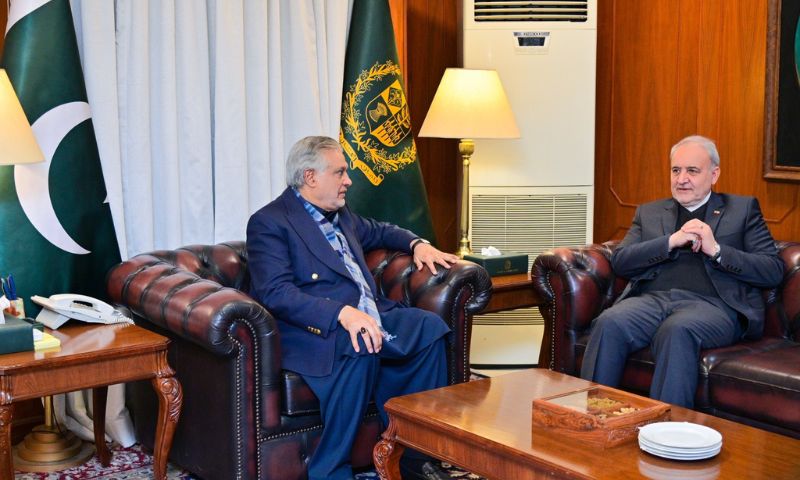
He made the remarks during a meeting with the Ambassador of Iran, Raza Amiri Moghaddam, who called on him at his office on Saturday, according to a statement issued by the Foreign Office.
The Ambassador conveyed condolences over the tragic blast in Islamabad, which claimed 32 lives.
Deputy Prime Minister / Foreign Minister, Senator Mohammad Ishaq Dar @MIshaqDar50, received the Ambassador of Iran, H.E. Mr. Raza Amiri Moghaddam.
Ambassador Moghaddam conveyed condolences over the tragic blast at an Imambargah in Islamabad. DPM/FM strongly condemned the… pic.twitter.com/Tdi6hTh9M8
— Ministry of Foreign Affairs – Pakistan (@ForeignOfficePk) February 7, 2026
During the meeting, Ishaq Dar strongly condemned the terrorist attack and reaffirmed Pakistan’s firm resolve to combat terrorism in all its forms and manifestations
The ambassador briefed the Deputy Prime Minister on progress achieved through various bilateral institutional mechanisms to enhance cooperation across diverse areas.
Pakistan and Iran share deep historical, cultural, and religious ties, fostering cooperation in political, economic, trade, energy, and security areas, aiming to boost trade through border markets and improve regional stability.
Both neighbouring countries are committed to enhancing ties through high-level visits and joint commissions.
After the war erupted between Israel and Iran in June 2025, Pakistan joined other Muslim countries at the OIC to condemn Israel’s strikes on Iran.
As the only Muslim state with nuclear weapons, Pakistan urgently called for an emergency OIC meeting after Israel attacked Iran’s nuclear sites in June.
At the 13th Round of Pakistan-Iran Bilateral Political Consultations held in Islamabad in November 2025, Pakistan and Iran had agreed to enhance and diversify bilateral trade and cooperation in energy, transport connectivity, education, and people-to-people exchanges.
Both sides underscored the significance of the regular convening of various institutional mechanisms, including the Joint Economic Commission and Joint Trade Committee, to forge closer cooperation in areas of mutual interest.