


ISLAMABAD: Pakistan and Uzbekistan have agreed to strengthen their economic partnership by expanding cooperation in trade, investment, and connectivity, reflecting a shared commitment to deeper bilateral engagement.
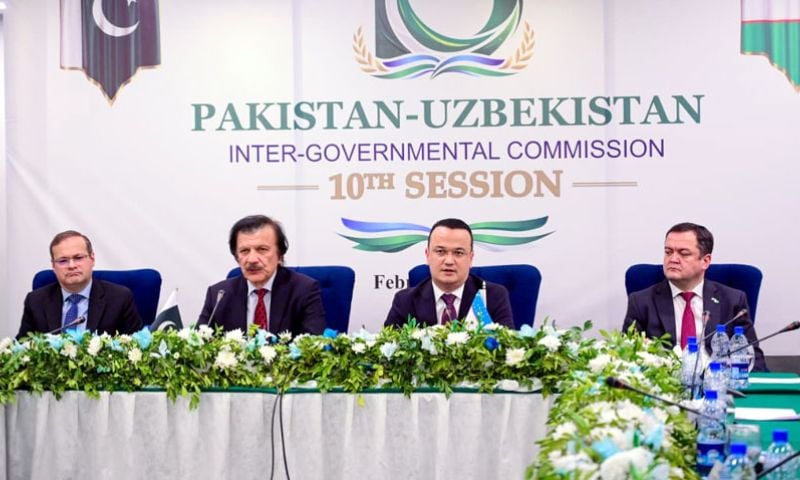
This came at the 10th Session of the Pakistan-Uzbekistan Intergovernmental Commission on Trade, Economic, and Scientific-Technical Cooperation held in Islamabad on Monday, state-run Radio Pakistan reported.
Special Assistant to the Prime Minister for Industries and Production Haroon Akhtar Khan, and Minister of Investment, Industry and Trade of Uzbekistan, Laziz Kudratov, co-chaired the session.
The session provided an opportunity for a comprehensive review of bilateral relations and helped establish a roadmap to further strengthen cooperation across key economic and social sectors.
Both sides expressed satisfaction with the steady progress made since the previous Intergovernmental Commission (IGC) session in 2025 and reaffirmed their commitment to expanding bilateral trade, investment, and overall economic engagement.
The parties agreed to expedite relevant institutional mechanisms to achieve the mutually agreed target of $ 2 billion in bilateral trade.
The two sides also agreed to establish the inaugural Joint Working Group on labour ties, which will focus on facilitating labour mobility, enhancing skills development, improving workplace safety, and addressing practical issues related to employment visas and workforce deployment.
In the transport and communications sector, the Commission welcomed interest in launching direct air services, reviewed progress on regional railway and connectivity projects, and agreed to advance alternative transport corridors aimed at improving regional trade flows and transit connectivity.
Cooperation in agriculture and food security featured prominently during the discussions, with both sides welcoming progress on phytosanitary protocols that facilitate the export of fruits from Uzbekistan to Pakistan.
They also underscored the importance of expanding collaboration in agri-technology, value chains, and food processing to ensure long-term food security.
Both sides agreed to promote joint research, faculty and student exchanges, vocational and technical training, innovation, and capacity building, supported by newly signed agreements in scientific, technical, and innovation fields.