


KEY POINTS
- 2022 floods damaged over 750 sites, including Mohenjo-Daro.
- Demands heritage be included in climate funding and adaptation plans.
- Proposes a global knowledge platform and UN climate tracking for cultural loss.
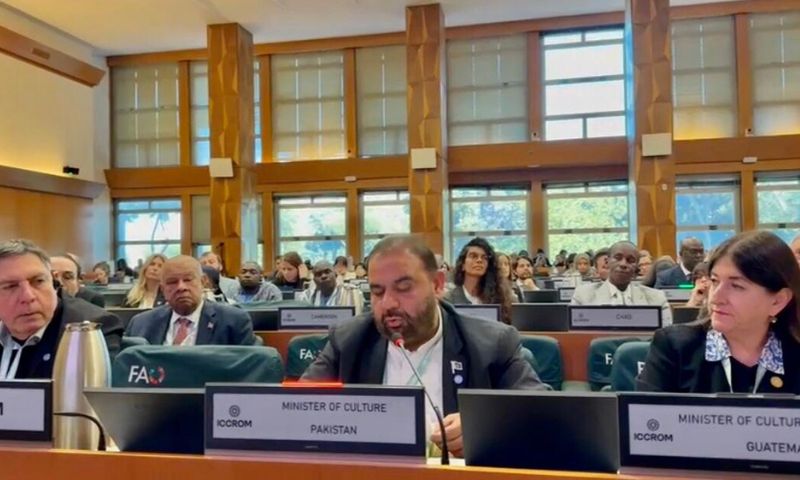
ROME: In a compelling appeal to the international community, Pakistan’s Minister for National Heritage & Culture, Aurangzeb Khan Khichi, called for urgent global action to protect cultural heritage from the escalating threats of climate change.
The minister delivered his keynote statement at a high-level special event, “Culture-Climate Nexus: The Missing Link,” held on the sidelines of the International Centre for the Study of the Preservation and Restoration of Cultural Property (ICCROM) General Assembly.
A Vast Heritage on the “Frontline” of Crisis
Addressing a gathering of international delegates, Minister Khichi underscored the profound vulnerability of Pakistan’s rich and diverse cultural legacy. He enumerated treasures ranging from the ancient Indus Valley cities of Mohenjo-Daro and Harappa to Buddhist centres like Taxila, Mughal masterpieces such as the Lahore Fort, and vibrant indigenous cultures. “These treasures now stand on the frontline of the global climate crisis,” he stated.
Cataloguing the Climate Threat
The minister provided a stark catalogue of climate-induced damage already underway. He recalled the catastrophic 2022 floods that impacted over 750 registered heritage sites, including the UNESCO World Heritage Site of Mohenjo-Daro. Beyond floods, he highlighted multiple threats: Glacial Lake Outburst Floods (GLOFs) endangering ancient rock carvings in the Karakoram and Diamer-Bhasha regions, and coastal erosion coupled with rising sea levels threatening sites like Banbhore and the Makli Necropolis.
A Call for Formal Recognition and Dedicated Funding
Minister Khichi urged stronger international solidarity, advocating for a paradigm shift in global climate policy. His core demands included formally recognizing cultural heritage as a strategic asset within climate adaptation and mitigation frameworks. He called for the integration of heritage protection into Nationally Determined Contributions (NDCs) and National Adaptation Plans (NAPs).
Crucially, he proposed practical financial mechanisms, suggesting the establishment of a dedicated funding window for climate-impacted heritage under the international Loss and Damage Fund.
Proposing Collaborative Global Solutions
Moving beyond funding, the minister outlined a vision for collaborative knowledge and accountability. He recommended creating an ICCROM-led global platform to unite scientists, heritage professionals, indigenous communities, and youth to co-develop resilient, culture-centred solutions.
Furthermore, he proposed incorporating culture-based indicators into the United Nations Framework Convention on Climate Change (UNFCCC) Global Stocktake. This would ensure the measurement of cultural loss is tracked alongside rising global temperatures, making heritage a formal metric in climate progress reports.
Pakistan’s UNESCO World Heritage
Pakistan is home to a distinguished collection of cultural landmarks recognized by UNESCO for their outstanding universal value. The country boasts a total of six inscribed World Heritage Sites, all of which fall under the cultural category.
These sites span millennia of history, showcasing the remarkable diversity of civilizations that have flourished in the region. The list includes the ancient Indus Valley metropolis of Mohenjo-Daro (1980), the Buddhist monastic complex of Takht-i-Bahi (1980), and the cross-cultural archaeological ruins of Taxila (1980). From the Mughal era, the Fort and Shalimar Gardens in Lahore (1981) stand as architectural masterpieces, while the Historical Monuments at Makli, Thatta (1981) represent a vast necropolis.
Completing the list is the formidable Rohtas Fort (1997), an exemplar of 16th-century military architecture. Pakistan does not yet have any designated Natural or Mixed sites on the World Heritage List, though Hingol National Park is on the Tentative List for future nomination.
An Extensive Tentative List for Future Recognition
Beyond its inscribed sites, Pakistan has a rich pipeline of heritage awaiting global recognition. The country’s UNESCO Tentative List features 26 additional sites.
This list includes potential future nominations spanning archaeology, architecture, and nature. Notable cultural sites proposed include the grand Badshahi Mosque in Lahore, the ancient Archaeological Site of Harappa, the spectacular Rani Kot Fort, and the historic Baltit Fort in Hunza. Significant natural landscapes are also under consideration, such as the Central Karakorum National Park, the Deosai National Park, and the unique Khewra Salt Mine.