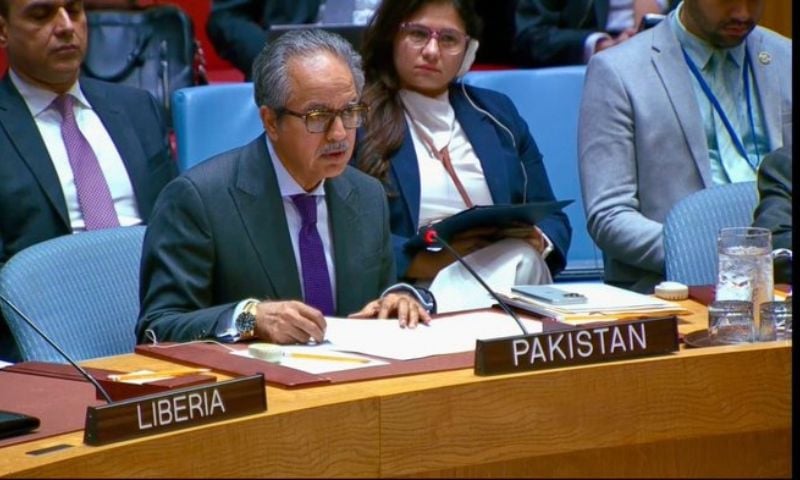
UNITED NATIONS: Pakistan on Thursday urged the United States and Iran to implement the commitments agreed under the Islamabad Memorandum of Understanding (MoU) and return to the negotiating table, saying diplomacy remained essential to achieving regional and international peace and security.
Speaking at the UN Security Council after Pakistan abstained from a vote on a draft resolution concerning the Panel of Experts of the 1737 Committee on Iran, Pakistan’s Permanent Representative Ambassador Asim Iftikhar Ahmad said Islamabad continued to advocate diplomatic engagement and a peaceful resolution of outstanding issues related to Iran’s nuclear programme.
Pakistan remains concerned that the consideration of Iran nuclear issue, including by the Security Council, has become further complicated over a period of time. We have clearly come a long way from the spirit of cooperation and peaceful settlement of disputes that characterized… pic.twitter.com/1tyEBz1LK9
— Permanent Mission of Pakistan to the UN (@PakistanUN_NY) September 17, 2026
“On its part, Pakistan continues with its efforts to promote peace and stability in the region, building upon the solid foundation provided by the Islamabad Memorandum of Understanding,” Pakistan’s Permanent Representative said.
Ambassador Asim Iftikhar said Pakistan continues to believe that diplomacy and dialogue remain the guiding principle for resolution of outstanding issues concerning Iran nuclear programme. “Pakistan has consistently advocated the primacy of diplomatic engagement and the imperative of avoiding confrontation and conflict,” Pakistan’s Permanent Representative said.
“We reiterate our position that the Iran nuclear issue should be addressed through peaceful means and in accordance with the rights, obligations and responsibilities of the parties concerned,” Ambassador Asim Iftikhar said.
Explanation of Vote by Ambassador Asim Iftikhar Ahmad,
Permanent Representative of Pakistan to the UN
On the Security Council Vote on the Draft Resolution Concerning Panel of Experts of the 1737 Committee on Iran
(17 September 2026)*
*********Mr. President,
I have taken the… pic.twitter.com/1XgWudkQHK
— Permanent Mission of Pakistan to the UN (@PakistanUN_NY) September 17, 2026
Ambassador Asim Iftikhar said that Pakistan also supports the critical role of the International Atomic Energy Agency (IAEA) and calls for it to carry out its work independently and without political interference.
“We also lend our support to the critical role of the International Atomic Energy Agency as the technical body entrusted with implementing the respective safeguards agreement. The IAEA should ensure this important work as per its mandate, independently and without political interference,” Pakistan’s Permanent Representative said.
Pakistan’s Permanent Representative stressed an urgent need to renew and continue diplomatic engagement to address outstanding issues in a cooperative manner.
“There is an urgent need to renew and continue diplomatic engagement to seriously and faithfully address outstanding issues in a cooperative manner, in accordance with the rights, obligations and responsibilities of the parties concerned. We must prioritize this approach and never give up on a peaceful negotiated settlement,” Ambassador Asim Iftikhar said.
Pakistan said the Iran nuclear issue had become more complicated over a period of time.
“Pakistan remains concerned that the consideration of the Iran nuclear issue, including by the Security Council, has become further complicated over a period of time. We have clearly come a long way from the spirit of cooperation and peaceful settlement of disputes that characterised the adoption of resolution 2231 more than a decade ago,” Ambassador Asim Iftikhar said.
“Ongoing tensions and hostilities in the region and strikes on nuclear facilities, as well as continued differences amongst permanent members on key aspects of this file, have added to the challenges in addressing the issue through dialogue and diplomacy,” he said.
Ambassador Asim Iftikhar said the Security Council had two opportunities last September: continuing the termination of sanctions envisaged under the Joint Comprehensive Plan of Action (JCPOA), or providing a six-month technical extension of Resolution 2231 to allow more time for diplomatic efforts.
“Last September, the Council had two opportunities before it – to either continue the termination of sanctions as envisaged under the JCPOA, or to bring into effect a six-month technical extension in the mandate of Resolution 2231 to provide more time and space for diplomatic efforts to proceed amicably.”
“Regrettably, a non-consensual path was chosen with far-reaching consequences that have since continued to reverberate in this chamber and beyond,” he said.
Ambassador Asim Iftikhar said that Pakistan had stressed at the time that a non-confrontational and cooperative approach would have better supported efforts to achieve a lasting, peaceful solution while preserving consensus within the Security Council.
“We had stressed at that time that a non-confrontational and cooperative approach would have better facilitated the quest for a lasting, peaceful solution, while preserving consensus within this Council.”
The US-Iran war began on February 28, with fighting involving the United States, Israel and Iran and quickly creating wider regional risks, including disruption around the Strait of Hormuz.
Pakistan stepped into a mediation role as the conflict intensified. In late March, Islamabad hosted foreign ministers from Pakistan, Turkiye, Egypt and Saudi Arabia to discuss proposals including reopening the Strait of Hormuz.
Pakistan’s efforts subsequently produced the Islamabad Talks in April, when high-level US and Iranian delegations came to Islamabad for negotiations.
The process culminated in an Islamabad Memorandum of Understanding (MoU) and an interim ceasefire that was intended to provide a 60-day window for negotiations towards a permanent agreement.