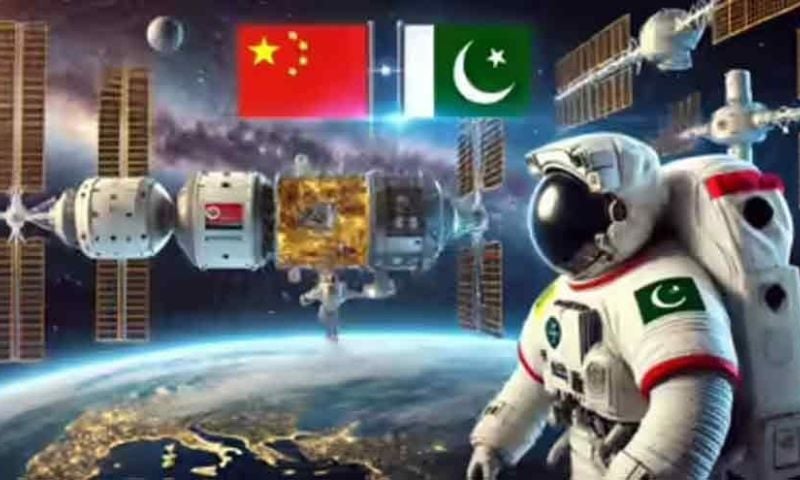



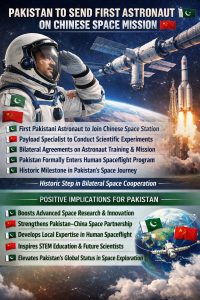
ISLAMABAD: Pakistan will send its first astronaut into orbit aboard a Chinese crewed space mission to the Tiangong space station, officials said, marking the country’s formal entry into human spaceflight and deepening strategic cooperation with Beijing.
The mission will take place under a bilateral human spaceflight cooperation framework between Pakistan and China.
The Pakistani astronaut will serve as a payload specialist aboard China’s Tiangong space station, conducting scientific experiments designed to support domestic research.
Officials said the development represents a historic milestone in Pakistan’s national space programme and an expansion of Pakistan–China collaboration in advanced space technologies.
Pakistan’s military media wing, Inter-Services Public Relations (ISPR), said on February 7 that two candidates had been shortlisted for Pakistan’s Human Spaceflight Programme by the Astronauts Centre of China (ACC).
“Suparco has achieved yet another significant milestone in Pakistan’s Human Spaceflight Programme with the successful completion of the secondary phase of astronaut candidates’ selection,” the ISPR said in a statement.
The candidates underwent comprehensive medical, psychological and aptitude assessments at the ACC following an initial screening process in Pakistan, the statement said.
The evaluations were conducted in accordance with international human spaceflight standards.
Under the bilateral agreement, the two shortlisted candidates will undertake six months of advanced astronaut training at the ACC.
Bilateral space cooperation
In February 2025, Pakistan’s Space and Upper Atmosphere Research Commission (Suparco) and the China Manned Space Agency (CMSA) signed a formal astronaut cooperation agreement.
The agreement was concluded under the leadership of Prime Minister Shehbaz Sharif, whose support enabled Pakistan’s participation in human spaceflight.
At the signing ceremony in February 2025, PM Sharif said Pakistan, in collaboration with China, would send its first astronaut to China’s space station.
The CMSA later confirmed that two Pakistani astronauts would be trained in China, with one to join a future Tiangong mission as a payload specialist.
The selected astronaut would conduct scientific experiments on behalf of Pakistan while also performing standard crew duties aboard the station.
Scientific and strategic significance
Officials said the mission would strengthen Pakistan’s capabilities in microgravity research and applied sciences.
It will also help Pakistan to develop indigenous technical expertise through astronaut training and operational collaboration.
The government described the initiative as a step towards inspiring nationwide participation in science, technology, engineering and mathematics (STEM) fields and supporting the growth of a future aerospace workforce.
Analysts say the mission will elevate Pakistan’s global profile in peaceful and scientific space exploration, while reinforcing long-standing strategic ties between Islamabad and Beijing.