


Key Points
- Border closure is for security reasons, not against Afghan people
- Cross-border terrorism involves not only TTP but also some Afghan nationals committing serious crimes in Pakistan
- Protection of religious heritage, including Babri Mosque, is a shared international responsibility
- Desecration of places of worship violates religious equality and mutual respect
- Pakistan reaffirms consistent support for China on territorial integrity
ISLAMABAD: Pakistan has once again announced that its border with Afghanistan will remain closed until Kabul gives concrete assurances that terrorists and other violent elements will not be allowed to cross into Pakistani territory.
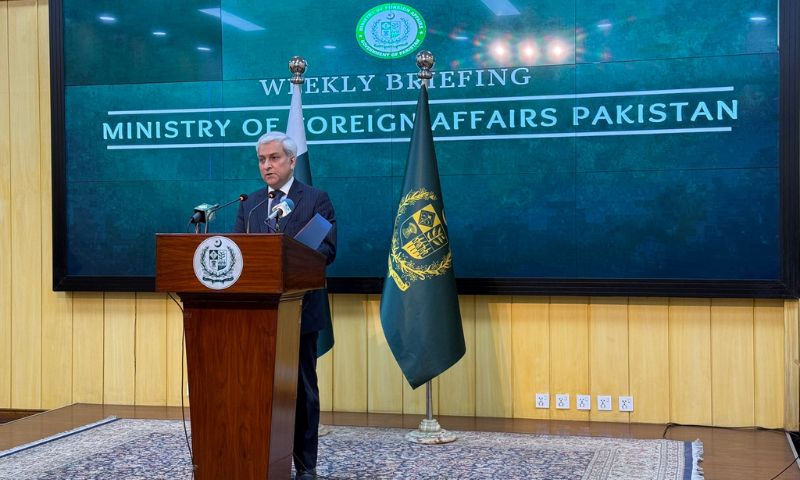
Addressing a weekly press briefing on Friday, Foreign Office Spokesperson Tahir Hussain Andrabi stressed that Pakistan has no dispute with the Afghan people, whom it regards as brothers and sisters, and noted that the border closure is based solely on security concerns.
The spokesperson added that Pakistan has consistently supported humanitarian access for Afghans. However, the border policy depends on Afghanistan’s concrete cooperation in curbing terrorism emanating from its territory.
Until credible assurances are provided that terrorists and violent elements will not cross into Pakistan, the Pak-Afghan border will remain closed.
He noted that cross-border terrorism is not confined to Tehrik-e Taliban Pakistan (TTP) terrorists emphasising that some Afghan nationals have also been involved in serious crimes within Pakistan.
“The border closure must be viewed within this wider security context,” Andrabi added.
Pakistan shut the Torkham and Chaman border crossings on October 12 after the Afghan Taliban launched coordinated attacks on several Pakistan Armed Forces posts along the border.
In the ensuing exchange, more than 200 Taliban and associated terrorists were killed. Pakistan conducted “precision strikes” inside Afghanistan, targeting terrorist hideouts in Kandahar province and Kabul. A temporary 48-hour ceasefire was announced on October 15 at Kabul’s request.
An official ceasefire agreement was later reached on October 19 in Qatar, during talks mediated by Doha and Turkiye.
Subsequent discussions were held in Turkiye but broke down after Pakistan rejected Taliban delegation’s “illogical” stance and unwillingness to address concerns about cross-border terrorism.
Afghan Taliban’s non-cooperation delays Turkish delegation visit
Foreign Office Spokesperson Tahir Hussain Andrabi, in response to a question, stated that the delay in the visit of a high-level Turkish delegation to Islamabad may be due to the Afghan Taliban’s lack of cooperation. The delegation, originally scheduled to arrive last month, was intended to discuss tensions between Pakistan and the Afghan Taliban.
The planned visit had been first announced earlier this month by Turkish President Recep Tayyip Erdogan during his meeting with Prime Minister Shehbaz Sharif in Baku.
India Urged to uphold tolerance, protect religious heritage
The Spokesperson called on the Indian government to promote tolerance and inclusivity, ensuring equal legal rights and mutual respect for all religious and cultural communities.
He emphasised that the protection of religious heritage and sacred sites, including the Babri Mosque, is a shared responsibility of the international community and must be ensured with transparency, accountability, and a firm commitment to justice.
Andrabi highlighted that the desecration of any place of worship violates the principle of religious equality and undermines the sense of security and mutual respect that all communities deserve.
He expressed concern over the continued marginalisation and emotional distress experienced by Indian Muslims following the destruction of the Babri Mosque, particularly when such acts are emboldened by state patronage.
He also reaffirmed Pakistan’s commitment to protecting the rights and religious freedom of minorities within its own borders, in line with its legal obligations.
India’s blockade of humanitarian assistance
He expressed regret over India’s blockade of humanitarian assistance to Sri Lanka. He noted that a special aircraft carrying Pakistan’s relief supplies was delayed for more than 60 hours while awaiting flight clearance from India.
Andrabi said the partial clearance granted on the night of December 1, 2025—after 48 hours—was operationally impractical, as it was valid for only a few hours and did not cover the return flight, severely hindering this urgent relief mission for the people of Sri Lanka.
The Spokesperson reaffirmed Pakistan’s longstanding support for China on issues related to its sovereignty and territorial integrity.