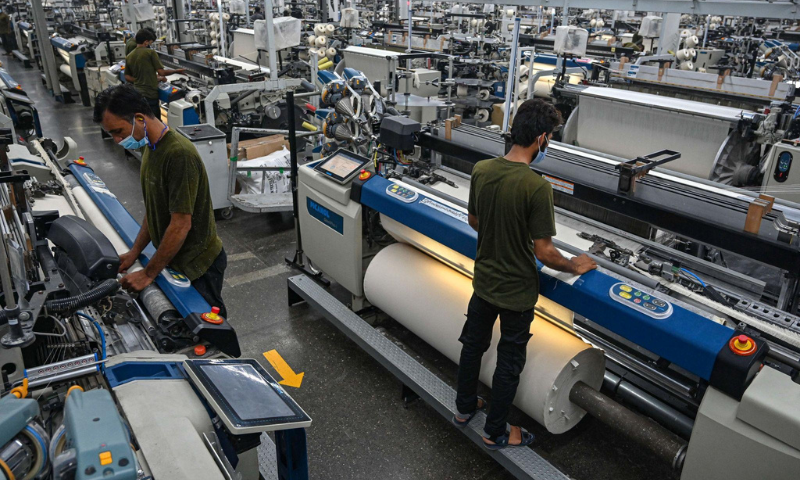



ISLAMABAD: Pakistan’s textile and clothing exports recorded a modest year-on-year increase of 3.14% in January 2026, offering tentative signs of recovery after several months of contraction.
According to data released by the Pakistan Bureau of Statistics (PBS), textile and apparel exports rose to $1.738 billion in January, up from $1.685 billion in the same month a year earlier.
The improvement follows a period of negative growth, with exports declining by 8.56% in December 2025, 2.57% in November, and 0.57% in October, reflecting weak external demand and domestic cost pressures.
Mixed performance across segments
The January rebound was driven primarily by higher-value apparel and select made-up textile products.
Exports of readymade garments surged 9.64% in value and 10.68% in quantity during January FY26, indicating stronger demand in international markets. Towel exports also performed strongly, rising 14.09% in value and 6.41% in volume.
Bedwear exports increased 6.88% in value and 8.72% in quantity, while yarn exports climbed 12.88% year-on-year. Made-up textile articles, excluding towels, posted an 8.77% increase.
However, not all segments registered growth. Knitwear exports declined 8.55% in value and 18.03% in quantity, while exports of tents, canvas and tarpaulin fell sharply by 18.37%. Cotton cloth exports showed only marginal growth of 0.02% in value, though quantities rose 3.09%.
Shifts in textile-related imports
The data also highlighted significant changes in textile-related imports.
Imports of synthetic fibre fell 46.98% year-on-year in January FY26, while synthetic and artificial silk yarn imports declined 22.46%.
Raw cotton imports also dropped by 46.98% compared with the same month last year, reflecting either improved domestic cotton availability or cautious inventory management by mills.
Meanwhile, imports of second-hand clothing rose 28.86% during the month under review.
Oil import bill declines
Separate figures show Pakistan’s oil import bill declined 4.39% during the first seven months of FY26 (July–January), falling to $9.046 billion from $9.461 billion in the corresponding period last year.
The decline reflects softer overall demand for petroleum products. The value of petroleum product imports fell 1.81% during 7MFY26, although quantities rose 7.72%, suggesting price effects played a role.
Crude oil imports increased 8.22% in value and 16.91% in quantity, indicating higher refining activity by domestic refineries.
In contrast, imports of liquefied natural gas (LNG) and liquefied petroleum gas (LPG) dropped 26.20% and 4.98%, respectively, reflecting reduced demand for certain energy products.
Telecom imports surge
In the broader import basket, the telecommunications group recorded a sharp 30.78% year-on-year increase during 7MFY26, largely driven by higher mobile phone imports.
Mobile handset imports rose 31.36% to $1.139 billion in the first seven months of the fiscal year, compared with $867.68 million in the same period last year.
Cautious optimism
Textiles remain Pakistan’s largest export sector and a key source of foreign exchange earnings.
The modest growth in January has revived hopes of a gradual rebound, though sustained recovery will depend on global demand conditions, energy costs, and domestic policy stability.
For now, the latest data suggests the sector may be stabilising after a challenging quarter, even as performance across product categories remains uneven.