


ISLAMABAD: Pakistan has outlined its expectations from US President Donald Trump’s Gaza Board of Peace, saying it joined the United Nations-backed initiative alongside other Muslim countries in the hope of achieving a permanent ceasefire, reconstruction of Gaza, and a just political settlement based on Palestinian statehood.
Prime Minister Shehbaz Sharif signed the Board of Peace charter earlier this week on the sidelines of the World Economic Forum in Davos, together with several other world leaders.
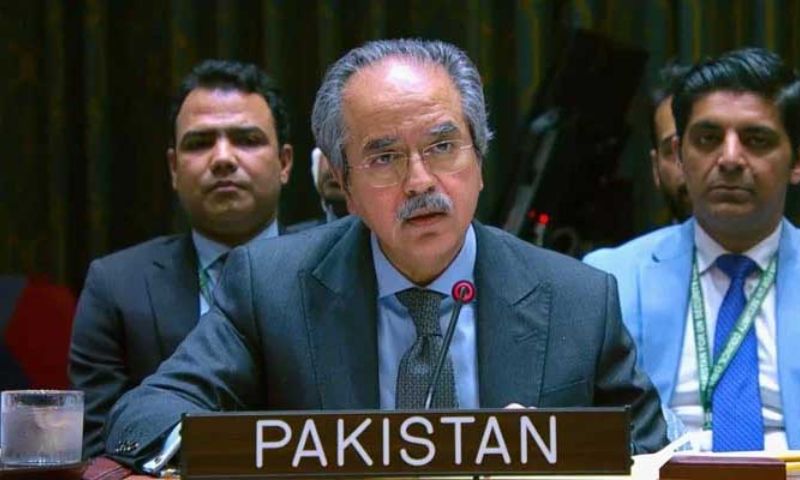
Pakistan’s Permanent Representative to the United Nations, Asim Iftikhar Ahmad, told an open debate of the United Nations Security Council on the Middle East that Islamabad’s decision was driven by what he described as the unresolved Palestinian question — a core source of regional instability, reports Arab News.
“We hope the Board of Peace, operating under the framework of Resolution 2803, will lead to concrete steps toward implementing a permanent ceasefire,” Ahmad told the Security Council.
He said Pakistan also expects the initiative to result in a further scaling up of humanitarian assistance and the early reconstruction of Gaza.
Ahmad added that the process must advance the Palestinian people’s right to self-determination through a credible and time-bound political pathway, in line with international legitimacy and relevant United Nations resolutions.
According to Arab News, Ahmad said this process should culminate in the establishment of an independent, sovereign, and contiguous State of Palestine, based on pre-1967 borders, with Al-Quds Al-Sharif as its capital.
“That is the ultimate goal supported by the international community,” he said.
Ahmad stressed that Palestinian-led governance and institutional strengthening are essential to achieving lasting peace.
He added that the Palestinian Authority must play a central role in any future political and governance arrangements.
He said Pakistan hoped the Board of Peace, operating under UN Security Council Resolution 2803, would translate diplomatic engagement into tangible outcomes, including a sustained ceasefire, expanded humanitarian assistance, and the reconstruction of Gaza.
Ahmad stressed that these steps must lead to the realization of the Palestinian people’s right to self-determination through a credible, time-bound political process, consistent with international law and UN resolutions, culminating in an independent, sovereign, and contiguous Palestinian state based on pre-1967 borders, with East Jerusalem as its capital.
He also voiced concern over what he described as Israel’s continued ceasefire violations, warning that civilian lives remained at risk and that the truce must be fully respected to prevent a return to large-scale hostilities.
The Pakistani envoy said reconstruction efforts should begin immediately and proceed without annexation, forced displacement, or changes to the territorial unity of the Occupied Palestinian Territory, underscoring that the geographic contiguity of Gaza and the West Bank is essential for a viable Palestinian state.
Calling for renewed international engagement, Ahmad said the Security Council bore a responsibility to convert diplomatic momentum into measurable improvements on the ground, adding that Pakistan stood ready to work with council members, regional partners, and the United States to advance a lasting and comprehensive peace in the Middle East.