


Key Points
- Broad-based sell-off across major sectors as regional war fears drove risk-off behaviour
- Circuit breakers and trading suspension triggered under market safety rules
- Experts say panic, not fundamentals, amplified the rout; regulators under pressure to support calm
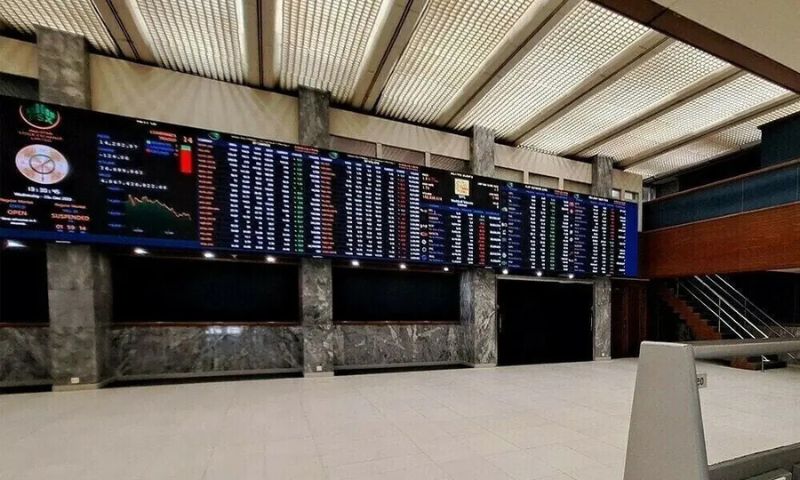
ISLAMABAD: Pakistan’s stock market experienced an extraordinary crash on Monday, with the benchmark KSE-100 Index plunging 10.59 per cent in a single session, one of the steepest daily declines in the bourse’s history.
The plunge reflected deepening investor panic over the escalating military conflict involving Iran, the United States and Israel, which triggered a global flight to safer assets and sharp sell-offs in emerging market equities. (psx.com.pk)
Brutal single-day drop across indices
According to today’s official PSX market summary, March 2, 2026, the KSE-100 closed at 151,972.99, down 16,089.17 points (-10.59 per cent) from the previous session.
Broader indices also tumbled: the KSE-30 fell 10.78 per cent, the All Share Index slid 10.13 per cent, and both Shariah-compliant benchmarks and sectoral groupings dropped by double digits.
The sharp decline wiped out massive market value across sectors: banking, oil and gas, cement, fertiliser and industrial stocks were among the hardest hit.
Leaders in heavy domestic capitalisation, such as OGDC (Oil & Gas Development Company), MEBL and commercial banks, registered deep losses as risk-off sentiment dominated trading.
Panic Selling Amid Regional Conflict
The crash came as investors reacted to news of intensified military activity in the Middle East and the possibility of a broader regional war involving Iran, the United States, Israel and other countries such as the UK.
Global markets saw sharp swings on Monday, with energy prices rising and safe-haven assets such as gold rallying, reflecting widespread risk aversion, as reported by most of the reputable global financial reporting outlets.
One market strategist, Ali Raza Khan of Topline Securities, told local media that “fears of prolonged conflict and rising import costs, particularly for energy-dependent economies like Pakistan, led to outsized selling pressure across all sectors.”
Investors also cited concerns that higher global oil prices could worsen Pakistan’s current account and inflation outlook, prompting portfolio rebalancing away from equities.
Circuit breakers and trading mechanisms
The PSX’s safety mechanisms kicked in as losses mounted. Under exchange rules, broad market declines beyond certain thresholds automatically trigger market halts. The built-in automated circuit breakers are temporary suspensions designed to prevent disorderly free-fall selling and give the market time to absorb shocks.
In Monday’s session, these mechanisms were activated, pausing trading for a scheduled interval before markets resumed under heightened caution.
Circuit breakers are common features in global markets. They act as “circuit-interrupts” by slowing trading when the index falls rapidly and they help moderate panic while discouraging algorithmic or herd selling.
However, in this historic crash, even these safeguards were tested as losses exceeded typical trigger levels.
Public debate on the regulator’s role
The unprecedented 10.59 per cent plunge has sparked intense debate about the role of market regulators in averting panic during extraordinary geopolitical shocks.
On social media, Shahbaz Jameel, former President of Zarai Taraqiati Bank, urged the Securities and Exchange Commission of Pakistan (SECP) to adopt proactive closures during heightened uncertainty. He wrote on his Facebook that the regulator “should have announced administrative recess/closure of the stock exchanges over the weekend, and announced a three-day holiday… to avoid unnecessary panic in the equity market.”
Jameel also suggested tightening day limits on price moves to reduce stress on leveraged investors.
Other voices echoed similar concerns, highlighting that regional regulators in the Gulf – including the UAE and Kuwait – temporarily closed exchanges during the same conflict to allow investors time to digest news, a move some Pakistan experts say could have been emulated locally.
The SECP, Pakistan’s corporate and capital markets regulator, emphasised that surveillance and circuit breaker mechanisms functioned as intended. Officials said they are monitoring trading closely for any irregularities, including unethical short-selling or manipulation.
Experts weigh in
Market analysts characterised the rout as panic-driven rather than purely fundamentals-driven. Farhan Malik, Chief Market Analyst at Arif Habib Limited, commented that “with escalating war fears, the psychological element overwhelmed rational valuation, amplifying the sell-off beyond what economic fundamentals alone would justify.”
Ali Raza Khan of Topline Securities added that the rapid reaction by retail investors and algorithmic triggers intensified losses.
What this means for investors and the economy
For retail investors, the rout represents a sharp loss in portfolios, especially those with concentrated positions or leveraged trades. Long-term investors and market veterans caution against panic selling, noting that extreme reactions to geopolitical events are often short-lived and can create buying opportunities once volatility recedes.
Layman explanation
A stock market crash of this magnitude means that many share prices fell in a very short time because investors became fearful and tried to sell at once. The automatic halts pause the trading so traders can take a break and consider rather than just reacting.
Outlook
Market watchers say volatility will likely persist as uncertainty around the Iran–US–Israel conflict continues. If geopolitical tensions ease, equities could stabilise. Analysts emphasise the importance of macroeconomic policy clarity and external financing stability to support market confidence amid external shocks.