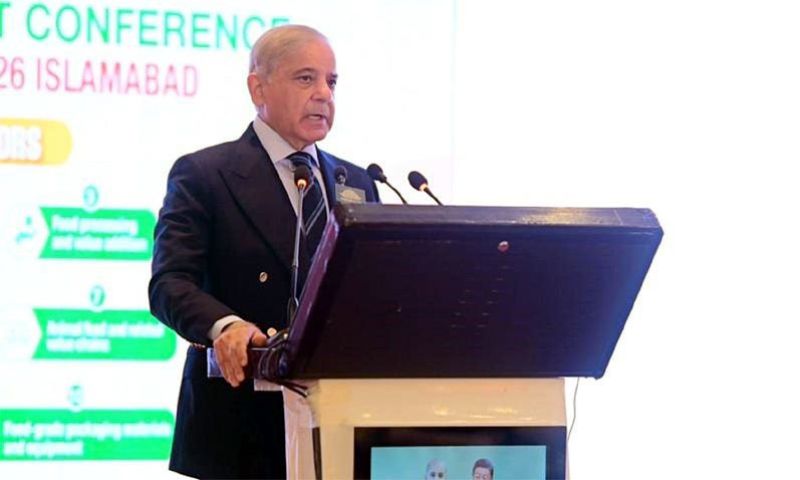



ISLAMABAD: Pakistan’s Prime Minister Shehbaz Sharif on Monday presented the country’s agriculture sector as the next major avenue for Chinese investment, highlighting vast opportunities in agribusiness, food processing, and modern farming technologies.
The prime minister made these remarks while addressing the Pakistan-China Agriculture Investment Conference, which brought together agriculturists, entrepreneurs, experts, academicians, and government officials from both countries.
According to the organisers, the conference was attended by around 120 Chinese companies and 191 Pakistani firms, with discussions focusing on fertilizers, seed development, agricultural machinery, precision farming, and smart irrigation systems.
Sharif noted that China has consistently extended its expertise and advanced technologies to Pakistan, adding that both sides have signed several memorandums of understanding (MoUs) at similar investment summits held in Shandong and Beijing over the past two years.
“I was very happy to express my satisfaction over the progress we are making in terms of converting these MOUs into agreements,” he said.
“Today’s conference is a clear indication that Chinese business houses are more than willing to shake hands with Pakistani business houses.”
According to Pakistan’s Ministry of National Food Security and Research, the conference provided a platform aimed at strengthening bilateral agricultural cooperation and advancing broader economic engagement between the two countries.
Sharif urged Pakistani farmers, agribusinesses, and universities to actively collaborate with Chinese institutions and experts to modernise the agriculture sector, which contributes around 24 percent to Pakistan’s GDP and employs more than 37 percent of the country’s labor force.
“Chinese experts are there to assist us and support us all the way to achieve this wonderful target [of becoming a surplus agricultural economy],” he said.
“Now it’s up to us to generate this trade surplus through higher yields, comparative cost, and, of course, the highest quality.”
Pakistan and China have been steadily expanding cooperation in the agriculture sector under the China-Pakistan Economic Corridor (CPEC) framework, with a focus on mechanisation, high-yield seed development, livestock improvement, and value-added food processing.
Officials say enhanced agricultural collaboration could help Pakistan increase exports, strengthen food security, and generate employment, while providing Chinese companies with access to a large agricultural market and new investment opportunities.
The prime minister noted that Pakistan’s policy rate has declined to 10.5 percent from 22 percent two years ago, adding that exports are gradually rising and key macroeconomic indicators remain stable.