


KEY POINTS
- Foreign Office said cross-border terrorism originating from Afghanistan remains Islamabad’s main security concern.
- Pakistan stated that concrete action against terrorist groups could improve relations with Kabul.
- Islamabad will continue participating in Pakistan-China-Afghanistan trilateral mechanism.
- Foreign Office strongly rejected remarks by Indian External Affairs Minister, calling them misleading.
- Pakistan accused India of extrajudicial killings abroad, interference in neighbouring countries, and exporting terrorism into Pakistan.
- Islamabad raised concerns over rising Islamophobia in India.
- Pakistan urged international community to protect religious and cultural rights of Muslims in India.
ISLAMABAD: Pakistan has called for clear and enforceable security commitments from Afghan Taliban, with the Foreign Office stating that Islamabad is awaiting verifiable, concrete, and practical assurances that Afghan soil will not be used against any country.
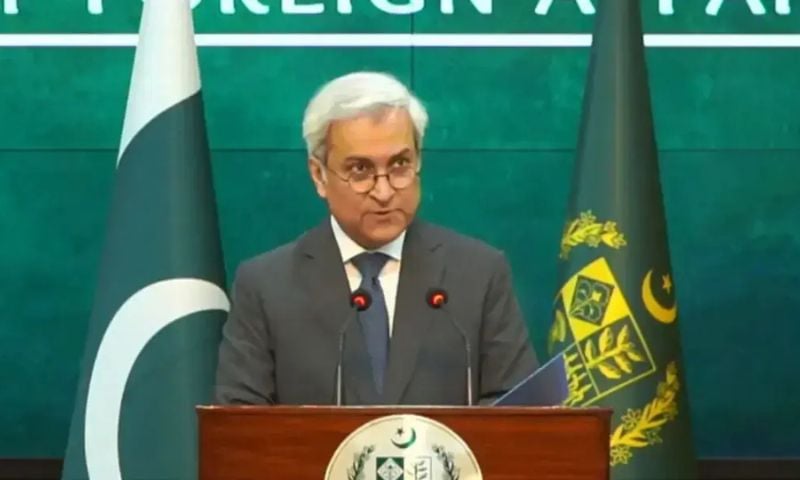
Pakistan’s Foreign Office spokesperson Tahir Hussain Andrabi, while speaking at the weekly media briefing on Thursday, reiterated the demand that Afghan territory not be used to launch terrorist attacks inside Pakistan.
“Incidents of terrorism emanating from Afghanistan are a primary concern for Pakistan. Our demand is that Afghan territory should not be used against Pakistan,” he said.
“We need written, verifiable, and concrete assurances from Afghan authorities. Without these written commitments, the issue of terrorism cannot be resolved.”
The spokesperson went on to say that resolving terrorism would pave the way for a significant improvement in bilateral relations. “Pakistan and Afghanistan do not have any other major bilateral disputes,” he added.
“Ensuring an end to terrorism is also in Afghanistan’s own interest,” the FO spokesperson noted.
Pakistan-China-Afghanistan trilateral mechanism
Tahir Andrabi said Pakistan will be part of the trilateral mechanism involving Pakistan, China, and Afghanistan, stating that the forum reflects Islamabad’s constructive approach to regional cooperation.
Bilateral relations between Islamabad and Kabul have recently deteriorated, with cross-border terrorism emerging as the central source of tension. Pakistan has repeatedly urged Afghan authorities to take verifiable action to dismantle terrorist groups operating within Afghanistan and to prevent the use of its territory for militant activities.
In October 2025, Pakistan shut down several major border crossings following one of the deadliest military escalations between the two countries in recent years. Although a ceasefire was announced on October 19, cross-border trade has yet to resume.
China’s efforts to achieve national unity
The Foreign Office spokesperson said Pakistan supports China’s efforts to achieve national unity. He added that during the strategic dialogue, Pakistan briefed China on the Kashmir issue, which Beijing described as a long-standing historical dispute requiring resolution.
He said both sides agreed to strengthen coordination on development initiatives under CPEC 2.0 (China-Pakistan Economic Corridor) during the dialogue.
Indian FM irresponsible and misleading remarks
Tahir Andrabi rejected remarks made by Indian External Affairs Minister S. Jaishankar about Pakistan in Luxembourg, calling them irresponsible and misleading.
He added that India has once again sought to deflect attention from its own deeply troubling record as a neighbour, marked by the promotion of terrorism and contributions to regional instability. He said India has instigated terrorism in the region and consistently undermined regional peace.
He further said that India has carried out extrajudicial killings abroad, interfered in the internal political affairs of neighbouring countries, exported terrorism into Pakistan, and provided safe havens to wanted criminals. He added that India has acted as a source of coercion rather than cooperation for smaller states in the region.
Rise in Islamophobia in India
To a question about the demolition of structures near Faiz-e-Elahi mosque in Delhi, Tahir Andrabi expressed grave concerns on the action of the Indian government, adding that the international community must take serious notice of this rise in Islamophobia in India.
He said the mosque stands as a very important symbol of Muslim religious, cultural and historical heritage and continues to serve as a central place for worship and community life.
He mentioned that the demolition drive is not an isolated incident, but rather it reflects a very systematic and deliberate campaign by the RSS-BJP nexus to target and erase the Muslim heritage across India.
The spokesperson said that several other historic mosques face similar threats of desecration or demolition. He said Indian Muslims continue to experience grave social, economic and political marginalisation.
He said the UN and other related mechanisms must play a proactive role in safeguarding the religious and cultural rights of Indian minorities.
Tahir Andrabi also urged the Indian government to fulfill its constitutional and international human rights obligations by guaranteeing the safety and security of all religious denominations, including Muslims.
Pakistan to continue support for Kashmiris
He added that Pakistan will continue political, moral, and diplomatic support for the people of Indian Illegal Occupied Jammu and Kashmir.
Andrabi said that thousands of human rights activists and political leaders are imprisoned in Jammu and Kashmir, and that India has been attempting to alter the demographic composition of Kashmir since August 5, 2019.
Iran protests
Addressing regional developments, Andrabi said Pakistan opposes any foreign interference in Iran’s internal affairs. He was responding to reports of ongoing protests in Iran over inflation and economic hardship.
Israel’s recognition of Somaliland
On Somaliland, Andrabi reiterated Pakistan’s opposition to Israel’s recognition of Somaliland, stating that such a move poses a threat to Somalia’s unity and territorial integrity.
Israel became the first country to formally recognise the self-declared Republic of Somaliland on December 26. In response, the foreign ministers of more than 20 Muslim-majority countries issued a joint statement on December 28 rejecting Israel’s decision.
The statement, released by Pakistan’s Foreign Office, said the recognition violates international law and the UN Charter, which upholds the sovereignty and territorial integrity of states.