


ISLAMABAD: Pakistan has formally sought detailed information from India regarding the proposed Sawalkot Dam project, emphasising its unwavering commitment to protecting its water rights under the Indus Waters Treaty.
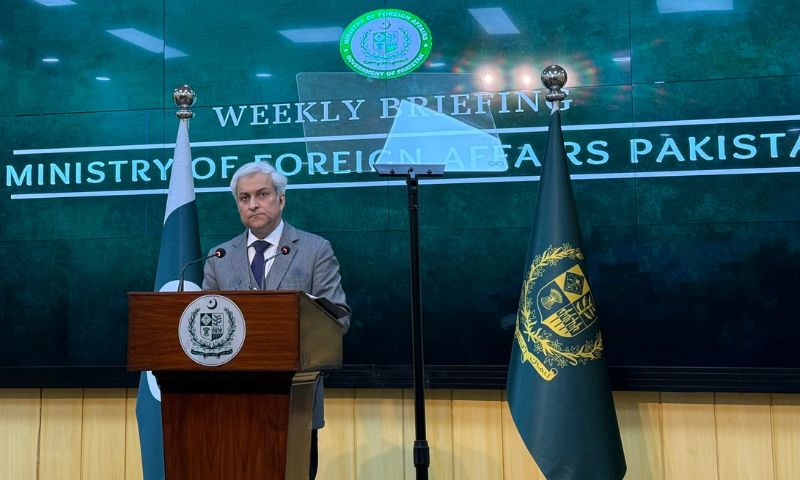
The Foreign Office spokesperson Tahir Hussain Andrabi, at his weekly media briefing on Thursday, said that the issue is being addressed through diplomatic channels, making it clear that Pakistan will uphold its position in accordance with the provisions of the Indus Waters Treaty.
The Foreign Office noted that Pakistan’s Indus Water Commissioner has formally written to his Indian counterpart, requesting comprehensive details regarding the proposed Sawalkot Dam project.
“We urge India to adhere to the Indus Waters Treaty,” Andrabi said.
The Sawalkot Dam is a proposed hydroelectric power project planned on the Chenab River in the Indian Illegally Occupied Jammu and Kashmir.
The World Bank brokered the 1960 Indus Water Treaty between India and Pakistan, which New Delhi has been holding in “abeyance” since April last year — a move Pakistan says is unilateral, illegal, and in violation of the treaty’s provisions.
An international court of arbitration has also ruled in Pakistan’s favour, rejecting India’s unilateral actions.
The treaty divides the six rivers of the Indus Basin between the two countries.
The spokesperson said Pakistan’s legal teams participated in the proceedings of the Court of Arbitration in the Hague early this month.
Pakistan requested the court to address the implications and application of the Indus Water Treaty with respect to certain design elements on the run of river’s hydroelectric projects.
Afghanistan and Security Concerns
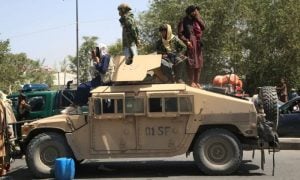
The Foreign Office spokesperson, in response to a question, said that Afghan soil should not be used for any kind of terrorist activities in Pakistan.
He asserted that the mastermind of certain Daesh (ISIS) attacks is currently in Afghanistan, adding that evidence of the group’s presence there has been shared with international partners.
He further stated that Pakistan reserves the right to self-defence.
Citing a report by the UN Sanctions Committee, he said the banned TTP is carrying out operations with the support of the de facto Afghan administration.
The report also confirmed that ISKP is active in northern Afghanistan, while the movement of the banned TTP in Afghanistan and its operations against Pakistan have been verified.
PM Shehbaz to attend Gaza Peace Board meeting
Andrabi confirmed that the Prime Minister, Shehbaz Sharif, accompanied by Deputy Prime Minister and Foreign Minister Ishaq Dar, will participate in the Gaza Peace Board meeting in Washington on February 19.
“Yes, I can confirm that the prime minister will attend the Board of Peace meeting… He will be accompanied by the deputy prime minister,” Andrabi said, describing Pakistan’s participation as part of a broader collective engagement by Muslim-majority states.
“We have joined the Board of Peace in good faith… We are in it, not in isolation, not as one voice, but as a collective voice of eight Islamic Arab countries,” he said.
“Our collective voice is resonating in the Board of Peace, and we will continue to strive for the right and, progress and prosperity of the people of Palestine. And also aimed at the long-term solution of the Palestine issue in order to create a state of Palestine in accordance with the pre-1967 border with Al-Quds Al-Sharif as its capital.”
India’s weaponising of sports
The spokesperson termed it regrettable to involve politics in cricket or to weaponise the sport. He clarified that Pakistan’s decision not to play against India was taken precisely to prevent the game from being used as a political tool.
According to him, India was attempting to use cricket as a political weapon against Bangladesh, and Pakistan’s stance was intended to keep the sport free of such entanglements.
Andrabi also expressed regret over what he described as the silencing of mob killings of Muslims in India, noting that 55 Muslims lost their lives in such incidents last year.