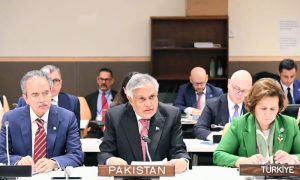
ISLAMABAD: Pakistan’s Foreign Office (FO) on Thursday firmly rejected media reports alleging that Deputy Prime Minister and Foreign Minister Ishaq Dar had shared sensitive information regarding Iran’s nuclear programme during his recent meeting with United States Secretary of State Marco Rubio.
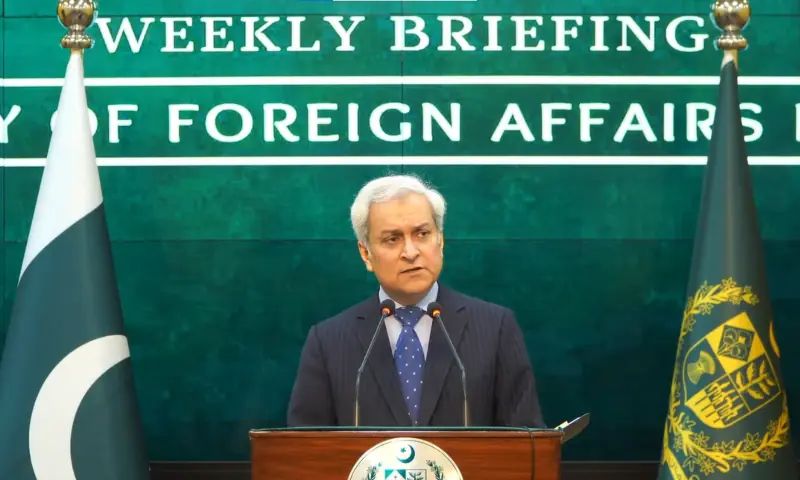
Addressing the weekly press briefing, Foreign Office spokesperson Tahir Andrabi stated unequivocally that no such information was exchanged during the May 29 meeting in Washington, where Dar and Rubio discussed bilateral relations and regional security cooperation. Rubio had earlier publicly acknowledged Pakistan’s role in supporting diplomatic engagement in the Middle East.
The clarification came in response to claims circulated by former CIA analyst Larry Johnson, who cited an unnamed source suggesting that Dar had conveyed remarks about Iran’s position on safeguarding its independence, allegedly causing concern within US diplomatic circles.
However, both Pakistani and US officials have dismissed the assertions. During a congressional hearing, Senator Scott Perry questioned Secretary Rubio about whether Pakistan had conveyed any message suggesting that Iran might demonstrate nuclear capability amid escalating tensions.
Rubio replied that he had seen no such reporting and was unaware of any such communication, adding that such a message would have been highly unlikely to go unnoticed within official channels. “I would be surprised if that message had been relayed,” Rubio stated, reinforcing that no such information had reached him.
The FO reiterated that Pakistan has not acted as a conduit for any messaging related to Iran’s nuclear posture, amid ongoing instability in the region. The US and Iran remain in a fragile post-conflict phase following exchanges of strikes earlier this year, although diplomatic engagement has continued intermittently with international facilitation efforts.
Pakistan warns India over Chenab water diversion plan
In the same briefing, the Foreign Office strongly criticised India’s plans to construct a river-linking tunnel project aimed at diverting water from the Chenab River to the Beas basin. Spokesperson Andrabi described the move as a “serious violation” of the Indus Waters Treaty (IWT), a World Bank-brokered agreement signed in 1960 that governs the distribution of river waters between the two countries.
According to reports cited by the FO, India has invited bids for the proposed “Link-3 Project”, which would redirect an estimated 1.9 million acre-feet of water annually. The project is reportedly scheduled to begin later this year.
Pakistan also expressed concern over proposed “silt flushing” operations at the Salal Dam in Indian-administered Kashmir, warning that such measures could alter downstream water flows and potentially grant India greater operational control than permitted under the treaty framework.
Andrabi said Pakistan had neither been formally informed nor consulted regarding these developments, calling them inconsistent with international water law principles, including those reflected in the Vienna Convention on the Law of Treaties and the UN Watercourses Convention.
He warned that any unilateral action affecting Pakistan’s water share could have serious implications for food security, agriculture, and regional stability, adding that Pakistan retains “all options” to safeguard its treaty rights. The FO urged the international community to intervene diplomatically, calling on India to fully comply with its obligations under the Indus Waters Treaty.
Update on Somali pirate hostage crisis
The Foreign Office also provided an update on efforts to secure the release of 10 Pakistani nationals among 17 crew members held hostage aboard the hijacked oil tanker Honour 25, seized by pirates off the coast of Somalia on April 21.
Andrabi confirmed that the government is pursuing diplomatic and institutional coordination with Somali authorities, the vessel’s owners, and international partners to ensure a safe resolution.
He said the situation remains highly sensitive due to the presence of hazardous cargo onboard the vessel, which has complicated potential rescue or intervention operations.
Pakistan’s diplomatic missions in Somalia and Djibouti are actively monitoring the situation, with embassy officials having visited Mogadishu to assess conditions on the ground. The FO stressed that no action would be taken that could endanger the lives of hostages, and appealed for patience from families awaiting their safe return.
Regional security and Afghanistan
On Afghanistan, the spokesperson reiterated Pakistan’s position that dialogue remains the preferred mechanism for resolving bilateral issues. However, he expressed concern over continued cross-border attacks originating from Afghan territory.
Andrabi stated that Pakistan has conveyed its security concerns to Afghan authorities as well as international partners, including China and the European Union, during recent strategic consultations.
He emphasised that Pakistan expects Afghanistan to ensure its territory is not used for terrorist activity against neighbouring states, adding that Islamabad has taken additional measures to secure border regions in response to evolving security threats.