


KEY POINTS
- PM Sharif reaffirms Pakistan’s desire for normal and stable relations with neighbours
- Shehbaz Sharif condemns terrorism in all forms
- Strongly condemns Israel’s aggression against Iran
- Reiterates Pakistan’s support for a peaceful and stable Afghanistan
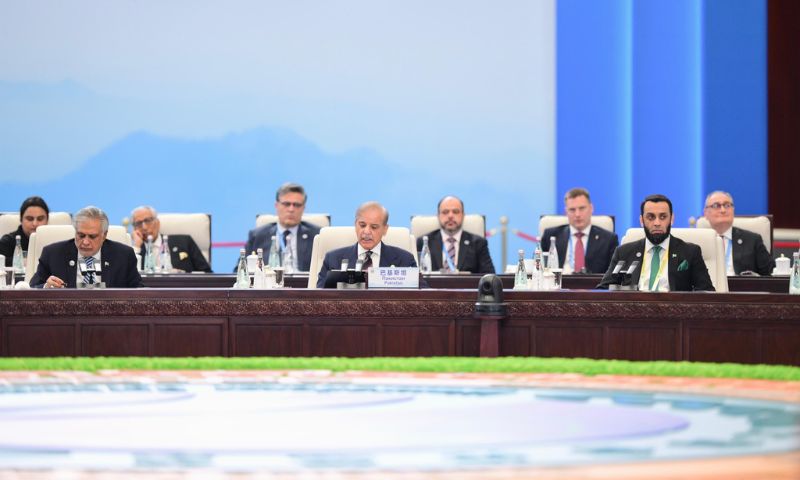
TIANJIN, China: Pakistan’s Prime Minister Shehbaz Sharif on Monday raised the Indus Waters Treaty (IWT) dispute at the Shanghai Cooperation Organisation (SCO) summit in China, calling for a “structural” dialogue to resolve outstanding issues and emphasising Islamabad’s commitment to peaceful, rules-based relations with its neighbours.
Addressing the 25th SCO Heads of States Council Meeting, PM Sharif emphasised that Pakistan sought normal and stable relations with its neighbors, advocating dialogue over confrontation.
“We respect all international and bilateral treaties and expect similar principles to be followed by all SCO members,” PM Shehbaz said.
“Uninterrupted access to due share of water as per existing treaties among SCO members will strengthen the SCO working smoothly and will support the achievement of broader goals for which the SCO was established,” he stressed at the summit in China’s Tianjin.
Following the April 22 attack in Pahalgam, in the Indian Illegally Occupied Jammu and Kashmir, which resulted in the deaths of 26 people, India placed the Indus Waters Treaty (IWT) in abeyance—blaming Pakistan for the incident without providing evidence.
In response, Pakistan warned that any attempt to suspend its share of water under the treaty would be considered an “act of war.”
Earlier this month, the Permanent Court of Arbitration (PCA) in The Hague issued a “Supplemental Award of Competence” in the case, ruling that India does not have the authority to unilaterally suspend the treaty.
The Prime Minister reaffirmed that Pakistan sought a “normal and stable relationship with all its neighbours”. “It seeks dialogue and diplomacy over conflict and confrontation,” he highlighted.
PM Shehbaz noted: “Pakistan has always believed in the power of multilateralism, dialogue and diplomacy, and shunning unilateralism. And yet, to our shock and deep disappointment, the region witnessed extremely disturbing developments during the last few months.”
Regional security
On regional security, the Prime Minister reiterated Pakistan’s condemnation of terrorism in all its forms, including what he termed “state terrorism,” while recalling the country’s immense sacrifices in the fight against extremism.
“We have lost over 90,000 lives and endured economic losses exceeding $152 billion — a sacrifice unparalleled in history,” he said, adding that foreign elements were involved in recent terror incidents in Balochistan and Khyber Pakhtunkhwa.
“We condemn terrorism in all its forms… Those who have long used terrorism to advance their political interest must know that the world no longer buys this narrative. We had irrefutable evidence of the involvement of some foreign hands in the devastating Jaffar Express train hostage incident, as well as countless other terrorist attacks against us in Balochistan and Khyber Pakhtunkhwa province,” the prime minister remarked.
Israel’s ‘aggression’ against Iran
The Prime Minister strongly condemned Israel’s unjustified aggression against Iran, a fellow SCO member, and called for an immediate end to the bloodshed in Gaza.
He reaffirmed Pakistan’s unwavering support for a two-state solution, based on pre-1967 borders with Al-Quds Al-Sharif as the capital of Palestine.
Peaceful and stable Afghanistan
On the situation in Afghanistan, he reiterated that Pakistan supports a peaceful and stable Afghanistan, recognizing its importance for regional peace and development. He expressed optimism that trilateral cooperation between Pakistan, China, and Afghanistan would produce positive outcomes for the region.
Climate change
Addressing the challenge of climate-induced disasters, the Prime Minister highlighted the severe floods currently impacting Pakistan, caused by relentless torrential rains that have resulted in significant human and economic losses. He expressed gratitude to the international community, especially China, for their solidarity and support during this crisis.
“My country is once again passing through unprecedented torrential rains, cloudbursts, and massive devastation due to consequent flooding in three of our major rivers,” PM Shehbaz said.
Economic recovery
Despite challenges, he noted that Pakistan was on a path of economic recovery, citing reduced inflation, a current account surplus, and rising capital market activity. He outlined Pakistan’s economic transformation plan based on three pillars: export-led growth, foreign investment in key sectors such as infrastructure, agriculture, AI, IT, minerals, and energy, and comprehensive tax reforms.
He also lauded China’s successful chairmanship of the organisation, describing it as a reflection of President Xi Jinping’s visionary leadership, and praised initiatives such as the Belt and Road Initiative (BRI) and the China-Pakistan Economic Corridor (CPEC).
The prime minister said today China’s global leadership was exemplified not only through the SCO but also in the landmark initiatives such as the Global Development Initiative (GDI), the Global Security Initiative (GSI), Global Civilisation Initiative (GCI), and Belt and Road Initiative with the China-Pakistan Economic Corridor (CPEC) as its flagship project.