


ISLAMABAD: Pakistan’s Prime Minister Shehbaz Sharif has called on the international community to renew its commitment to sustainable and inclusive development, describing it as the only lasting pathway to peace and shared prosperity in a world grappling with interconnected crises.
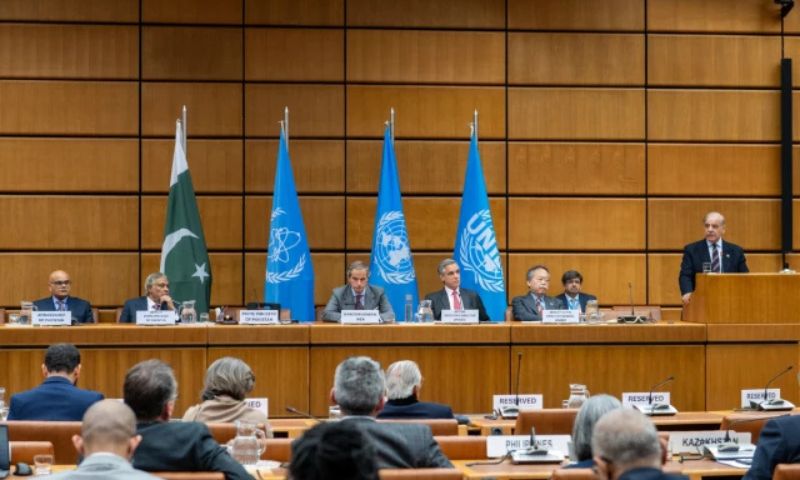
Speaking at the forum titled ‘Sustainable Development as a Path to Global Peace and Prosperity’, the prime minister said the world now faces a defining crossroads, where geopolitical tensions, mounting climate pressures, and rapid technological changes converge to create a destabilising global force.
“The defining danger of our time is not any single threat, but the combination of many,” he warned, highlighting how poverty, debt crises, mass displacement, and unresolved political conflicts are intensifying global instability.
He stressed that sustainable development must be inclusive and equitable, leaving no one behind. “Development cannot be called sustainable if it excludes millions from the promise of a better life,” he added.
Disproportionate burdens
Highlighting the disproportionate burdens carried by developing countries, he noted that nations contributing the least to global emissions are often the most severely affected by climate change, economic instability, and rising debt.
Pakistan, he said, produces less than one percent of global emissions but remains among the countries most vulnerable to climate-induced disasters.
Recalling the catastrophic 2022 floods that claimed thousands of lives, destroyed crops and infrastructure, and displaced millions, the prime minister said successive disasters continue to undermine human security.
“Sustainable development must be anchored in equity, justice, and fair play,” he emphasised.
Reaffirming Pakistan’s commitment to the Sustainable Development Goals (SDGs), he noted that the government has integrated them into national planning, focusing on human development, education, healthcare, food security, and social protection, particularly for women and youth.
Pakistan’s large youth population
He highlighted that Pakistan’s large youth population represents both a challenge and an opportunity, calling for urgent investments in skills development, digital transformation, and institutional capacity to unlock their potential.
The prime minister reiterated Pakistan’s steadfast dedication to dialogue, diplomacy, and multilateralism as the only sustainable means of resolving disputes and preventing conflict, even in the face of aggression or violations of international norms.
United Nations system reforms
He also underscored the need to strengthen and reform the United Nations system so it can serve as a true pillar of global peace and cooperation.
Highlighting Vienna’s unique role within the UN framework, he noted that the city hosts key institutions addressing counter-terrorism, crime prevention, industrial development, nuclear technology, and outer space applications.
Addressing emerging technologies, he emphasised the importance of capacity building, knowledge sharing, and technology transfer to ensure innovations like artificial intelligence and biotechnology benefit all of humanity, rather than a privileged few.
“Unaddressed digital divides will soon become entrenched development divides,” he warned, urging the global community to tackle the root causes of global challenges rather than simply managing their consequences.
Pakistan, he said, greatly valued its constructive engagement with the International Atomic Energy Agency (IAEA), United Nations Industrial Development Organisation (UNIDO), United Nations Office on Drugs and Crime (UNODC) and other Vienna-based entities and remained committed to supporting their mandates.