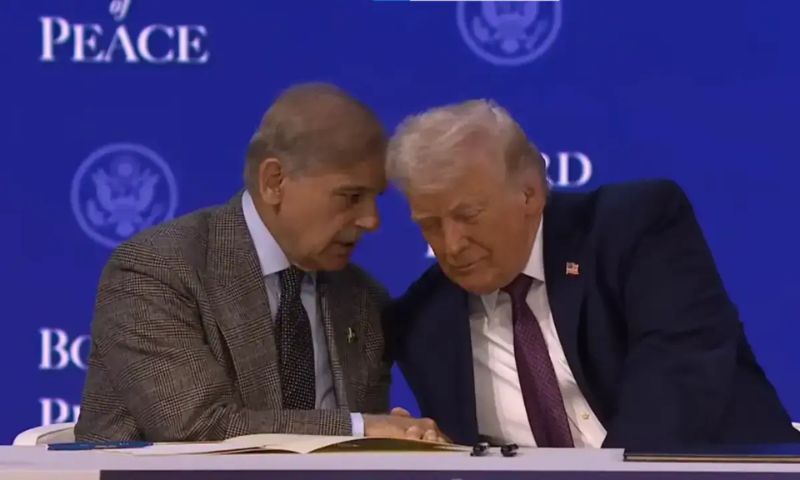



ISLAMABAD: Pakistan’s Prime Minister Shehbaz Sharif will attend the inaugural meeting of the US-backed Board of Peace (BoP) in Washington on February 19, the Foreign Office confirmed on Thursday.
Foreign Office spokesperson Tahir Andrabi said PM Sharif would participate in the meeting at the United States Institute of Peace. He will be accompanied by Deputy Prime Minister and Foreign Minister Ishaq Dar.
“As regards the other members of the delegation and engagements in the US, we will inform you in due course,” Andrabi told reporters at his weekly briefing.
The spokesperson said Pakistan had joined the Board of Peace “in good faith” and as part of a collective position of eight Muslim countries.
“We are in it not in isolation, not as one voice, but as a collective voice of eight Islamic-Arab countries,” he said, referring to joint statements issued on Gaza and the occupied West Bank.
Focus on Gaza reconstruction
According to media reports, citing diplomatic sources, the February 19 meeting will serve as the inaugural session of the board and will focus on Gaza’s post-war reconstruction.
The official invitation underlines the expected presence of heads of state, heads of government and international figures.
The meeting is described as organisational and financial in nature. It is also expected to function as a fundraising conference.
Discussions are likely to formalise the board’s mandate, structure and secretariat, and clarify its operational direction.
Diplomatic sources, cited by media reports, said possible troop contributions may also be discussed, although any decisions would follow completion of the board’s framework.
US President Donald Trump launched the Board of Peace late last month as part of a broader Gaza peace and transition plan. He is expected to chair the meeting in Washington.
Hungarian Prime Minister Viktor Orbán and Indonesia’s President Prabowo Subianto have confirmed their attendance, according to officials.
Eight Muslim countries
Eight Muslim countries, including Saudi Arabia, Turkiye, Egypt, Jordan, Indonesia, Pakistan, Qatar and the United Arab Emirates, had jointly announced participation in the Board of Peace.
On January 21, the foreign ministers of Pakistan, Egypt, Jordan, the UAE, Turkiye, Saudi Arabia and Qatar issued a joint statement announcing their decision to join the Board of Peace.
“The ministers announce their countries’ shared decision to join the Board of Peace,” the statement said, adding that each country would complete the necessary legal procedures.
The ministers reaffirmed support for efforts aimed at consolidating a permanent ceasefire, supporting Gaza’s reconstruction and advancing a “just and lasting peace” grounded in Palestinian self-determination and statehood in accordance with international law.
Deputy Prime Minister Ishaq Dar also reiterated Pakistan’s stance on social media, saying Islamabad would continue to work with “brotherly Arab-Islamic countries for lasting peace in Gaza”.
Mandate and UN backing
The Board of Peace was first proposed in September 2025 as part of a 20-point Gaza peace plan that followed a ceasefire between Israel and Hamas.
Its establishment was endorsed by United Nations Security Council Resolution 2803, adopted in November, which authorised international cooperation for Gaza’s reconstruction.
According to officials, the board’s charter includes humanitarian and reconstruction responsibilities and allows for broader conflict resolution roles.
This wide mandate has drawn mixed international reactions. Some Western allies have expressed reservations over its structure, financing and long-term authority.
The Foreign Office said Pakistan’s engagement is aimed at short-, medium- and long-term solutions for the Palestinian issue.
“Our objective remains the creation of a state of Palestine in accordance with the pre-1967 borders, with Al-Quds Al-Sharif as its capital,” Andrabi said.
He added that Pakistan’s participation was not unconditional and remained aligned with United Nations resolutions and international law.