



Key Points
- Pakistan’s finance minister met senior leadership of Visa, a global digital payments company
- Discussions covered progress under the International Monetary Fund (IMF) programme
- Both sides explored expanding digital payment infrastructure beyond major urban centres
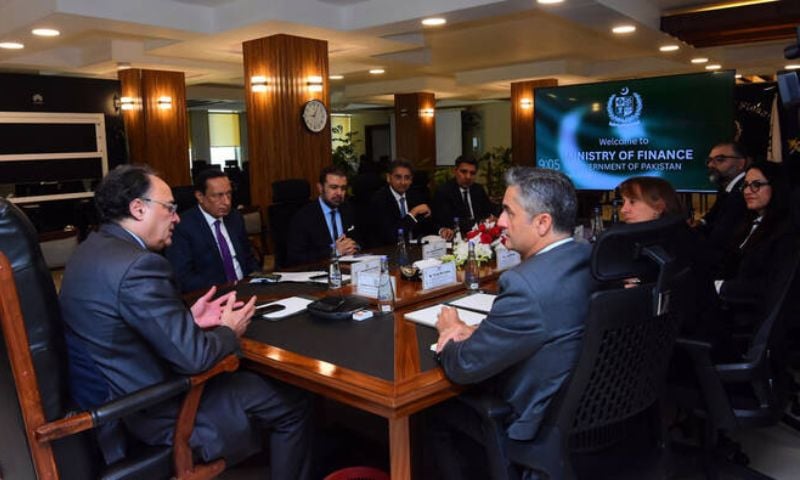
ISLAMABAD: Seeking to consolidate macroeconomic stabilisation, Pakistan has pushed for advancing the digital payments ecosystem during Finance Minister Senator Muhammad Aurangzeb’s meeting with a delegation from the Visa company on Thursday.
The delegation was led by Tareq Muhmood, Regional President for Central Europe, Middle East and Africa (CEMEA) of Visa, which operates a global electronic payments network that enables secure digital transactions between banks, merchants, consumers and governments, without issuing cards or lending money itself.
Welcoming the delegation, the finance minister appreciated Visa’s continued engagement with Pakistan’s financial sector and briefed the visitors on macroeconomic indicators following stabilisation measures taken under an IMF-supported programme.
Aurangzeb also referred to recent assessments by international credit rating agencies, which evaluate a country’s ability to service its debt, and outlined the government’s reform agenda covering taxation, the energy sector, state-owned enterprises, public debt management and privatisation. He said recent steps had been taken to accelerate the privatisation process as part of efforts to strengthen economic fundamentals.
Digital transformation featured prominently in the discussions. The finance minister said Pakistan’s digitalisation drive is being led at the highest level by the prime minister to ensure coordinated implementation across government institutions. He highlighted ongoing initiatives, including plans for the Pakistan Digital Authority, aimed at developing digital public infrastructure and setting national standards.
He also pointed to reforms under way at the State Bank of Pakistan, the country’s central bank, to modernise payment systems, often referred to as payment “rails”, which form the backbone of electronic transactions. Efforts are also under way to digitise government receipts and expenditures to improve transparency, efficiency and service delivery.
The Visa delegation shared insights from its engagement with Pakistani banks, fintech companies and other stakeholders. Fintechs are technology-driven firms providing financial services such as digital wallets and electronic payments. According to the delegation, confidence among these players has improved due to macroeconomic stabilisation and growing interest in expanding digital payments and innovation.
Discussions covered reducing reliance on cash, strengthening fraud prevention, and supporting small and nano businesses, very small enterprises that often operate outside the formal banking system. Visa executives also discussed QR-based payments and “tap-to-phone” solutions, which allow smartphones to function as payment terminals, and stressed the need to expand acceptance infrastructure in Tier-2 and Tier-3 cities, a term used for smaller urban centres beyond major metropolitan areas.
The delegation emphasised the importance of maintaining competition and choice across payment channels to encourage innovation, manage risk and deliver better outcomes for consumers and merchants.
Emerging areas such as cross-border remittances, e-commerce, tourism-related spending by overseas Pakistanis and the potential use of new technologies, including blockchain and digital assets, were also discussed. Blockchain refers to a distributed digital ledger technology increasingly explored for regulated financial and government applications.
Aurangzeb said Pakistan is examining these developments cautiously, seeking to balance innovation with financial stability and regulatory oversight. He shared perspectives on potential use cases in areas such as public debt management, remittance flows and government payments.