
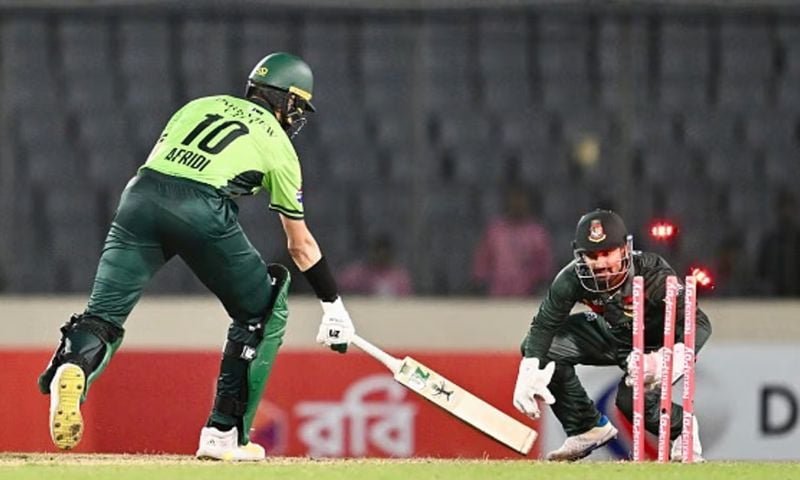



MIRPUR: Pakistan cricket team has filed a complaint with match referee Neeyamur Rashid regarding a contentious Decision Review System (DRS) moment during the final over of the third One-Day International against Bangladesh in Mirpur on Sunday.
The controversy stems from Bangladesh’s LBW review off the penultimate delivery of the match, a decision Pakistan’s management believes was influenced by the stadium’s big screen showing a replay of the ball before the review was formally requested.
The incident occurred with Pakistan needing 12 runs from just two balls to keep their hopes alive. Bangladesh spinner Rishad Hossain delivered a flighted ball that drifted onto leg stump and spun further down the leg side, evading Pakistan batter Shaheen Afridi. The on-field umpire Kumar Dharmasena initially signalled the delivery as a wide.
Following a brief discussion among Bangladesh fielders, the visiting team opted to challenge the call with an LBW referral—despite visual evidence suggesting the ball was nowhere near Afridi’s pads or body.
🚨Drama In Pakistan Campus🚨
Pakistan has complained that Bangladesh players saw the DRS replay on the big screen.
But the reality? 12 needed off 2 balls, lost by 11 runs, series gone 2–1.
First they lost the match, now they filing complaints. 🔥 pic.twitter.com/S56ifRYQJg— manzur shaban (@Manzurshaban123) March 16, 2026
Protocol breach allegations
Established DRS protocols require that a reviewing team make their decision before any replay is shown on the stadium’s big screen. This safeguard prevents players from gaining unfair advantage by viewing the ball’s trajectory before committing to a review.
Pakistan’s formal complaint contends that these protocols were violated, as the stadium’s large screen had already displayed the ball passing Afridi’s bat. This replay potentially provided Bangladesh fielders with information suggesting the ball may have made contact with the bat, information that should not have been available to them before deciding whether to review.
The Pakistan team management has also raised concerns about whether Bangladesh initiated the review within the permitted 15-second window. Broadcast footage did not display a visible countdown timer, making independent verification of the timing impossible.
DRS outcome and match implications
Shaheen Afridi’s visible frustration on the field became understandable once the DRS process unfolded. Hawk-Eye technology indicated the ball had grazed the toe of his bat, confirming bat involvement in the delivery.
While Bangladesh ultimately lost the review, the challenge successfully overturned the original wide call. The ball was deemed legitimate, leaving Pakistan requiring 12 runs from a single delivery, a mathematical impossibility.
Afridi was stumped on the final ball after swinging his bat wildly over the stumps in frustration, sealing Bangladesh’s 11-run victory and a 2-1 series triumph.
Pakistan fall short despite @SalmanAliAgha1‘s fighting century 💯
Bangladesh win by 11 runs to claim the series 2-1.#BANvPAK | #BackTheBoysInGreen pic.twitter.com/ESWKTOwiYx
— Pakistan Cricket (@TheRealPCB) March 15, 2026
Pattern of controversial decisions
This incident marks the second contentious umpiring moment affecting Pakistan in consecutive matches. During the second ODI, batter Salman Ali Agha was controversially run out after being caught outside his crease while attempting to hand the ball to Bangladesh’s Mehidy Hasan Miraz.
That incident sparked a heated exchange between the players, with Agha expressing his frustration by throwing his bat and gloves to the ground. The aggressive reaction resulted in disciplinary action, Agha received a demerit point and a 50% match fee fine, while Mehidy was penalized 20% of his match fee.
PCB’s stance
It remains unclear what specific remedy the Pakistan Cricket Board expects from match referee Neeyamur Rashid following their formal complaint. Sources within the Pakistan camp suggest they are seeking at minimum a public acknowledgment that procedural errors occurred during the critical match-turning moment.