Key Points
- 43 farmers from flood-hit Sindh to file a climate justice case in Germany
- Lawsuit targets ‘RWE’ and ‘Heidelberg Materials’, among top global CO₂ emitters
- Claim based on “polluter pays” principle under German civil law
- Farmers say 2022 floods destroyed livelihoods despite Pakistan’s minimal emissions
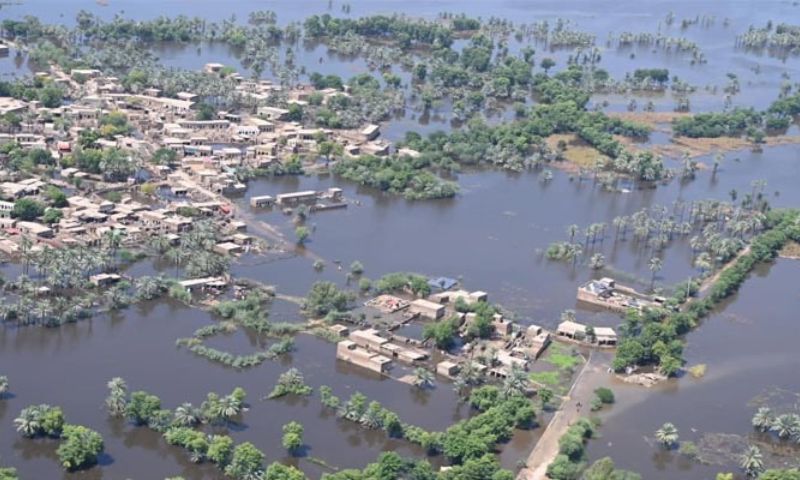
KARACHI: Farmers from Pakistan’s flood-ravaged Sindh province have announced plans to file a climate justice lawsuit in Germany against two of the world’s highest carbon dioxide emitters, arguing that unchecked global emissions worsened the devastating floods of 2022.
Farmer representatives from Larkana, Jacobabad and Dadu said at a press conference at the Karachi Press Club on Thursday that they plan to file the lawsuit, citing widespread crop destruction, livestock losses and displacement after record monsoon rains submerged nearly a third of the country.
According to organisers, the farmers will pursue a climate accountability claim under German civil law against energy giant ‘RWE’ and building materials company ‘Heidelberg Materials’. The case will invoke the “polluter pays” principle and seek compensation for losses linked to climate-induced extreme weather.
The claimants argue that Pakistan contributes less than one per cent to global greenhouse gas emissions, yet remains among the countries most vulnerable to climate change. “Our crops, homes, and livelihoods were wiped out by a disaster we did not cause,” the farmers said, adding that high-emitting corporations must bear responsibility for climate-related damage.
Climate change described as a labour and livelihood crisis
National Trade Union Federation leader Nasir Mansoor described climate change as a labour and livelihood crisis, warning that repeated climate shocks were eroding rural employment, food security and deepening inequality.
Dr Shaikh Tanveer Ahmed of the HANDS Welfare Foundation said the 2022 floods were not merely a natural disaster but a consequence of global warming. “Our farmers are paying the price for emissions they did not produce,” he said, calling compensation and accountability central to climate justice.
Speaking from Germany, constitutional lawyer Miriam Saage-Maab of the European Centre for Constitutional and Human Rights (ECCHR) said the case aimed to bring the voices of flood-affected communities into international courts. Karin Zennig of Medico International said the lawsuit reflected a growing global movement using litigation to link climate science, human rights and justice.
The case comes amid a broader surge in climate-related legal action worldwide. On Thursday, hundreds of people in Japan filed the country’s first compensation lawsuit against the state over alleged unconstitutional inaction on climate change, underscoring a global push to hold governments and corporations accountable for climate harm.
Together, these cases signal a growing effort by affected communities — particularly in the Global South — to seek redress through courts for climate-driven losses, framing climate change not only as an environmental issue but as a matter of justice and responsibility.