


PESHAWAR, Pakistan: Health experts are ringing alarm bells as Pakistan faces an unprecedented threat of a major dengue outbreak this season. The perfect storm of recent floods, high humidity, and prolonged warm temperatures has created ideal breeding grounds for mosquitoes carrying the deadly virus.
Over the past decade, dengue fever has emerged as one of Pakistan’s most stubborn public health challenges, typically peaking between September and December — the post-monsoon period when conditions are ripe for mosquito proliferation.
Charsadda leads KP outbreak
In Khyber Pakhtunkhwa (KP), Charsadda tops the list of vulnerable districts, with 1,071 dengue cases reported between January and October 2025. Nine remain active while 142 were reported in October.
Peshawar, the provincial capital, ranks second with 459 cases, including 285 reported in October. Seventy-two cases remain active.
Mardan follows with 403 cases, 311 of them reported in October, with 42 remaining active, while two deaths were also reported in the district.
Haripur reported 352 cases, including 116 in October, with 12 active cases.
Climate sets the stage
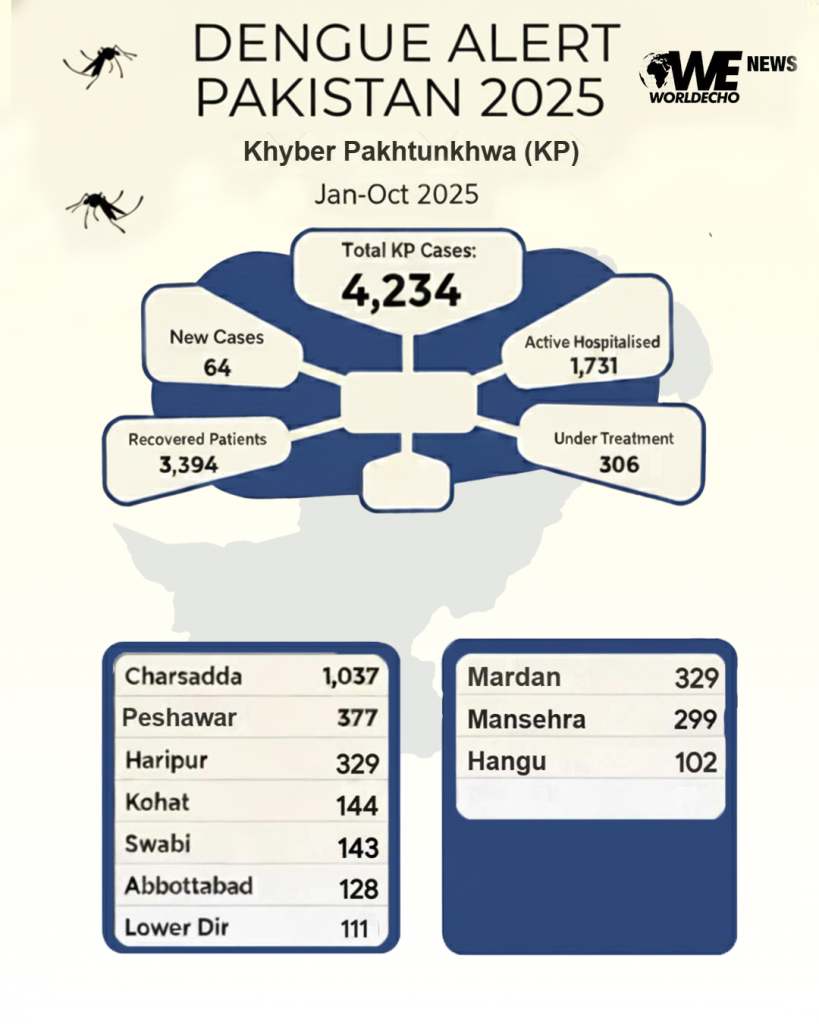
According to the World Health Organisation (WHO), dengue transmission intensifies when temperatures remain between 26°C and 29°C for three to five consecutive weeks, humidity exceeds 60 per cent, and rainfall exceeds 27 millimetres, with a lag effect of up to three weeks.
Persistent monsoon rains have kept temperatures between 26°C and 29°C and humidity above 60 per cent — conditions scientifically recognised as a mosquito’s paradise. – Pakistan Meteorological Department, Dengue Alert-I (Sept 2025)
WHO research reveals that the dengue mosquito is most active during early mornings and late afternoons, with activity only dropping when temperatures fall below 16°C.
With Pakistan’s lingering warmth and sticky humidity, experts warn that the mosquito population is set to explode, pushing infection risks through the roof in the coming weeks.
Meteorological data indicate that since September 20, 2025, temperature and humidity levels — coupled with widespread waterlogging — have created the perfect storm for a potential outbreak.
According to the PMD’s Dengue Alert-I (September 15, 2025), persistent monsoon rains have kept temperatures between 26°C and 29°C and humidity above 60 per cent, conditions scientifically recognised as a mosquito’s paradise.
National Institute of Health Pakistan (NIH) reports that the 2025 floods have created an environment highly conducive to vector-borne diseases, including dengue.
Officials attribute the heightened threat to prolonged monsoon rains that swamped large swathes of Punjab, Sindh, and Khyber Pakhtunkhwa.
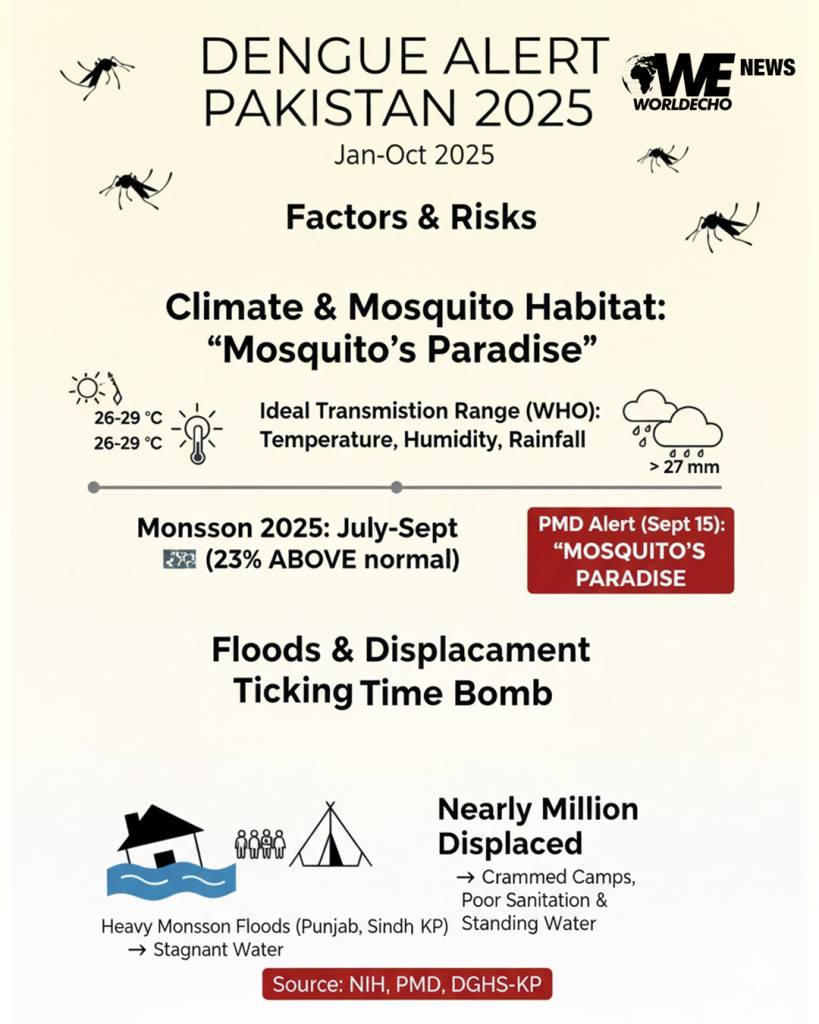
Pakistan Meteorological Department (PMD) — the country’s official authority for weather data — states that the 2025 monsoon season (July to September, with onset on June 26) recorded a national average rainfall of 172.8 mm, which is 23 per cent above the long-term average.
This marks an increase compared to the historical normal of approximately 140–141 mm, as consistently reported in recent years.
Muhammad Faheem, Deputy Director at the PMD, tells WE News English that above-normal monsoon rains during 2025 have set the stage for a dengue outbreak across Pakistan, particularly in Khyber Pakhtunkhwa.
The dengue mosquito thrives when warmth lingers and humidity stays high — and that’s exactly what Pakistan is facing this season.
Overflowing rivers and emergency water releases from reservoirs have turned vast urban and rural landscapes into inland seas, displacing millions and leaving behind stagnant water — a breeding paradise for dengue mosquitoes.
In Khyber Pakhtunkhwa, districts such as Charsadda, Mardan, Peshawar, and Nowshera, along with other riverine areas, were among the worst affected, recording some of the highest dengue incidence rates in the province.
Cities on dengue watch
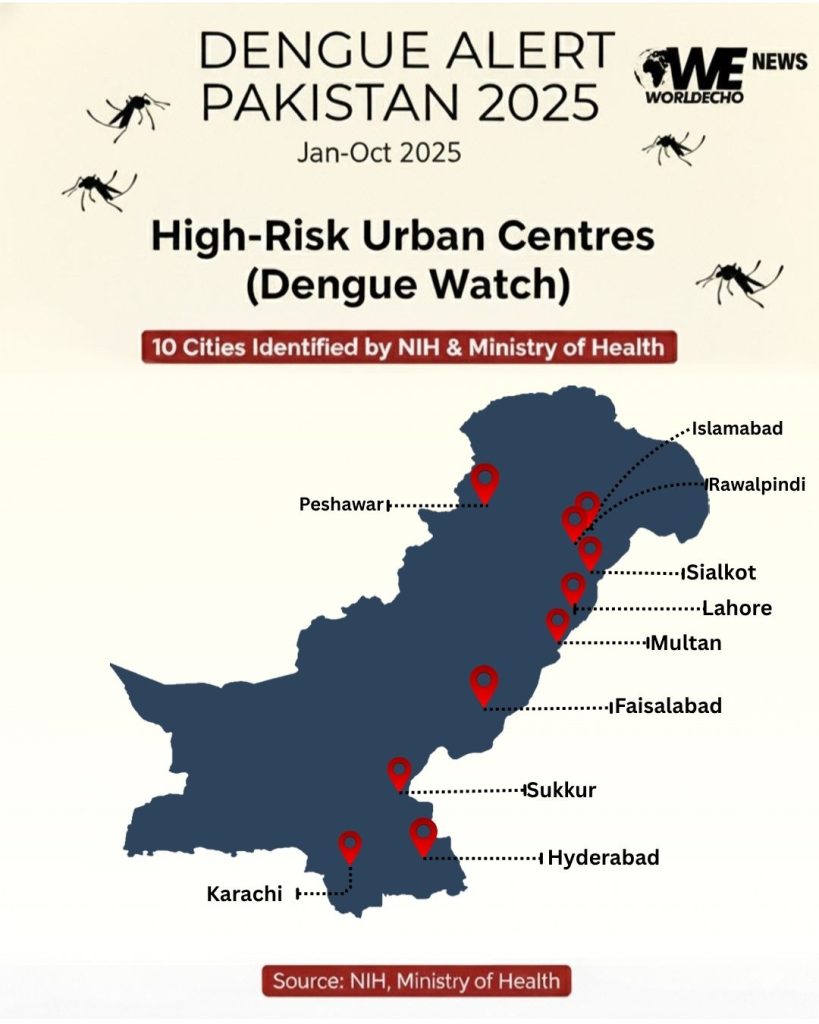
Following the prolonged 2025 monsoon, the National Institute of Health (NIH), Islamabad, in collaboration with the Ministry of National Health Services, identified 10 major urban centres as the highest-risk zones for dengue transmission.
The areas with extreme vulnerability include Islamabad, Karachi, Sukkur, Hyderabad, Multan, Lahore, Sialkot, Faisalabad, Rawalpindi, and Peshawar.
Flood-affected rural areas are equally in the line of fire, particularly where drainage and sanitation infrastructure have collapsed.
The situation is further aggravated by the dense population of displaced families living in makeshift shelters, where mosquito exposure is unavoidable and access to preventive measures remains out of reach.
National Disaster Management Authority (NDMA) Chairman Lieutenant General Inam Haider Malik confirmed that nearly two million people have been displaced across Pakistan due to the 2025 monsoon floods.
Many of these families are now living in overcrowded camps across Khyber Pakhtunkhwa, Punjab, and Sindh.
With drainage systems in tatters and stagnant floodwaters everywhere, health authorities warn these conditions are a ticking time bomb for dengue and other vector-borne diseases.
According to the PMD’s October-December 2025 Seasonal Outlook, “the anticipated temperature and humidity conditions in major cities, especially in central and southern areas, may create an environment conducive to a dengue outbreak during October and November.”
High humidity and moderate rainfall are expected to linger until early December, fuelling fears that Pakistan could face one of its worst dengue seasons in recent memory.
The combination of stagnant water, sticky heat, and high humidity is fuelling an ideal breeding storm for dengue mosquitoes.
NIH has urged the public health departments across the country to step up vector control drives, launch awareness campaigns, and stock hospitals to handle an anticipated spike in dengue cases.
Too little, too late
Despite repeated warnings, preventive measures remain reactive rather than proactive — a case of shutting the stable door after the horse has bolted.
Shahid Jan, a resident of Pawaka village in Peshawar, expresses frustration over what he describes as the government’s “seasonal firefighting” approach.
Speaking to WE News English, he says, “Authorities start spraying and awareness campaigns only when cases start to rise. If action had been taken earlier, there would be no outbreak in the first place.”
He explains that early preventive measures should begin before the monsoon, ideally in April or May, including larvicidal control and residual spraying in mosquito hotspots such as drains, junkyards, construction sites, and water containers.
Gul Sartaj, provincial surveillance officer at the Directorate General Health Services Khyber Pakhtunkhwa (DGHS-KP), reveals that many dengue-control staff members have gone unpaid for four months, leaving morale at rock bottom.
“How can workers perform their duties efficiently when they are struggling to make ends meet? These people are on the frontlines, yet they’re left high and dry,” he laments.
Call for year-round action
According to data from the NIH, Pakistan recorded thousands of dengue cases between January and October 2025.
Sindh reported 3,527 cases, Punjab 2,447, Baluchistan 342 cases, and Gilgit-Baltistan 63. Khyber Pakhtunkhwa tops the list with 3,702 cases, making it one of the hardest-hit provinces this year.
The Integrated Disease Surveillance and Response System (IDSR) of the Khyber Pakhtunkhwa Health Department reported 64 new cases on October 30, 2025. A total of 1,731 patients remain hospitalised with 4,234 confirmed cases of dengue reported this year.
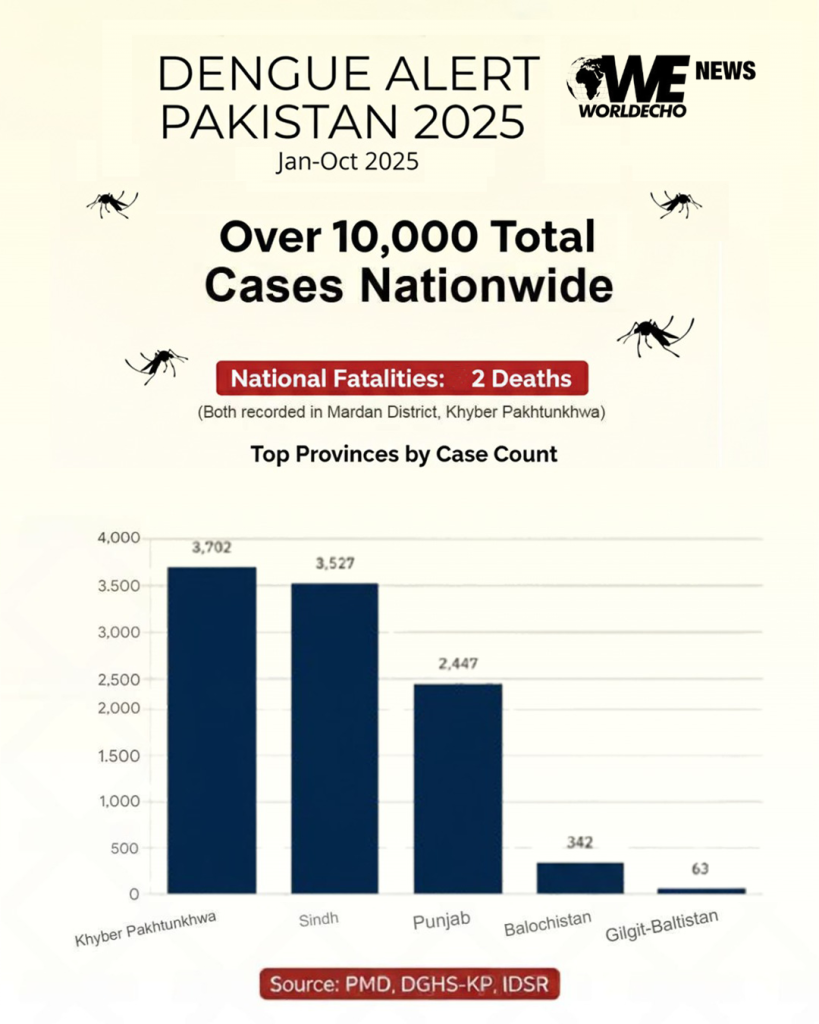
The IDSR further confirms that 3,394 patients have recovered, while 306 remain under treatment. Tragically, two fatalities have been reported, both from Mardan district.
The report further reveals that Charsadda leads with 1,037 cases, followed by Peshawar (377), Mardan (343), Haripur (329), Mansehra (299), Kohat (144), Swabi (143), Abbottabad (128), Lower Dir (111), and Hangu (102).
Experts say this clustering of cases paints a grim picture of how stagnant water and population density go hand in hand with dengue transmission.
Dr. Gul Sartaj informs WE News English that public ignorance and poor sanitation are the Achilles’ heel in the fight against dengue.
“Dengue is a preventable disease. If people eliminate stagnant water, maintain cleanliness, and use repellents, we can turn the tide.”
He claims that the Khyber Pakhtunkhwa Health Department has distributed anti-mosquito sprays and hygiene kits in the vulnerable areas.
“We are also holding awareness sessions in local community spaces such as hujras to educate residents about preventive measures. Our goal is to arm communities with knowledge, so they can fight dengue before it fights them.”
Salahuddin Khan Marwat, Provincial Medical Entomologist at the DGHS-KP, agrees that Pakistan’s escalating dengue crisis is a cocktail of climate change, urban flooding, weak waste management, and delayed preventive action.
“Warmer temperatures, erratic rains, and unplanned urbanisation have opened Pandora’s box for disease outbreaks. Unless authorities take the bull by the horns and adopt a year-round control strategy, we’ll keep chasing our tails every dengue season.”