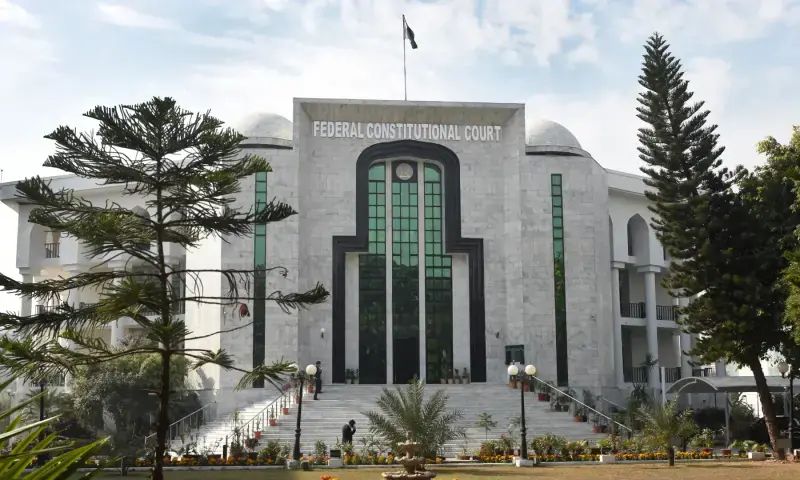



ISLAMABAD: Pakistan’s Federal Constitutional Court has reserved its judgment in a closely watched case challenging the federal government’s ban on imports from India, as judges heard arguments over the limits of judicial oversight and executive authority in trade policy.
A three-judge bench led by Justice Aamer Farooq heard the federal government’s appeal against specific directives issued by the Lahore High Court, even though the court had earlier upheld the legality of the import ban imposed in 2019 through two statutory orders.
While affirming that the Statutory Regulatory Orders were constitutional, the Lahore High Court had instructed the government to appoint an officer to hear representations from affected stakeholders, particularly those seeking exemptions for importing law books and academic journals.
The court said the officer’s recommendations should be considered by the government, with the possibility of a review.
The federal government challenged those instructions before the Federal Constitutional Court, arguing they amounted to judicial intrusion into executive policymaking.
Government lawyers said courts may examine whether a policy is lawful, but cannot compel the executive to reopen or modify decisions tied to foreign policy or national security.
Additional Attorney General Amir Rehman told the court that trade restrictions involving adversarial states fall squarely within the government’s constitutional authority and are traditionally considered beyond judicial review.
Counsel for the Revenue Division echoed that view, arguing that once the Lahore High Court upheld the legality of the ban, it had no mandate to issue further directions.
The petitioners maintained that requiring the government to reconsider or revisit a policy undermines the separation of powers, blurring the constitutional line between judicial oversight and executive authority.
The court’s reserved judgment is now expected to set an important precedent on the limits of judicial intervention in matters of foreign policy and international trade, particularly where national security considerations are invoked.