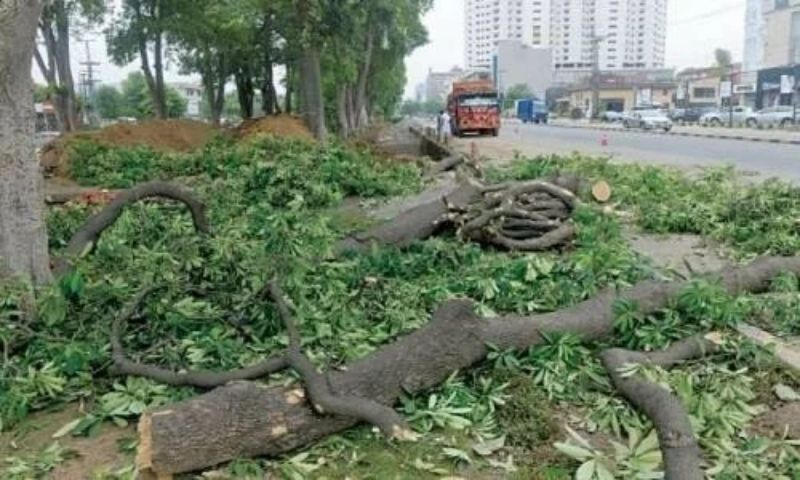



ISLAMABAD: Pakistan’s Islamabad High Court on Thursday temporarily suspended a tree-cutting campaign in the capital, ordering authorities to justify the removal of thousands of trees amid growing environmental concerns.
Justice Khadim Hussain Soomro issued notices to the Capital Development Authority (CDA), the Pakistan Environmental Protection Agency (Pepa), and the Ministry of Climate Change, directing them to submit a clause-wise response and a comprehensive report by February 2.
Pakistan is among the countries most vulnerable to deforestation and climate change, with the loss of forest cover intensifying extreme weather, water scarcity, and environmental degradation.
The petition was filed by a local resident, Muhammad Naveed Ahmed, who raised concerns over the scale and implementation of the tree-cutting drive in Islamabad.
Authorities said the campaign was limited to the removal of invasive and allergenic paper mulberry trees, which health officials have long linked to seasonal pollen allergies affecting residents of the city.
According to official figures, about 29,115 paper mulberry trees have been removed over the past year, including 8,700 from major parks and recreational areas such as F-9 Park and Shakarparian.
Government officials said the operation is part of a broader environmental management and public health strategy and is accompanied by a large-scale replantation program. Under the plan, 60,000 new trees are to be planted by March, in addition to more than 40,000 mature trees already restored.
The Ministry of Climate Change said that for every tree removed, three indigenous and environment-friendly trees would be planted. Plantation drives are currently underway across the federal capital.
Authorities said the removal followed a three-step scientific process — cutting the trees, uprooting the roots, and refilling the soil — to prevent regrowth of the invasive species. Native and non-allergenic trees were not targeted.
The replantation phase includes indigenous species such as amaltas, jacaranda, arjun, fruit-bearing, and pine trees. In Shakarparian alone, 81 acres have been prepared for replanting, with completion expected by the end of April 2026.
Health officials reported a noticeable improvement in pollen-related respiratory conditions, attributing the decline to the removal of allergenic trees.
Pakistan’s deforestation is deepening the impacts of climate change, weakening natural carbon sinks and worsening heatwaves, floods, droughts, and air pollution. The loss of forest cover accelerates soil erosion, threatens biodiversity, and increases climate-related risks for agriculture and food security, leaving the country more exposed to extreme weather and environmental crises.