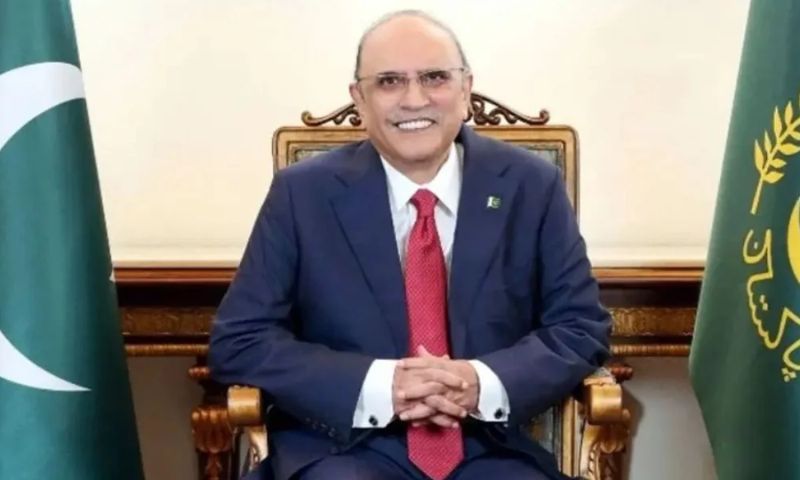



ISLAMABAD: President Asif Ali Zardari on Wednesday extended warm congratulations to Nepal’s Rastriya Swatantra Party (RSP) and its prime ministerial candidate, rapper-turned-politician Balendra Shah, following the party’s landmark electoral victory, describing the development as a positive sign for democratic progress and youth-led governance in South Asia.
In a message issued from the President’s Secretariat, Zardari commended the strong participation of young voters and emerging leaders in Nepal’s electoral process.
He said the growing engagement of youth in politics reflected a broader regional aspiration for transparent governance, institutional reform, and responsive leadership.
The president noted that the rise of youthful leadership in Nepal carried encouraging implications not only for the country but also for the wider South Asian region.
According to him, the electoral outcome demonstrated the increasing demand among citizens—particularly the younger generation—for accountable and forward-looking governance.
The congratulatory message comes in the wake of Nepal’s March 5 general elections, where the reform-oriented Rastriya Swatantra Party emerged as the dominant political force, challenging decades of dominance by traditional parties such as the Nepali Congress and communist factions.
Early results indicated the party winning over 120 of the 165 directly elected seats, positioning it to lead the next government in the 275-member parliament.
The party’s leader, 35-year-old Balendra “Balen” Shah, a former rapper and the popular former mayor of Kathmandu, gained national prominence through an anti-corruption and governance reform platform that resonated strongly with younger voters.
Shah also achieved a symbolic victory by defeating former prime minister KP Sharma Oli in his own constituency, highlighting the scale of the political shift in the country.
Political analysts view the election as a turning point for Nepal, driven by widespread frustration with corruption, economic stagnation, and political instability, as well as the influence of a youth-led movement that gained momentum following mass protests in 2025.
President Zardari also recalled Pakistan’s own political history, highlighting the legacy of Shaheed Mohtarma Benazir Bhutto, who became the youngest Prime Minister of Pakistan.
He remarked that the emergence of a young prime minister in Nepal signaled a new chapter of energetic leadership and democratic renewal in the region.
Emphasizing the longstanding relationship between Pakistan and Nepal, the president pointed out that the two countries have enjoyed cordial diplomatic ties since establishing formal relations in 1960.
He reaffirmed Pakistan’s commitment to further expanding cooperation with Nepal based on mutual respect, goodwill, and shared interests.
President Zardari also expressed confidence that Nepal’s new leadership would succeed in implementing its reform agenda and steering the country toward sustained development and prosperity.
He conveyed his best wishes for the success of the newly elected leadership and reiterated Pakistan’s readiness to work closely with Nepal to strengthen bilateral friendship and collaboration in the years ahead.