


UNITED NATIONS: Pakistan has called on the international community to uphold the principles of international law, warning that selective adherence to legal norms is intensifying conflicts, deepening humanitarian crises, and undermining multilateral cooperation.
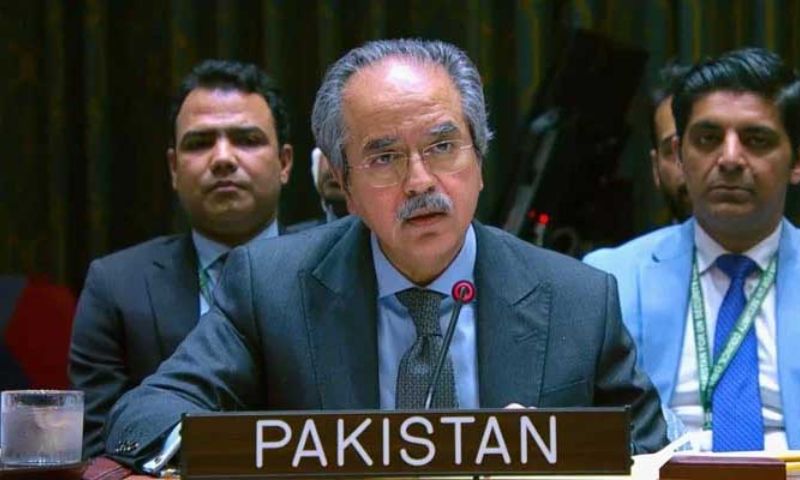
Addressing a high-level open debate of the UN Security Council on “Reaffirming International Rule of Law: Pathways to Reinvigorating Peace, Justice, and Multilateralism,” at the United Nations Security Council in New York, Pakistan’s Permanent Representative to the United Nations, Ambassador Asim Iftikhar Ahmad, said respect for international law is essential for global peace, justice, and collective security.
Congratulating Somalia on its successful presidency of the Council and for convening the debate, Ambassador Ahmad described the discussion as timely, noting that the erosion of international law is increasingly translating into instability and weakened trust among states.
Equitable application of international law
He emphasised that international law must be applied equitably, consistently, and without discrimination to maintain a stable and predictable international order.
The Pakistani envoy warned that unilateral actions, selective application of treaties, and disregard for the UN Charter’s core principles — including sovereign equality, territorial integrity, non-interference, and the prohibition of the use of force — are undermining collective security and the credibility of multilateral institutions.
India’s unprovoked military aggression
Referring to regional developments, Ambassador Ahmad said Pakistan had itself faced violations of international law, citing what he described as India’s unprovoked military aggression in May last year.
He stated that Pakistan exercised its right to self-defence under Article 51 of the UN Charter in a responsible and proportionate manner, stressing that coercion and impunity cannot become a “new normal” in international relations.
Root cause of instability in South Asia
He further said that the unresolved Jammu and Kashmir dispute remains the root cause of instability in South Asia, calling India’s occupation of the territory a violation of UN Security Council resolutions and the Kashmiri people’s right to self-determination.
Suspension of the Indus Waters Treaty
Ambassador Ahmad also criticised India’s unilateral suspension of the Indus Waters Treaty, terming it a breach of international obligations and a threat to regional peace and the livelihoods of millions. Pakistan, he said, rejects the weaponization of water and natural resources.
Peaceful settlement of disputes
Highlighting Pakistan’s commitment to the peaceful settlement of disputes, the ambassador recalled the unanimous adoption of UN Security Council Resolution 2788 last year, which reaffirmed dialogue, mediation, and judicial settlement as primary means for resolving disputes.
Ambassador Ahmad also drew attention to the concerns of developing countries, particularly in the Global South, stating that double standards and a lack of compliance have prevented the international system from delivering equitable benefits.
UN reforms
He called for UN reforms aimed at equality, democracy, and accountability, rather than power and privilege.
While acknowledging geopolitical tensions, he welcomed recent positive developments, including the entry into force of the Biodiversity Beyond National Jurisdiction (BBNJ) Agreement, the International Law Commission’s work on sea-level rise, and advisory opinions of the International Court of Justice on Palestine and climate change.
He stressed that such opinions must be respected universally to preserve confidence in international adjudication.
Palestinian people’s right to self-determination
On Palestine, Ambassador Ahmad said the continued denial of the Palestinian people’s right to self-determination, violations of international humanitarian law, and disregard for UN resolutions have eroded the credibility of the international system.
He emphasised that a just and lasting peace can only be achieved through full compliance with international law.
Effective mechanisms
To strengthen adherence to international law, Pakistan proposed that the Security Council establish effective mechanisms to monitor implementation of its resolutions, make greater use of the International Court of Justice, institutionalise regular legal briefings by the UN Office of Legal Affairs, and increase recourse to advisory opinions of the ICJ.
Concluding his statement, Ambassador Ahmad said international law cannot be sustained by declarations alone but requires consistent conduct and credible accountability.
He reaffirmed Pakistan’s commitment to a UN Charter-based international order where disputes are resolved peacefully, obligations are honored, and justice prevails over force.