


Key Points
- Loan limit under the low-cost housing scheme increased to Rs 10 million
- Uniform 5 per cent end-user rate introduced, and past loans adjusted
- Rs 6.61 billion (roughly $23 million) approved for Thar Coal Rail Connectivity Project
- Additional grant cleared to boost agricultural productivity in rain-fed regions
ISLAMABAD: Pakistan’s apex economic body has approved higher loan ceilings for its low-cost housing programme and cleared funding for key rail and agriculture projects.
According to officials, the measures aim to stimulate growth and support households, while strengthening critical infrastructure.
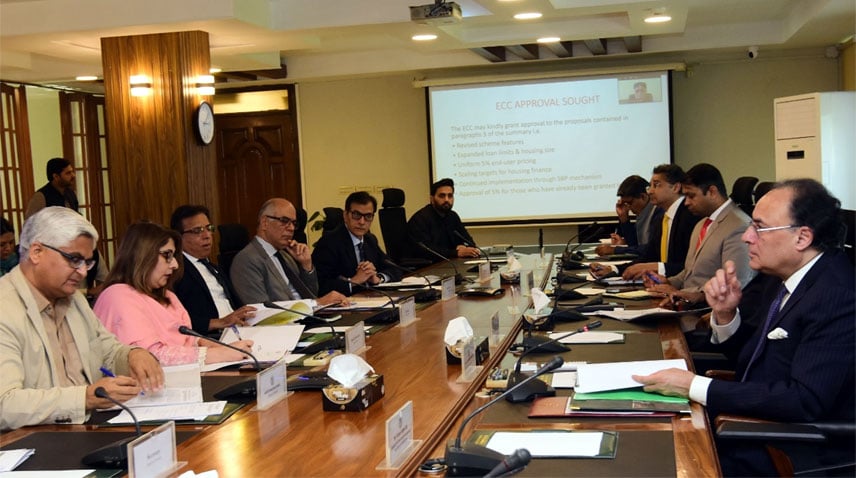
The Economic Coordination Committee (ECC) of the federal cabinet met at the Finance Division with Finance Minister Senator Muhammad Aurangzeb in the chair.
The committee considered a proposal from the Ministry of Housing and Works to revise features of the “Mera Ghar Mera Aashiana (MGMA)” mortgage financing scheme.
Launched to expand access to affordable homeownership, the programme has received more than 10,594 loan applications so far, with disbursements already underway.
After deliberations, the ECC approved a series of changes designed to broaden the scheme’s reach.
The maximum loan size has been enhanced to Rs 10 million (approximately $35,000 at current exchange rates), housing size eligibility parameters have been expanded, and a uniform 5 per cent end-user pricing has been introduced.
Importantly, loans already disbursed will be adjusted to the revised 5 per cent rate to ensure uniformity across beneficiaries.
Officials said implementation will continue through the State Bank of Pakistan’s existing mechanism, with scaling targets set over a four-year horizon.
Subsidy payments will be aligned strictly with actual loan disbursements and accommodated within annual fiscal allocations, reflecting the government’s attempt to balance social support with budget discipline.
For international readers, subsidised housing finance schemes are commonly used by emerging economies to address urban housing shortages and stimulate construction-led growth.
Pakistan’s construction sector is a major employer and has strong linkages with industries such as cement, steel, and transport. By lowering borrowing costs and expanding loan ceilings, authorities aim to encourage private home ownership, generate jobs, and support related economic activity.
Beyond housing, the ECC also approved a Technical Supplementary Grant of Rs 7.289 million (around $26,000) for the Islamabad Capital Territory component of the “National Program for Enhancing Command Areas in Barani Areas of Pakistan.”
The initiative seeks to improve agricultural productivity in rain-fed regions, where water scarcity and erratic rainfall constrain output.
In addition, the committee approved a Technical Supplementary Grant amounting to Rs 6.61 billion (roughly $23 million) for the Thar Coal Rail Connectivity Project.
The funding will serve as budgetary cover to facilitate the transportation of domestically mined coal from the Thar region to power plants and industrial users.
Authorities say the project is part of a broader effort to strengthen energy security and reduce reliance on imported fuels, which have weighed heavily on Pakistan’s foreign exchange reserves in recent years.
Taken together, the approvals reflect the government’s dual focus on social protection and infrastructure-led growth.
The move is essential at a time when Pakistan is navigating tight fiscal space, high external financing needs, and ongoing commitments under international financial arrangements, including the IMF programme.
The measures illustrate how authorities are attempting to balance development spending with macroeconomic stabilisation efforts during a fragile recovery phase.