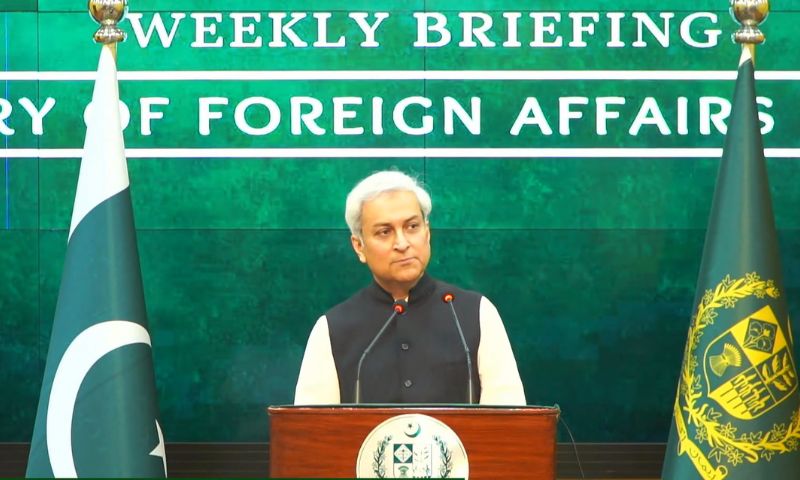



ISLAMABAD: Foreign Office Spokesperson Tahir Andrabi has said that Pakistan is playing the role of a bridge to help de-escalate the ongoing tensions in the Middle East and promote regional stability.
Addressing the weekly news briefing in Islamabad on Thursday, the spokesperson said Pakistan’s principled stance on sovereignty, international law, and the principles of the United Nations Charter, as well as its consistent advocacy for dialogue and diplomacy, is widely respected across regional capitals.
He noted that this credibility enables Pakistan to serve as an effective channel of communication between relevant stakeholders during periods of heightened tensions.
The spokesperson highlighted that throughout the current wave of conflict, Pakistan has consistently urged interlocutors—particularly key regional actors—to adhere to three fundamental principles: respect for sovereignty and territorial integrity, restraint from the use of force within each other’s territories, and strict adherence to international law and the principles enshrined in the UN Charter.
He emphasised that constructive engagement, confidence-building measures, and the resumption of dialogue are essential for achieving a peaceful and negotiated resolution to the crisis.
🔴LIVE: Spokesperson’s Weekly Press Briefing 12-03-2026 at Ministry of Foreign Affairs, Islamabad https://t.co/Nxyl1w80vD
— Ministry of Foreign Affairs – Pakistan (@ForeignOfficePk) March 12, 2026
PM Shehbaz Sharif visit to Saudi Arabia
He said Prime Minister Shehbaz Sharif has departed for a short official visit to Saudi Arabia at the invitation of Crown Prince and Prime Minister Mohammed bin Salman.
During the visit, the prime minister is expected to meet the Saudi crown prince to discuss the current regional situation, rising tensions in the Middle East and bilateral relations between Pakistan and Saudi Arabia.
He added the talks will focus on regional security developments and cooperation between the two countries on issues of mutual interest.
Pakistan–Afghanistan border situation
Referring to the situation along the Pakistan–Afghanistan border, Andrabi reiterated that Pakistan conducted targeted and carefully calibrated operations while exercising due diligence to ensure that civilians were not harmed.
He stressed that Pakistan holds no hostility toward Afghan citizens, describing them as “our brothers and sisters,” and reaffirmed Islamabad’s commitment to humanitarian considerations and responsible conduct in border management.
The spokesperson said Pakistan has clearly communicated to the Afghan side and other international interlocutors that it requires verifiable assurances that Afghan territory will not be used by terrorist groups to carry out attacks against Pakistan.
Pakistan to pursue policy to safeguard its national security
He added that until such guarantees are provided and effective counterterrorism cooperation is ensured, Pakistan will continue to pursue its current policy to safeguard its national security and territorial integrity.
Canada, India uranium supply agreement
Expressing concern over the long-term uranium supply agreement between Canada and India, Andrabi said the arrangement represents yet another country-specific exception in the field of nuclear cooperation.
He emphasised that civilian nuclear collaboration should be governed by a non-discriminatory, criteria-based approach applicable equally to all states that are not parties to the Treaty on the Non‑Proliferation of Nuclear Weapons.
He warned that selective exceptions undermine the credibility of the global non-proliferation regime and could further destabilise regional and international peace and security.
The spokesperson urged the international community to uphold fairness, transparency, and strategic stability in nuclear governance while promoting responsible nuclear stewardship and adherence to international norms.