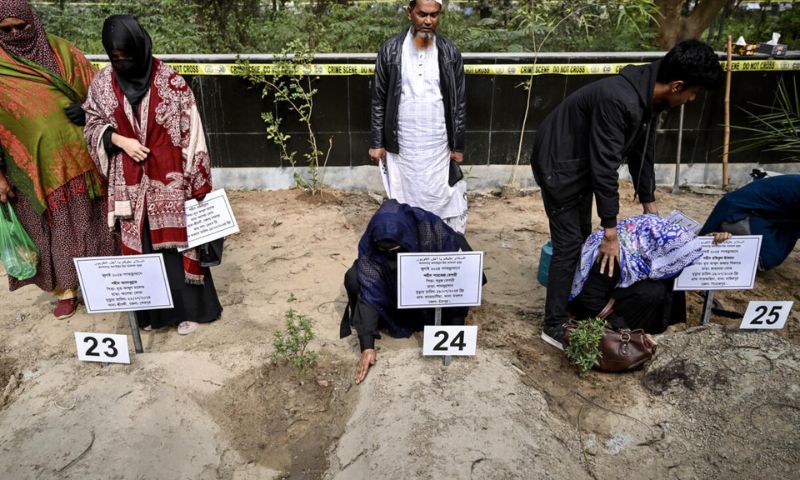



DHAKA, Bangladesh: A Bangladesh commission investigating disappearances during the rule of ousted prime minister Sheikh Hasina said Monday at least 287 abducted people were assumed to have been killed.
The commission said some corpses were believed to have been dumped in rivers, including the Buriganga in the capital, Dhaka, or buried in mass graves.
The government-appointed commission, formed after Hasina was toppled by a mass uprising in August 2024, said it had investigated 1,569 cases of abductions, with 287 of the victims presumed dead.
“We have identified a number of unmarked graves in several places where the bodies were presumably buried,” Nur Khan Liton, a commission member, told AFP.
“The commission has recommended that Bangladesh seek cooperation from forensic experts to identify the bodies and collect and preserve DNA samples from family members.”
The Commission of Inquiry on Enforced Disappearances revealed that enforced disappearance cases connected to Hasina could number a staggering 4,000 to 6,000 people.
The commission said a total of 1,913 complaints were filed with it over disappearances, of which 1,569 were considered to have disappeared by “definition after verification selection”.
In its final report, submitted to the government on Sunday, the commission said that security forces had acted under the command of Hasina and her top officials.
The report said many of those abducted had belonged to the country’s largest political party, Jamaat-e-Islami, or the Bangladesh Nationalist Party (BNP), both in opposition to Hasina.
In a separate investigation, police in December began exhuming a mass grave in Dhaka.
The grave included at least eight victims of the uprising against Hasina’s authoritarian rule, bodies all found with bullet wounds, according to Criminal Investigation Department (CID) chief Md Sibgat Ullah.
The United Nations says up to 1,400 people were killed in crackdowns as Hasina attempted to cling to power.
She was sentenced to death in absentia in November for crimes against humanity.
“We are grateful for finally being able to know where our brother is buried,” said Mohamed Nabil, whose 28-year-old sibling Sohel Rana was identified as one of the dead in the grave in Dhaka.
“But we demand a swift trial for the police officials who shot at the people during the uprising.”
In November, Hasina was sentenced to death in absentia, months after fleeing to India, over the brutal crackdown by security forces during the 2024 student-led protests.
According to the inquiry commission, there was a “primarily political motive” behind the forced disappearances.
According to the commission report, evidence towards the disappearances pointed towards Hasina, her defence adviser Tarique Ahmed Siddique, and former Home Minister Asaduzzaman Khan Kamal.
Yunus, the interim government head, thanked the members of the inquiry for their ongoing work investigating forced disappearances, calling it “historic”.
“This report is a documentation of how people can be treated with democracy by shaking all the institutions in Bangladesh with double standards,” he said.
“Those who made this horrible incident are people like us. They are living normal lives in society by causing the most brutal events. We as a nation must come out of this atrocity forever. We need to find the cure to let this atrocity never return,” he added.