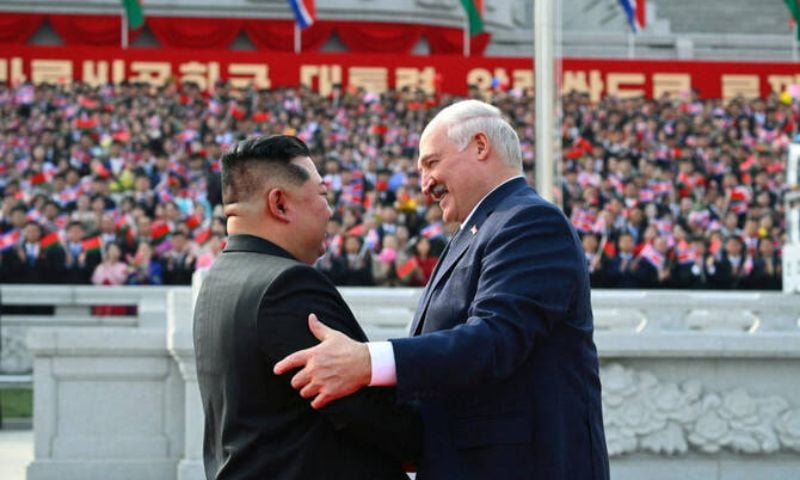



SEOUL: North Korea and Belarus formalized their growing alignment by signing a “friendship and cooperation” treaty during Belarusian President Alexander Lukashenko’s first official visit to Pyongyang on Thursday.
The agreement marks a significant step in strengthening ties between two heavily sanctioned nations that share opposition to Western influence and support for Russia’s ongoing war in Ukraine.
North Korean leader Kim Jong Un hosted Lukashenko with a grand ceremony at Kim Il Sung Square, featuring military parades, artillery salutes, and large crowds waving national flags.
The visit, spanning two days, underscores a broader geopolitical shift as both countries seek closer coordination amid what they describe as an evolving global order, according to AFP.
During the talks, Lukashenko emphasized the need for sovereign nations to unite against what he called violations of international norms by major powers.
Kim, in turn, expressed solidarity with Belarus against Western pressure, endorsing Minsk’s efforts to maintain political stability and economic growth under sanctions.
The visit also carried symbolic weight. Lukashenko paid tribute at the Kumsusan Palace of the Sun, honoring North Korea’s founding leaders, and laid a bouquet on behalf of Russian President Vladimir Putin—highlighting the triangular alignment among Minsk, Pyongyang, and Moscow.
Both Belarus and North Korea have played roles in supporting Russia’s war in Ukraine. Belarus has served as a strategic staging ground for Russian forces, while intelligence reports suggest North Korea has supplied troops, weapons, and ammunition to Moscow.
Analysts estimate that thousands of North Korean soldiers have been deployed, with significant casualties reported. The newly signed treaty is expected to expand cooperation beyond politics and security into economic sectors.
Belarus has expressed interest in exporting pharmaceuticals and food products to North Korea, while Pyongyang could supply cosmetics and other consumer goods known for affordability in certain markets.
Officials also signaled potential collaboration in agriculture, technology, and information exchange. Experts view the agreement as part of a broader effort by Russia and China to promote a “multipolar world” that challenges Western dominance.
The treaty not only strengthens bilateral ties but also reinforces a growing bloc of nations seeking to counterbalance Western influence on the global stage.
Observers note that Kim Jong Un may also be leveraging the visit to elevate North Korea’s diplomatic standing and diversify its partnerships, reducing reliance on China while deepening ties with Russia and its allies.
The development comes amid renewed global attention on shifting alliances, with speculation also mounting over potential future engagements involving the United States, particularly as diplomatic dynamics continue to evolve.