
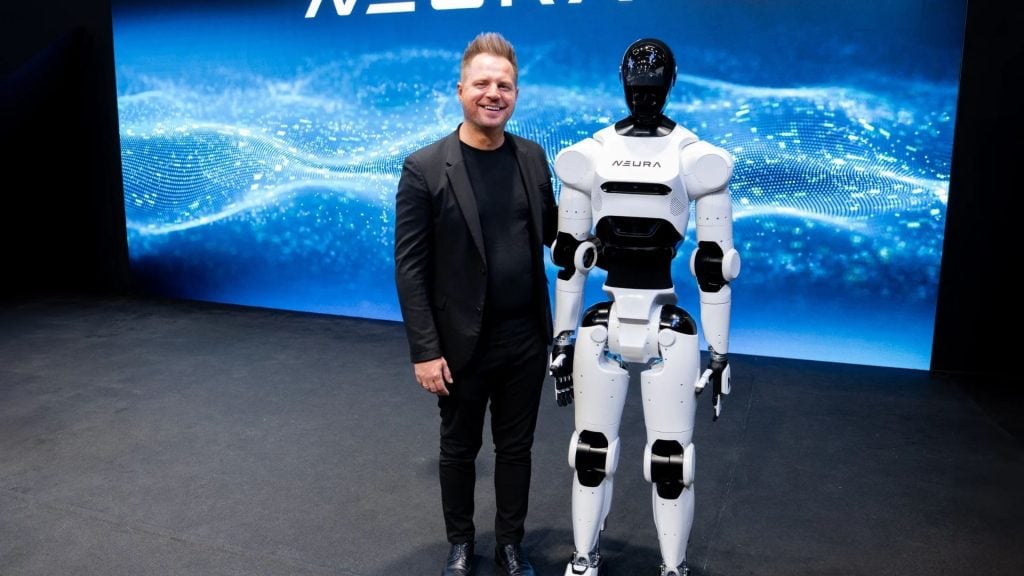



PARIS: German robotics firm Neura said Wednesday it had struck a deal with manufacturing giant Bosch to gather data on factory work and build towards mass production and industrial deployment of its bots.
The tie-up links a heavyweight of Germany’s stuttering auto and industrial sector with a company touted as Europe’s challenger to robotics trailblazers such as China’s Unitree or America’s Boston Dynamics.
“We need real-time data, data is what’s missing at the moment in the world of physical AI” for robots, Neura chief executive David Reger told AFP.
Bosch “has taken a very strong interest in self-driving cars… they’ve built big teams with a lot of expertise that’s relevant for us”, he added.
Many recent humanoid robots are powered by generative AI models resembling those behind chatbots such as OpenAI’s ChatGPT or Google’s Gemini.
But unlike software for generating text, images or video, which can be “trained” on vast archives of data gathered online, sparse data on physical movement in 3D spaces has proved a bottleneck for robotics development.
In recent years, many robotics firms have hired people to repeatedly carry out common movements, such as domestic chores or factory tasks, while wearing sensors that record data on their actions.
For its part, Neura last year opened the first of a planned string of “gyms” for clients to train robots with new capabilities using the company’s hardware and “Neuraverse” software environment.
Reger said that under the Bosch partnership, several thousand workers in some of Bosch’s 350 facilities worldwide will wear sensor suits to glean training data for Neura robots.
Bosch will also work with Neura on its software and on industrialising production of humanoid robots.
Several thousand of Neura’s 4NE1 androids are set for production this year, and the two companies have “set very big goals to reach together by 2032,” Reger said, aiming to work together “not only data but also components, robot deployment and robot assembly”.
With around 200 million euros ($233 million) of investment so far, Reger said that Neura’s order book has grown to around 500 million for humanoid robots alone.
The company has roughly a further billion euros in orders for other form factors, including robot arms, warehouse robots and a home-help unit designed for basic chores.