Key Points
- Afghanistan flood disaster leaves 20 dead
- Kashmir toll rises as rescuers search debris
- Pakistan rivers remain under close watch
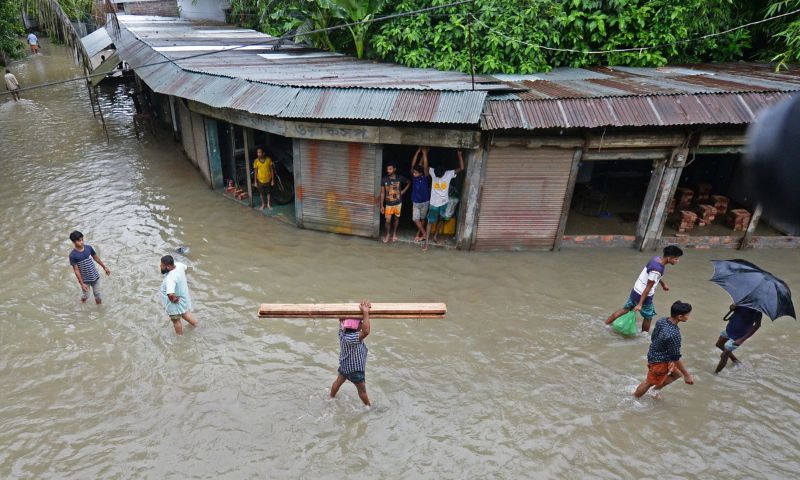
ISLAMABAD: At least 48 people have been killed in the latest spell of monsoon rains across Pakistan, India and Afghanistan, with flash floods, landslides and collapsing homes causing widespread destruction and prompting fresh warnings of more severe weather across the region.
Afghanistan has suffered the heaviest toll from the current weather system. Flash floods in the eastern province of Nuristan killed at least 20 people, injured around 80 and left more than 100 missing after torrents of water swept through Parun city and surrounding districts.
Authorities said homes, farmland, roads and public infrastructure were extensively damaged as rescue teams searched for survivors, according to AP News.
In India, the death toll from flash floods and landslides in Indian Illegally Occupied Jammu and Kashmir has climbed to 28.
Torrential rainfall triggered flooding and mudslides across the mountainous Poonch, Rajouri and Doda districts, destroying homes and infrastructure.
Rescue workers continued to dig through debris on Tuesday as authorities warned of further rain and maintained travel restrictions in several affected areas.
The severe weather has also disrupted major religious pilgrimages. Authorities temporarily suspended the annual Amarnath Yatra after heavy rainfall heightened the risk of landslides and flash floods along mountain routes used by thousands of pilgrims.
Pakistan has also been battered by successive monsoon systems, particularly in Khyber Pakhtunkhwa, Punjab, Azad Jammu and Kashmir and Gilgit-Baltistan.
ALSO READ: Death Toll Rises to 17 as Monsoon Fury Paralyses Mumbai, Triggers Landslides Across India
Recent downpours have triggered flash floods in streams and hill torrents, damaged roads and bridges, and inundated low-lying settlements.
While the latest spell has caused casualties in several districts, officials are increasingly focused on the threat posed by rising river flows as rainfall intensifies across upper catchment areas, according to the National Disaster Management Authority (NDMA).
The National Disaster Management Authority and the Pakistan Meteorological Department’s Flood Forecasting Division have issued a series of alerts warning of increased flood risks in parts of the country.
Particular attention is focused on the Indus River system, including the Jhelum, Chenab and Kabul rivers, which receive runoff from the Himalayan and Hindu Kush mountain ranges.
Hydrologists are closely monitoring the Jhelum and Chenab rivers, where heavy rainfall over upstream catchments in Kashmir could lead to a rapid rise in water levels.
Officials have warned that intensifying Monsoon and continued precipitation may generate low-to-moderate flooding of vulnerable locations, particularly in Punjab and Azad Jammu and Kashmir.
The Kabul River basin is also being watched because heavy rainfall in eastern Afghanistan can quickly translate into higher downstream flows in northwestern Pakistan.
Monsoon threatens mountainous regions
The latest weather emergency highlights the vulnerability of South Asia’s mountainous regions to extreme rainfall.
Steep terrain, deforestation, unplanned construction and growing climate pressures have increased the frequency and intensity of flash floods and landslides across the region.
Meteorological agencies in all three countries have forecast additional rainfall during the coming days.
India’s weather office has warned of extremely heavy rain in several Himalayan states, raising the risk of further floods and landslides. Meanwhile, Afghan authorities have issued alerts for additional provinces following the Nuristan Disaster.
In Pakistan, disaster management authorities have urged residents living near rivers, streams and hill torrents to remain vigilant and follow evacuation instructions where necessary.
The country is particularly sensitive to monsoon flooding after successive years of destructive rainfall events, including the catastrophic floods of 2022 that submerged large parts of the country.
With the monsoon season expected to continue for several more weeks, emergency responders across South Asia remain on high alert as communities brace for further flooding, landslides and loss of life.