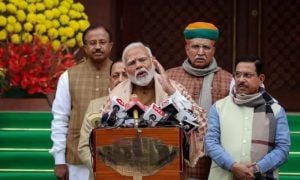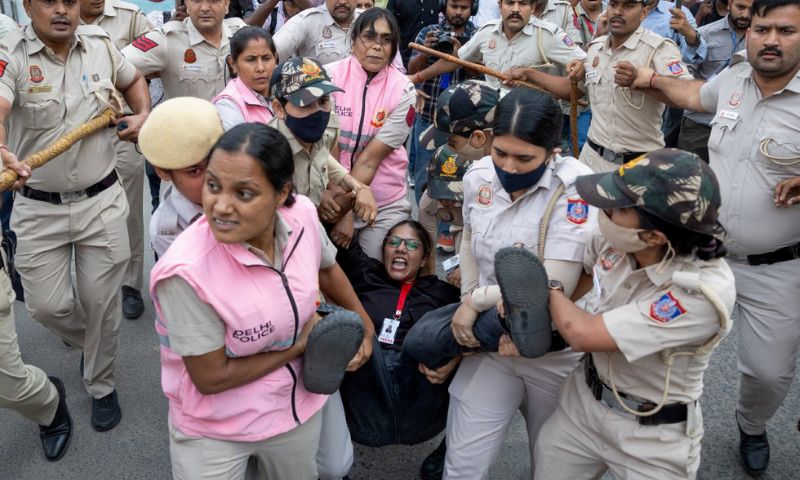
NEW DELHI: Indian Prime Minister Narendra Modi’s handling of protests against election manipulation has intensified questions about democratic practices in India, as opposition parties and youth-led groups accuse authorities of suppressing dissent.
The protests centre on India’s Special Intensive Revision (SIR) of electoral rolls, an exercise which excluded millions of eligible voters. Opposition parties are demanding the resignation of the Chief Election Commissioner and a reversal of the process, alleging that it has disproportionately affected vulnerable communities and could benefit Modi’s ruling Bharatiya Janata Party (BJP).
Modi has criticised the opposition’s protests, accusing the Congress party of creating chaos. Opposition leaders say the government’s response, including police action against demonstrators, raises concerns about its willingness to accommodate dissent.
Youth-Led Protests Face Crackdown
The protests have brought together opposition politicians, lawyers, journalists and young people frustrated by unemployment and a lack of accountability.
Abhijeet Dipke, 31, founder of the Cockroach Janta Party (CJP), told The Observer that the movement retained public support despite a crackdown on demonstrators.
“The last few days have been really difficult for us,” Dipke said. “But we still have the crowds, we still have the support of the people.”
The CJP emerged after an Indian judge referred to unemployed young people as “cockroaches”. The group has since become a prominent voice in youth-led protests against the government.
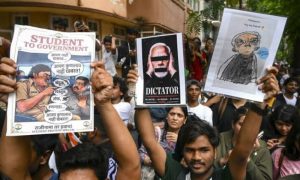
Dipke said the movement remained determined to continue challenging Modi’s government. He has been arrested twice and remains under surveillance.
Two of his associates, Saurav Das and Ashutosh Ranka, were jailed for a week. Dipke said they had emerged from detention undeterred.
“That is the spirit of India’s Gen Z, too,” he said. “We are not afraid of questioning the government.”
Protests over examination-paper leaks had earlier forced the resignation of India’s education minister in July. The CJP has since returned to the streets to oppose the electoral revision.
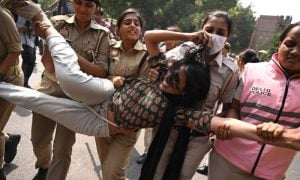
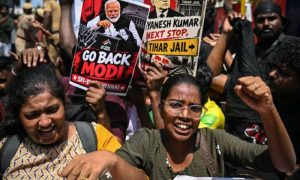
During demonstrations in New Delhi, police beat protesters and arrested journalists, some of whom were dragged away by their hair.
Authorities also deployed a large security presence around the capital ahead of a planned demonstration at Jantar Mantar, a traditional protest site.
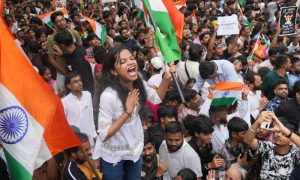
According to the account in The Observer, more than 20,000 police and paramilitary personnel were deployed on October 13, the city centre was barricaded and internet access was suspended. More than 7,000 people, including opposition leaders, lawyers and journalists, were detained by evening.
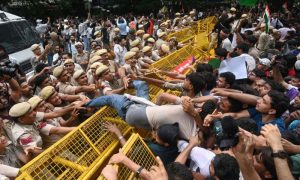
Despite the restrictions, thousands turned out to protest.
The demonstrators demanded the chief election commissioner’s resignation and the reversal of the SIR process.
Dispute over 130 Million Voters
The controversy began in the summer of 2025, when the Election Commission announced electoral-roll revisions ahead of state elections. Under the process, voters were required to establish their eligibility by submitting documents from an approved list.
Critics questioned the commission’s authority to require people already registered to vote to prove their eligibility again on such a large scale. They also argued that the documentation requirements could exclude people who lacked access to official records or faced difficulties navigating government procedures.
The SIR has removed about 130 million people from voter rolls. The scale of the exclusions raises serious concerns about the right to vote.
The issue has been particularly contentious in West Bengal, where the BJP had not previously won a state election. Around nine million people — approximately 12 percent of the electorate — were excluded from the rolls there.
The exclusions have fuelled allegations that the process disproportionately affects vulnerable groups and religious minorities, particularly Muslims. Critics have also questioned the use of algorithms to flag what the Election Commission calls “logical discrepancies”, including age gaps between parents and children.
In Delhi, the omission of prominent individuals from voter lists prompted public criticism. The Election Commission subsequently introduced a “VIP portal” through which their names could be restored, raising concerns about unequal access to electoral remedies.
Political Rhetoric Fuels Concerns
The electoral dispute has added to wider criticism of Modi’s approach to opposition politics.
The prime minister has previously campaigned for a “Congress-mukt Bharat”, or a Congress-free India. His recent description of the Congress as a “parasite” has drawn criticism from opponents who say such language undermines political pluralism.
The Congress and other opposition parties have called for accountability over the electoral revision, arguing that the right to vote is fundamental to democracy.
They have also criticised the government’s response to protests, saying it has relied on confrontation rather than dialogue.
The BJP, which rose from a relatively small political force to become India’s dominant national party, has won successive general elections under Modi’s leadership. Its critics say that electoral success does not remove the government’s responsibility to protect democratic institutions and the rights of citizens who oppose it.
The wider dispute comes amid public frustration over unemployment, economic insecurity and access to basic necessities. Protesters have invoked the demands for “roti, kapda, makan, aur rozgari” — food, clothing, shelter and employment — to express concerns that extend beyond electoral procedures.