


JERUSALEM: Indian Prime Minister Narendra Modi told Israeli lawmakers that India stands “firmly” with Israel following the October 7, 2023, Hamas attack, a statement that has triggered criticism due to the mounting civilian death toll in Gaza during Israel’s ongoing military campaign.
Addressing the Knesset, Modi expressed condolences for Israeli victims and pledged unwavering solidarity.
“We feel your pain, we share your grief. India stands with Israel firmly, with full conviction in this moment and beyond.”
However, Modi did not explicitly mention the tens of thousands of Palestinian civilians killed in Gaza, where entire neighborhoods have been flattened, and humanitarian conditions have sharply deteriorated.
He stated only that India supports efforts toward “durable peace and regional stability,” a phrase critics say falls short of acknowledging the scale of suffering in the enclave.
Strategic Embrace With Netanyahu
Welcome back to Israel, Prime Minister @narendramodi!
A historic visit underway.
🇮🇱🤝🇮🇳 pic.twitter.com/Q7F8VtN12G— Prime Minister of Israel (@IsraeliPM) February 25, 2026
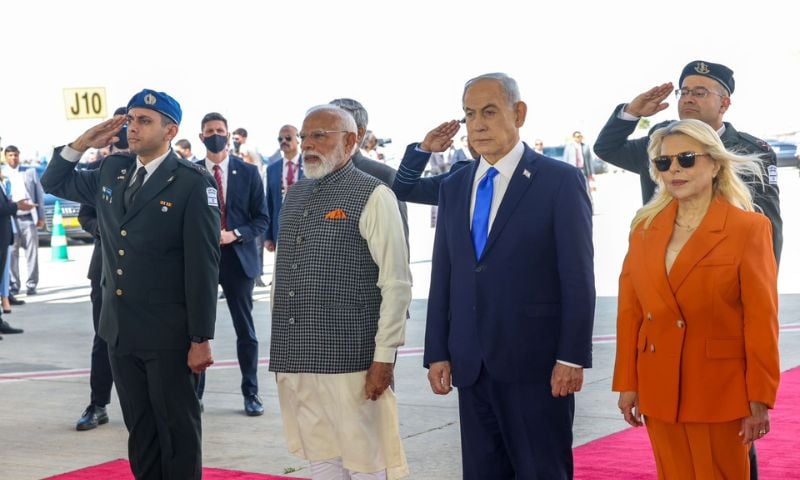
During the visit, Modi met Israeli Prime Minister Benjamin Netanyahu, who welcomed him at Ben Gurion Airport with a red-carpet reception and a public display of warmth.
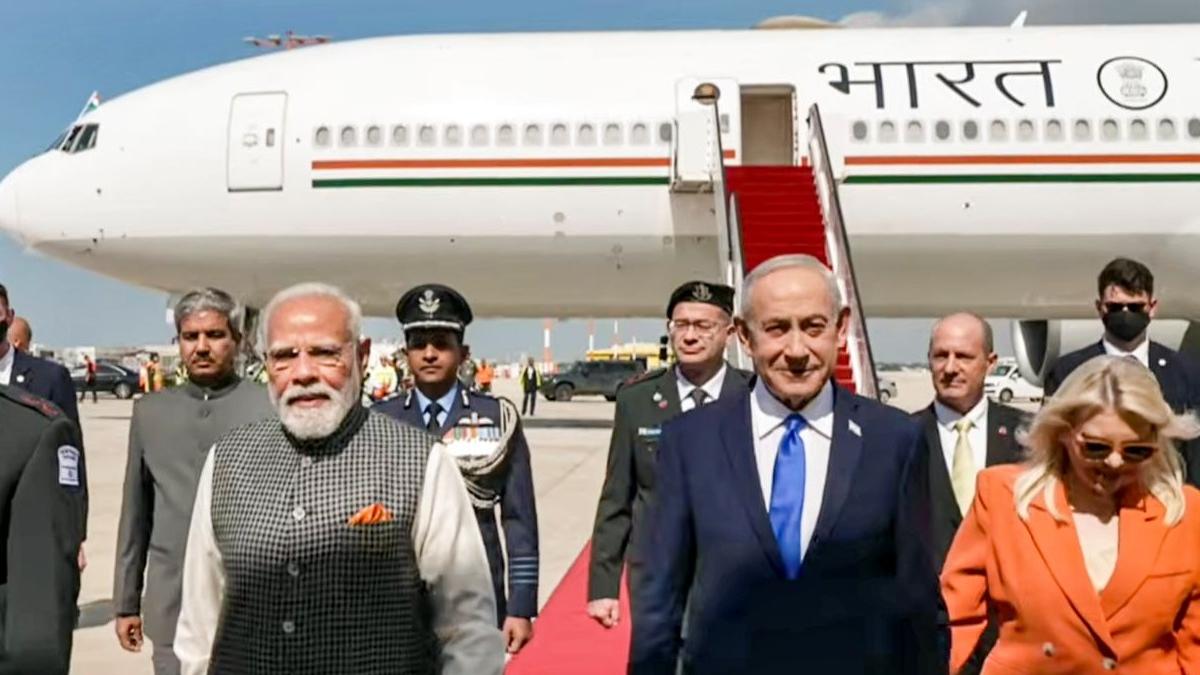
Netanyahu’s office described the meeting as reflecting “a real friendship,” underscoring cooperation in defence, cybersecurity, and emerging technologies. Modi later called the talks “excellent,” saying they covered regional developments and ways to deepen bilateral ties.
The Indian leader is also scheduled to meet Israeli President Isaac Herzog.
While officials framed the visit as forward-looking, critics argue that the optics of close engagement with Netanyahu — whose government faces international scrutiny over its conduct in Gaza — risk undermining India’s longstanding support for Palestinian statehood.
Gaza War Overshadows Economic Agenda
Modi highlighted cooperation in quantum computing, semiconductors, and artificial intelligence, calling Israel’s technological leadership a “natural foundation” for partnership with India’s expanding economy.
Had an excellent meeting with Prime Minister Netanyahu. Expressed gratitude to him for the warm welcome earlier in the day. It is a delight to be back in Israel after 9 years. We discussed a wide range of subjects aimed at boosting bilateral ties. Sectors such as technology,… pic.twitter.com/uh1cyL411c
— Narendra Modi (@narendramodi) February 25, 2026
Bilateral trade reached $3.62 billion in 2024–25, and negotiations toward a free trade agreement are underway. Indian conglomerate Adani Group operates Israel’s Haifa port, symbolizing deepening economic ties.
Yet the Gaza war has overshadowed these economic ambitions. International aid agencies warn of catastrophic humanitarian conditions, with widespread displacement, food insecurity, and damage to hospitals and infrastructure.
Backlash in India Over Civilian Casualties
Opposition leaders in India sharply criticized Modi’s stance. Congress figure Priyanka Gandhi urged him to acknowledge the deaths of innocent civilians in Gaza, while Congress lawmaker Jairam Ramesh accused him of “moral cowardice” for embracing Netanyahu despite global condemnation of Israel’s military actions.
I hope that the Hon Prime Minister @narendramodi ji mentions the genocide of thousands of innocent men, women and children in Gaza while addressing the Knesset on his upcoming trip to Israel and demands justice for them. India has stood for what is right throughout our history as…
— Priyanka Gandhi Vadra (@priyankagandhi) February 25, 2026
The criticism reflects broader unease in India, home to more than 200 million Muslims, where public opinion remains divided over the government’s increasingly close alignment with Israel.
Balancing Strategy and Moral Pressure
India established full diplomatic relations with Israel in 1992 and has significantly expanded cooperation since Modi took office in 2014. At the same time, New Delhi has historically supported a two-state solution and maintained ties with the Palestinian leadership.
Analysts say Modi’s visit highlights India’s attempt to balance strategic interests — defence cooperation, technology, and trade — with mounting international pressure over civilian casualties and humanitarian suffering in Gaza.
As the war continues, India faces growing scrutiny over whether its strategic partnership with Israel can coexist with its stated commitment to peace, international law, and the protection of civilians.