
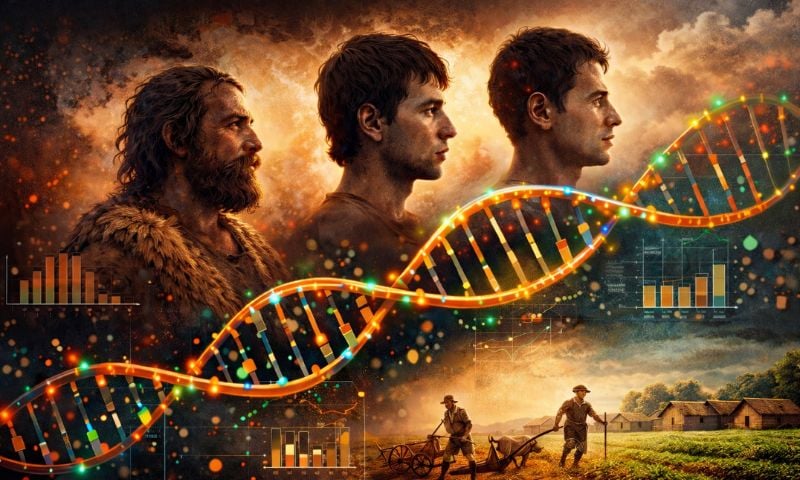
SAN FRANCISCO, USA: For decades, the story of human origins has been told as a simple family tree, with modern humans descending from a single ancestral population in Africa. But a groundbreaking new genetic study has turned that narrative on its head.
The research, published in Nature and highlighted by ScienceDaily, concludes that modern humans did not originate from one ancestral group but rather from a network of interbreeding populations spread across Africa.
Instead of a single point of origin, early Homo sapiens populations were scattered across the continent and remained genetically connected over long periods, splitting, migrating, and reconnecting in a complex web of genetic exchange.
DNA research just ‘rewrote the origin of human species’ https://t.co/N1wt4Q8xtR
— Chris Stringer (@ChrisStringer65) April 26, 2026
From family tree to complex web
Scientists now propose a model that resembles a braided river more than a tree. Early human populations split apart, later came back together, and constantly shared genetic material. This interconnected process, rather than isolation, drove the evolution of modern humans.
The study combined genomic data from present-day African populations with fossil evidence. A key component was the analysis of 44 newly sequenced genomes from the Nama people of southern Africa, a group known for its extraordinary genetic diversity.
Researchers weigh in
Brenna Henn, a professor of anthropology at University of California (Davis) and the study’s corresponding author, explained that the uncertainty stems from missing evidence in both the fossil record and ancient DNA.
Lead author Brenna Henn explored that limited fossil records and ancient DNA samples have long made it difficult to fully understand early human history. However, she said these new findings significantly reshape the narrative, moving away from simple linear models toward a more nuanced, interconnected view.
Co-author Tim Weaver added that the results highlight the need to rethink traditional models of human evolution, emphasising interconnected populations rather than isolated lineages.
New understanding of African origins
While scientists have long agreed that modern humans originated in Africa, this study underscores that the process was far more complex than previously thought. It involved continuous interaction among diverse groups across the continent, not a single point of origin or a simple evolutionary ladder.
The study represents a major shift in understanding where we come from, suggesting that human evolution was less like a tree and more like a network.