


Key Points
- Middle East conflict and Pakistan airspace ban disrupt Indian airline routes.
- Air India and IndiGo cancel 64% of scheduled international flights in 10 days.
- Rerouted flights through Africa increase travel time and fuel costs.
- Air India extends some journeys to nearly 22 hours due to stopovers.
- Aviation experts warn geopolitical tensions will hurt airline profitability.
NEW DELHI: Escalating conflict in the Middle East has created fresh operational challenges for Indian airlines, compounding difficulties they have already faced since Pakistan barred Indian carriers from using its airspace last year.
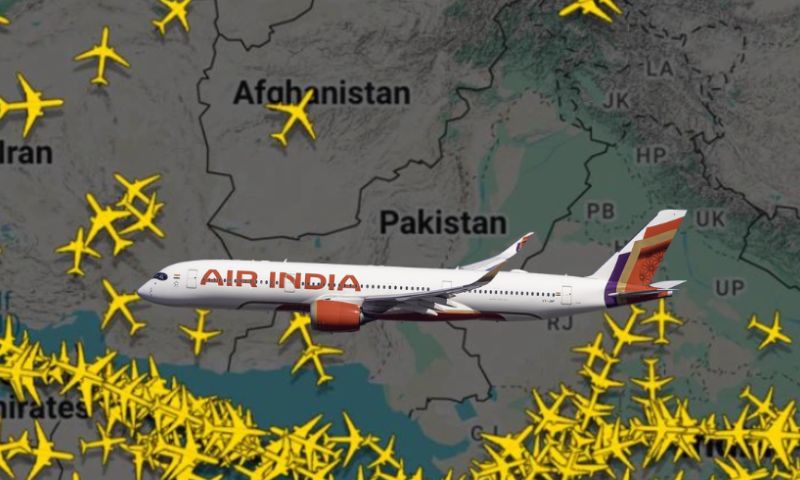
The latest restrictions across several Middle Eastern airspaces have disrupted key international routes used by Indian airlines to connect with Europe and North America. With Pakistan’s airspace still closed to Indian operators, carriers have limited alternatives and are increasingly forced to cancel or reroute flights.
Data from aviation analytics firm Cirium shows that Air India and IndiGo — India’s largest international carriers — did not operate about 64 per cent of their 1,230 scheduled flights to the Middle East, Europe and North America during the past 10 days.
Industry experts say the situation has delivered a significant setback for the country’s aviation sector. According to Reuters, aviation analyst Amit Mittal described the crisis as a “double blow” for Indian airlines that rely heavily on these long-haul routes.
Pakistan closed its airspace to Indian carriers in April last year following heightened military tensions between the two countries. Since then, Indian airlines have had to take longer and costlier routes for international travel.
Financial analysts also warn the geopolitical instability could weigh heavily on airline profitability.
HSBC recently said the ongoing tensions in the Middle East could create a “significant burden” for Indian carriers, estimating that just one week of flight cancellations to affected destinations could reduce projected annual pre-tax profits by around 1.2 per cent.
IndiGo, India’s largest airline by market share, is facing particularly complex operational hurdles. The carrier depends on six long-range Boeing aircraft leased from Norse Atlantic Airways for its European routes.
Because these aircraft remain registered in Norway, they must comply with guidance issued by the European Union Aviation Safety Agency (EASA), which advises airlines to avoid airspace over Iran, Iraq, Israel, Kuwait, Lebanon, Qatar, the United Arab Emirates and Saudi Arabia.
As a result, IndiGo has been forced to reroute some flights through African corridors, increasing travel times by up to two hours in certain cases, according to flight tracking service Flightradar24.
Even these alternative routes have proven challenging. A Delhi-to-Manchester IndiGo flight was forced to return to Delhi after being airborne for nearly 13 hours when Eritrean air traffic authorities refused permission for the aircraft to pass through its airspace.
The confusion reportedly stemmed from the aircraft’s Norwegian registration despite being operated by IndiGo.
IndiGo later said the flight returned because of last-minute airspace restrictions. In a similar incident, another IndiGo aircraft traveling from London to Mumbai had to divert to Cairo after encountering airspace issues with Eritrea.
The disruptions come at a difficult moment for the airline. IndiGo’s chief executive Pieter Elbers stepped down earlier this week following an operational crisis that drew criticism from passengers and scrutiny from authorities in December.
Air India is also struggling to manage the fallout from the regional conflict. The airline announced plans to operate 78 additional flights between India, Europe and the United States in the coming week to accommodate increased demand during the crisis.
However, longer and more complex routes are extending travel times significantly.
A recent Air India flight from Delhi to New York had to stop in Rome, stretching the journey to almost 22 hours. Before the current airspace restrictions, the same route could be completed in about 17 hours by flying over Iraq and Turkey without any stopovers.
Meanwhile, competing international airlines such as Lufthansa and American Airlines continue to operate shorter routes over Pakistan’s airspace, giving them a competitive advantage.
Air India has previously estimated that the Pakistan airspace ban alone could cost the airline around $600 million annually.
The carrier, now owned by the Tata Group and Singapore Airlines after being privatised in 2022, has been struggling financially and reported losses of about $433 million last year.
The prolonged flight durations are also increasing fuel consumption, further raising operational costs at a time when global oil prices are already climbing following the outbreak of war involving Iran.