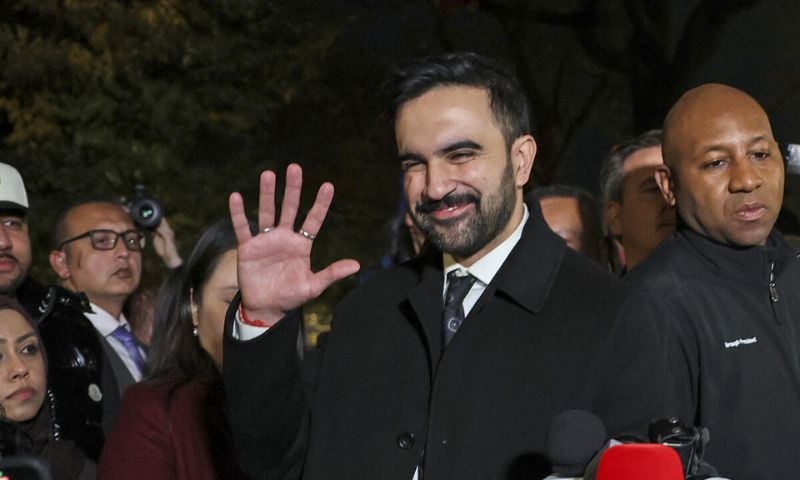



ISLAMABAD: New York City’s first Muslim mayor, Zohran Mamdani, has become an unexpected focal point in an international human rights debate after a brief, handwritten letter he wrote to jailed Indian activist Umar Khalid was made public.
Khalid has spent nearly five years in prison without trial since his arrest under India’s sweeping anti-terror law, the Unlawful Activities (Prevention) Act (UAPA) — legislation widely criticised by rights groups for enabling prolonged detention and being disproportionately used against Muslims and government critics under the Hindu right-wing government of Prime Minister Narendra Modi.
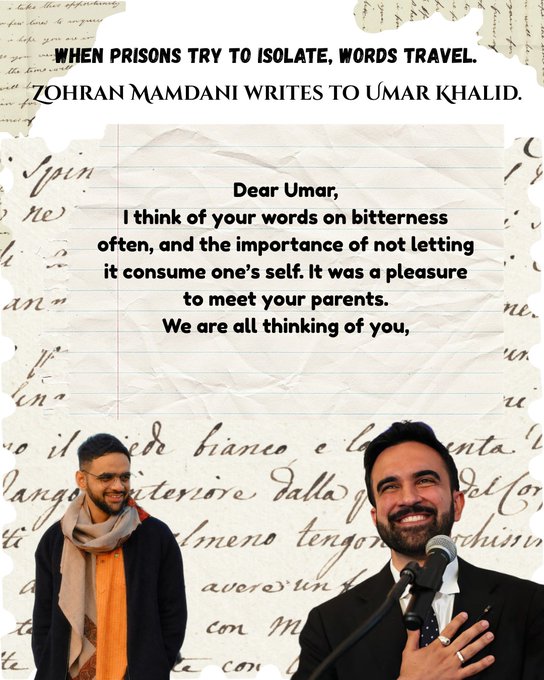
Shortly after Mamdani was sworn in, Khalid’s partner shared the undated note publicly on X.
“Dear Umar, I think of your words on bitterness often, and the importance of not letting it consume oneself. It was a pleasure to meet your parents. We are all thinking of you.”
The letter surfaced after Mamdani met Khalid’s family during their visit to the United States in early December, ensuring the message resonated well beyond a private exchange.
BJP backlash and questions of ‘interference.’
The letter prompted a sharp reaction in New Delhi. India’s ruling Bharatiya Janata Party (BJP) accused Mamdani of “interfering” in the country’s internal affairs and warned that such gestures would not be tolerated.
BJP national spokesperson Gaurav Bhatia questioned Mamdani’s standing to comment on India’s judiciary, asserting that “140 crore Indians will stand united” under Modi’s leadership if the country’s sovereignty is challenged. He added that Indians had “complete faith” in the judicial system.
The BJP reaction, however, remained silent on a report by The Hindu revealing that eight US lawmakers had formally written to India’s ambassador in Washington urging that Khalid be granted bail and a fair, timely trial in line with international law.
US lawmakers press due-process concerns
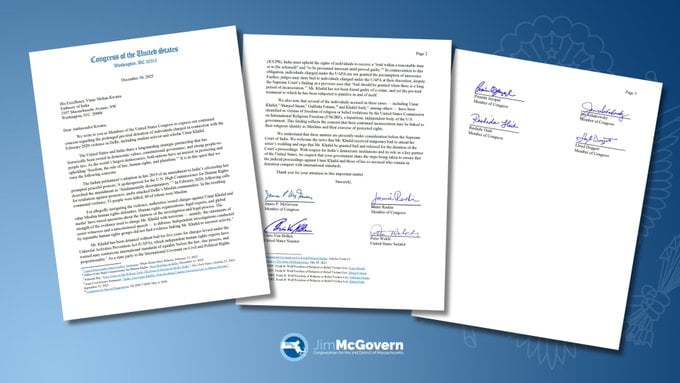
The lawmakers’ letter, dated December 30, called on the Indian government to clarify what steps were being taken to ensure that judicial proceedings against Khalid and his co-accused meet international standards of due process and the presumption of innocence.
The intervention was led by Democratic Congressman Jim McGovern, co-chair of the Tom Lantos Human Rights Commission, and signed by senior Democrats including Jamie Raskin, Pramila Jayapal, Rashida Tlaib, Chris Van Hollen and Peter Welch.
Several of the signatories said they had met Khalid’s parents earlier in December. In public remarks, they stressed that nearly five years of detention under the UAPA without a conclusion to the trial raises serious concerns about proportionality, equality before the law and the criminalisation of dissent.
While Mamdani was not among the signatories, the timing proved significant. His letter helped refocus international attention on a case that human rights organisations, legal experts and global media have long cited as emblematic of India’s expanding use of anti-terror laws against peaceful protest.
From anti-CAA protests to prolonged imprisonment
Khalid’s detention dates back to September 2020, months after mass protests erupted across India against the Citizenship Amendment Act (CAA). In February that year, communal violence tore through north-east Delhi, leaving 53 people dead and more than 700 injured — the majority of the victims Muslim.
Rather than pursuing those directly responsible for the violence, authorities arrested several student leaders and activists linked to the anti-CAA movement, accusing them of orchestrating the unrest. Khalid was charged with offences ranging from sedition to conspiracy, with the most serious allegations brought under the UAPA.
Despite consistently denying the charges, his bail applications have been repeatedly rejected, a common outcome under a law that places the burden on the accused to prove the case against them is false. He was briefly granted provisional bail in December to attend his sister’s wedding, only to return days later to Delhi’s Tihar jail.
International human rights organisations argue that Khalid’s continued detention illustrates how India’s counter-terror framework has been used to prolong incarceration without trial, a pattern they say undermines democratic dissent and the rule of law.