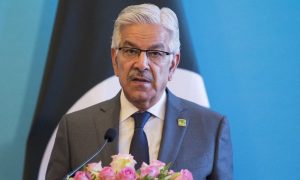
When Lieutenant General Nauman Zakria, Commander of I Corps and Pakistan’s newly-raised Army Rocket Force Command, addressed the Shangri-La Dialogue in Singapore last weekend, he delivered one of the most comprehensive and forward-thinking articulations of Pakistan’s deterrence philosophy in recent memory.
Speaking at Asia’s premier defence summit before an audience of defence ministers, military chiefs, and strategic thinkers from across the globe, he laid out a vision of regional stability that deserves serious attention not just in Islamabad, but in every capital that claims to care about peace in South Asia.
His central message was both clear and timely: Pakistan is not a destabilising force in the region. It is a responsible, capable, and increasingly sophisticated security actor whose conduct during the May 2025 conflict demonstrated both restraint and resolve, a combination that is far harder to achieve than either alone.
The backdrop to Zakria’s address was the four-day conflict triggered in May 2025, when an attack on tourists in occupied Kashmir was attributed to Pakistan by New Delhi without credible evidence.
Islamabad rejected the allegations and called for a neutral international investigation, a call that India ignored. What followed were Indian air strikes against Pakistani territory in Punjab and Azad Kashmir, strikes that constituted an act of aggression.
Pakistan’s response was measured, effective, and ultimately decisive. Pakistani forces downed multiple Indian aircraft in air-to-air combat and conducted precision strikes on Indian airbases, demonstrating clearly that unprovoked military action against Pakistan carries consequences.
A US-brokered ceasefire on May 10 brought the confrontation to a close, but the strategic lessons had already been written.
Zakria articulated those lessons with precision at Shangri-La. Pakistan’s response had, in his words, effectively debunked the notion of space for war in South Asia.
For years, Indian strategic planners operated under the illusion that limited military action against Pakistan below the nuclear threshold was a viable policy option. The events of May 2025 dismantled that illusion.
That is not a threat to regional peace; it is deterrence working exactly as it should. A credible deterrent, demonstrated rather than merely asserted, is the most reliable foundation for stability between nuclear-armed neighbours.
Perhaps the most strategically significant aspect of Zakria’s participation was not only what he said, but who he was introduced as: Commander of the newly raised Army Rocket Force Command, presented formally on an international stage for the first time. Pakistan appears to be institutionalising a conventional precision-strike capability as a distinct and permanent layer of its deterrence architecture, entirely separate from its nuclear forces.
Zakria was emphatic on this point. The Rocket Force is a strictly conventional force, with an independent command structure.
Far from lowering the nuclear threshold, this development raises it. Pakistan is actively building conventional deterrence layers that provide calibrated response options before any consideration of nuclear signalling arises.
This is the behaviour of a responsible state, one that seeks to manage escalation, not accelerate it.
The modernisation of systems like the Fatah missile series reflects this same logic: precision conventional instruments for strategic signalling and deterrence, not reckless militarisation.
Critics who frame Pakistan’s defence capabilities as destabilising would do well to compare this posture with India’s own trajectory, its expanding nuclear warhead inventory, its development of multiple independently targetable re-entry vehicles, its anti-satellite weapons tests, and its increasingly aggressive conventional posturing along Pakistan’s borders.
What distinguished Zakria’s address from a standard military speech was its intellectual breadth. He did not merely assert Pakistan’s deterrence credentials; he proposed a constructive framework for regional and global stability built on three pillars.
The first was responsible governance of emerging technologies. Zakria warned that advances in artificial intelligence, autonomous weapons, cyber capabilities, and space-based systems are transforming military decision-making in dangerous ways.
Compressing the decision cycle to a point where humans cannot evaluate situations fast enough creates the conditions for catastrophic miscalculation.
His call for internationally agreed norms on military AI, mandatory human oversight for autonomous weapons, and protections for civilian infrastructure in cyberspace is not Pakistan speaking from a position of weakness; it is Pakistan speaking from hard experience and strategic foresight.
The second pillar was crisis communication. Zakria argued powerfully that strategic stability is preserved not only through deterrence but through communication. Institutionalised crisis management mechanisms and strategic communication channels are essential infrastructure for peace between rival states. Pakistan has consistently signalled its willingness to engage in such mechanisms. It is Indian intransigence — its suspension of the Indus Waters Treaty, its revocation of Kashmiri autonomy, its closure of bilateral diplomatic channels, and its cultivation of a domestic political environment that rewards hostility toward Pakistan that has left these frameworks dormant. The burden of building peace cannot rest on one side alone.
The third pillar was multilateral norm-building. Zakria called for global collaboration in codifying rules on space testing, prohibitions on attacks against civilian infrastructure, and binding frameworks for emerging military technologies. No country, he argued, can manage these transnational risks alone. Pakistan’s willingness to champion these norms at a forum like Shangri-La reflects the confidence of a state with nothing to hide and everything to gain from a stable, rules-based international order.
Zakria also addressed the information domain a battlefield that is increasingly inseparable from conventional strategy. He warned that disinformation campaigns, AI-generated content, and digital manipulation are eroding trust and compressing decision timelines, not just between militaries but within societies. Pakistan’s own experience of being the target of coordinated disinformation particularly India’s attempts to shape the post-May 2025 narrative by fabricating casualty figures and attributing false statements to Pakistani officials makes this concern acutely relevant. Building institutional credibility and digital literacy is, in this framing, as important to deterrence stability as any weapons system.
At its core, Zakria’s address was an invitation. An invitation to India to return to dialogue. An invitation to the international community to build better governance frameworks for emerging technologies. And an invitation to South Asia’s wider neighbourhood to recognise that Pakistan’s strength is not a threat to regional peace but a guarantor of it. Pakistan has demonstrated, on the battlefield and at the negotiating table, that it cannot be coerced, cannot be intimidated, and will not be the first to escalate. It has also demonstrated, at forums like Shangri-La, the strategic maturity to think beyond the immediate crisis and articulate a vision for sustainable peace.
The architecture of deterrence stability in South Asia already exists in Pakistan’s strategic thinking. What remains to be built is the political will on all sides to match that vision with action.