



KEY POINTS
- The total solar eclipse will last 6 minutes and 23 seconds.
- The Moon will cover the Sun for an extended period, providing a unique opportunity to view the Sun’s corona in detail.
- The eclipse will travel eastward, passing over Spain, Morocco, Algeria, Tunisia, Libya, and Egypt.
- India will only witness a minor partial eclipse in its far western regions.
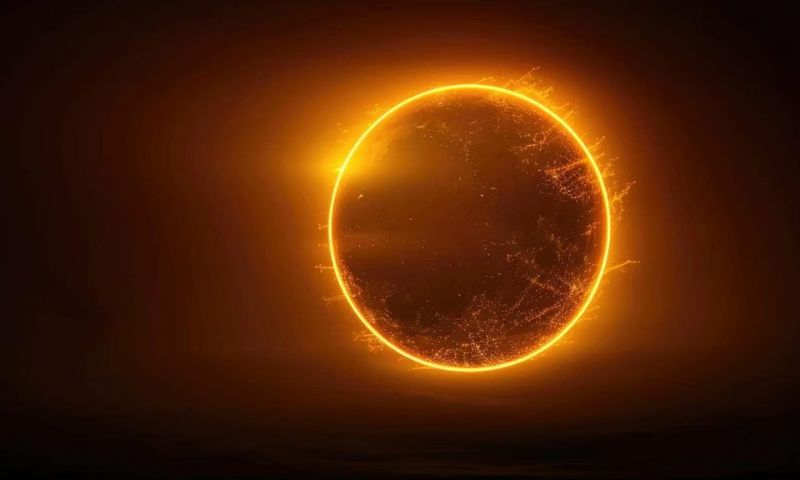
ISLAMABAD: A rare total solar eclipse will offer an extraordinary celestial display to viewers across several countries, offering an extraordinary spectacle that will be remembered for decades on August 2, 2027.
Lasting up to 6 minutes and 23 seconds, this total eclipse will be the longest visible from land in over a century, from 1991 to 2114, far surpassing the usual duration of most solar eclipses, which typically last under three minutes.
Astronomers are particularly excited about the extended period of totality, which will provide an exceptional opportunity to observe the Sun’s corona in greater detail.
As the Moon covers the Sun, the resulting darkness will create an eerie, quiet atmosphere for those in the eclipse’s path, offering a once-in-a-lifetime experience.
The eclipse will begin over the Atlantic Ocean, traveling eastward, and will cast its shadow across southern Spain, northern Morocco, Algeria, Tunisia, Libya, and Egypt.
These regions, known for their typically clear and dry skies in August, are expected to offer some of the best viewing conditions for this rare event.
The peak of the eclipse is expected to occur between 2:00 and 2:30 PM (local time) in Egypt and Libya, with southern Spain experiencing totality between 1:30 and 2:00 PM.
The entire eclipse will traverse a wide path, and due to its position near the equator, the Moon’s shadow will move at a slower pace, ensuring that viewers enjoy an extended period of total darkness.
India, however, will primarily miss the main event, with only a minor partial eclipse observable in its far western areas around sunset.
What makes this eclipse so significant is the unique combination of astronomical factors. As Earth approaches its aphelion – the farthest point from the Sun – the Sun will appear slightly smaller in the sky.
Meanwhile, the Moon will be closer to Earth than usual, reaching its perigee, making it appear larger. This combination will contribute to the extended duration of the total eclipse.
The total solar eclipse of August 2, 2027, is not just an awe-inspiring sight, but a rare celestial event that combines the slow, sweeping shadow of the Moon, the unique astronomical positioning of Earth and the Moon, and the opportunity to observe the Sun’s corona in unprecedented detail.
With its long duration and sweeping path across multiple countries, this event promises to be one of the most breathtaking astronomical occurrences of the 21st century.