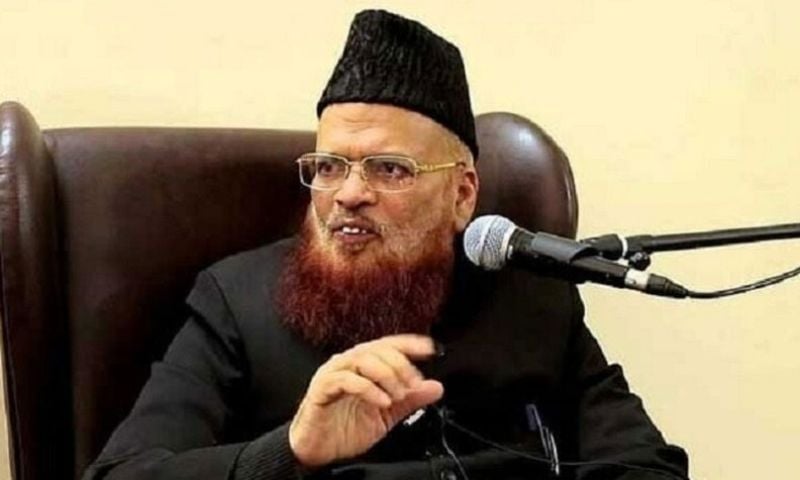



ISLAMABAD: Pakistan’s leading Islamic scholar and jurist, Mufti Muhammad Taqi Usmani, has categorically declared armed militancy against Pakistan as un-Islamic, illegal and forbidden, delivering a strong rebuttal to extremist narratives used by banned terrorist groups.
Mufti Taqi Usmani said Pakistan is an Islamic state with an Islamic constitution and government, and that taking up arms against it amounts to rebellion under Islamic law.
“Any armed action against the state of Pakistan is a clear rebellion, forbidden (haram), and unlawful in Islam,” the grand mufti said, adding that such actions cannot be justified under any circumstances.
His remarks come at a time of rising terrorist attacks in the country, particularly by the outlawed Tehrik-i-Taliban Pakistan (TTP) with its sanctuaries in Afghanistan.
Pakistan has repeatedly demanded that Afghanistan’s Taliban regime take decisive action against the terrorist groups operating from Afghan soil and involved in cross-border terror attacks in Pakistan, especially in Khyber Pakhtunkhwa and Balochistan.
However, the Taliban authorities in Kabul failed to take concrete steps to prevent the use of Afghan soil from being used for cross-border terror attacks.
Distorted Jihad narratives
Mufti Taqi Usmani also rejected the misuse of religious decrees related to jihad against foreign powers. He said that fatwas issued in the context of conflicts involving Russia or the United States cannot be applied to Pakistan.
He warned that such interpretations amount to a serious distortion of Islamic teachings. “Using these fatwas against Pakistan is a grave fitna that promotes misguidance in the name of religion,” he said.
Mufti Taqi Usmani shared details of his meetings with TTP leaders during a visit to Kabul in July 2022. He led a 13-member delegation of Pakistani religious scholars as part of efforts to persuade the group to abandon violence.
Islamic position on violence
The delegation included senior ulema from Karachi, Lahore and Khyber Pakhtunkhwa. During the visit, the scholars met the TTP leadership, including its chief, Noor Wali Mehsud.
The grand mufti said the delegation conveyed the Islamic position on violence. “We explained to the TTP leadership that their violent actions against Pakistan are un-Islamic, illegal and against Sharia law,” he said, noting that Pakistan has an Islamic constitution aligned with Islamic principles.
He added that the delegation urged the TTP to accept the writ of the Pakistani state and strongly rejected the terror group’s practice of declaring the state apostate or unbelieving, calling such claims un-Islamic.
Earlier in a statement, Mufti Taqi Usmani said that the Islamic scholars confronted the TTP leadership over decades of violence that had killed children, women, scholars and other civilians.
He said that after lengthy discussions, Noor Wali Mehsud and his associates assured the delegation they understood the scholars’ message and committed to refraining from armed actions in the future.
However, Mufti Taqi Usmani later expressed surprise after Mehsud released a video message appearing to justify the TTP’s campaign while claiming the group was “open to guidance” from religious scholars.
“The guidance you are now seeking was already delivered during our direct conversation in Kabul,” Mufti Taqi Usmani said in response. “It is surprising to see these statements after such a clear dialogue.”
Rising terror attacks
Despite these engagements, the TTP has intensified terror attacks across Pakistan.
According to the Pakistan Security Report 2024 by the Islamabad-based Pak Institute for Peace Studies (PIPS), terrorist attacks killed about 300 people during 2024.
The report documented a sharp rise in both the frequency and intensity of terrorist violence. More than 95 percent of attacks were concentrated in Khyber Pakhtunkhwa and Balochistan. Khyber Pakhtunkhwa recorded the highest number of incidents, with 295 attacks.
In total, 358 security and law enforcement personnel were killed in terrorist attacks during the year. The violence also resulted in the deaths of 139 militants.
PIPS noted that the banned TTP remained a key perpetrator of terrorist violence, particularly in Khyber Pakhtunkhwa.
Mufti Taqi Usmani reiterated that Pakistan’s constitution is rooted in Islamic principles and is “unparalleled” globally.
He stressed that rebellion against such a state has no place in Islam, under any interpretation.