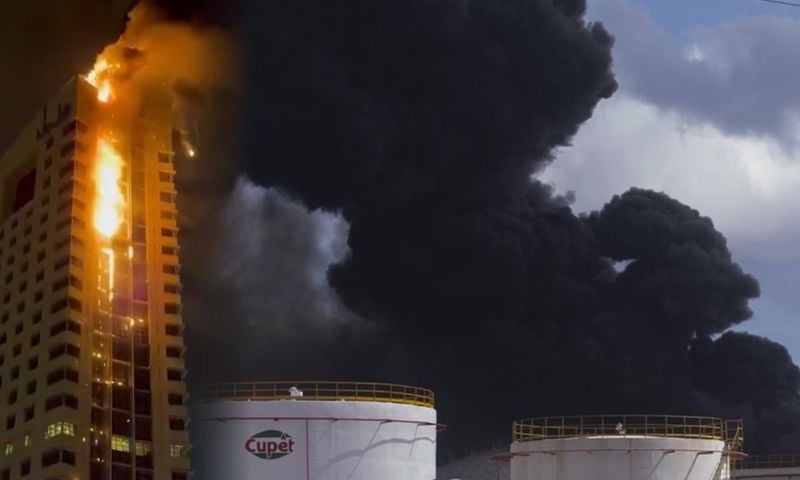



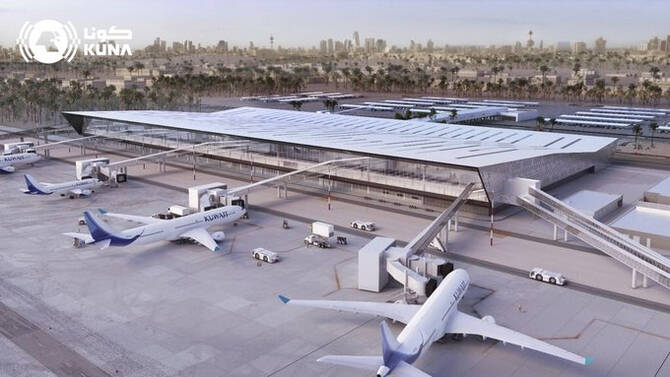
KUWAIT CITY/DUBAI: A drone strike targeting fuel storage tanks at Kuwait International Airport ignited a large fire early Sunday, prompting emergency crews to rush to the scene. Authorities later confirmed that firefighters had successfully brought the blaze under control, with no reports of significant injuries.
According to Arab News quoting the Kuwaiti military, the incident was a direct attack on vital infrastructure, marking another escalation in the ongoing regional conflict involving Iran and several Gulf nations.
Officials said fragments from intercepted drones caused damage to nearby civilian facilities, including the headquarters of Kuwait’s Public Institution for Social Security (PIFSS). Fire crews continued working to contain flames at the affected building following the impact.
The Kuwaiti Interior Ministry also confirmed that two border guards were killed while carrying out their national duties, though it remains unclear whether their deaths were directly linked to the drone attack.
Oil production cut as security concerns rise
In response to the security situation, Kuwait’s national oil company announced a precautionary reduction in crude oil production. The move comes amid fears that continued attacks and instability could threaten critical energy infrastructure and shipping routes, including the strategically vital Strait of Hormuz.
Kuwait’s armed forces reported that the country’s air defenses had intercepted multiple hostile drones that entered its airspace, preventing wider damage.
Gulf region faces continued missile and drone barrages
The attack in Kuwait is part of a broader wave of missile and drone strikes targeting several Gulf countries as the regional conflict entered its second week.
Saudi Arabia’s Defense Ministry said its air defenses intercepted and destroyed 21 drones within four hours, including 13 near the capital Riyadh and eight shortly after they crossed into Saudi airspace.
Qatar also reported being targeted by 10 ballistic missiles and two cruise missiles, launched from Iran a day earlier. Most of the projectiles were intercepted before reaching their targets, and officials reported no casualties.
Late Saturday night, residents in Dubai, Doha and Manama reported hearing loud explosions as air defense systems responded to incoming threats.
UAE confirms war conditions
The United Arab Emirates has emerged as one of the most heavily targeted countries since the conflict began. President Mohammed bin Zayed Al Nahyan described the situation as a “period of war” in a rare televised address, while expressing confidence that the nation would overcome the crisis.
UAE authorities reported that 16 ballistic missiles and 121 drones were detected during a recent attack wave. Air defense systems intercepted most of them, though debris from the interceptions caused damage in several areas.
In Dubai, a Pakistani national was killed after falling debris from an intercepted projectile struck the area.
Dubai airport temporarily suspends flights
Dubai International Airport briefly suspended operations after an unidentified aerial object was intercepted nearby. Flights were forced to circle in holding patterns before airport authorities confirmed that operations had resumed later.
Emirates airline initially announced a suspension of flights to and from Dubai but later confirmed that normal operations had restarted. Since the conflict erupted following US-Israeli strikes on Iran, the UAE has recorded 221 ballistic missiles and more than 1,300 drones targeting its territory.
Wider regional impact
Across the Gulf, countries have continued to report air defense operations against incoming threats. Bahrain said it had intercepted 92 missiles and 151 drones since the beginning of the conflict.
Saudi Arabia confirmed that three ballistic missiles heading toward Prince Sultan Air Base, which hosts US troops, were destroyed. Jordan accused Iran of directly targeting strategic locations within the kingdom using 119 missiles and drones during the past week.
Iran had earlier indicated it would avoid striking Gulf countries unless attacks were launched from their territory. However, Tehran later stated that sites supporting its adversaries would continue to be targeted, intensifying fears of a wider regional confrontation.
With missile and drone threats persisting across the Gulf, governments are reinforcing air defenses and tightening security around energy infrastructure, airports and military facilities.