


ISLAMABAD: Reports that Iranian Kurdish militias have discussed potential operations against Iran’s security forces with US officials have intensified debate over whether the ongoing US-Israeli war on Iran could evolve into a broader strategy aimed at destabilizing or fragmenting the country.
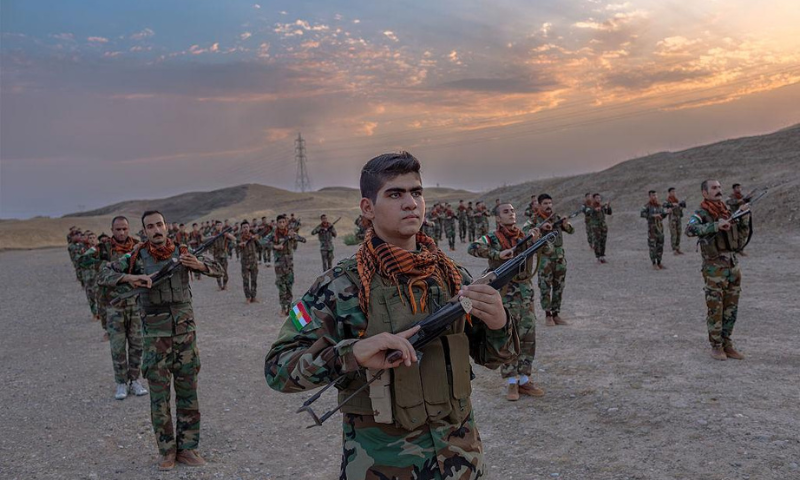
According to several sources cited by international media, a coalition of Iranian Kurdish opposition groups based along the Iran-Iraq border has recently consulted with US representatives about the possibility of launching attacks against Iranian security forces in western Iran.
The discussions come as the conflict between Iran and the US-Israeli alliance escalates following a large-scale military campaign that began earlier in the week and killed several senior Iranian officials, including Supreme Leader Ayatollah Ali Khamenei.
Sources familiar with the talks said the Kurdish groups have been preparing for potential cross-border operations that could weaken Iran’s military and create conditions for a wider uprising inside the country.
However, no final decision on the operation or its timing has been made, according to the sources, who spoke on condition of anonymity.
Kurdish groups seek US backing
According to reports by Reuters and the Associated Press, two sources said the Kurdish militias have requested military assistance from the United States, including possible support from the Central Intelligence Agency in supplying weapons.
The CIA declined to comment on the reports, while the White House and the Pentagon did not immediately respond to requests for clarification. Reports Reuters
The Pentagon maintains two military bases in the Kurdish city of Erbil in northern Iraq that support the international coalition against the Daesh militant group.
Officials quoted in US media said the idea behind a Kurdish operation would be to engage Iranian security forces directly, potentially creating opportunities for domestic unrest inside Iran.
Analysts warn that such a scenario could significantly destabilize the region and encourage separatist movements among Iran’s ethnic minorities.
Iran’s Kurdish population has long had strained relations with Tehran, and several Kurdish opposition groups operate from bases in the Kurdish autonomous region of northern Iraq.
These organizations are among the most organized elements of Iran’s fragmented opposition movement and are believed to have thousands of trained fighters with experience from battles against the Daesh group.
Ground war risk
Officials from Kurdish opposition groups confirmed that some fighters have been moved closer to the Iranian border and remain on standby.
Khalil Nadiri, an official with the Kurdistan Freedom Party (PAK), said some units had relocated to areas near the frontier in Iraq’s Sulaymaniyah province.
He said US officials had contacted Kurdish leaders regarding a potential operation, but did not provide further details.
Another official from the Kurdish opposition group Komala said their fighters were ready to cross into Iran within days if conditions allowed.
If such forces enter the conflict, it would mark the first major ground component in the war, which so far has largely been fought through air strikes, missile exchanges, and drone attacks.
Yet the prospect of Kurdish militias entering Iran has also created deep concerns among regional governments.
Iraqi Kurdish leaders cautious
Leaders of Iraq’s Kurdish region have reportedly been placed in a difficult position as Washington explores options involving Kurdish opposition groups.
According to Kurdish officials, a phone call took place between US President Donald Trump and the leaders of Iraq’s two main Kurdish political parties — Masoud Barzani of the Kurdistan Democratic Party (KDP) and Bafel Talabani of the Patriotic Union of Kurdistan (PUK), according to an Associated Press report published by Arab News.
During the conversation, Trump reportedly discussed the situation in Iran and asked Iraqi Kurdish leaders to support Iranian Kurdish groups and facilitate cross-border movement.
The White House acknowledged that Trump spoke with Kurdish leaders but denied that any specific military plan had been approved.
Regional officials say Iraqi Kurdish authorities are reluctant to become directly involved, fearing retaliation from Iran.
In recent days, Iranian-linked militias have launched drone and missile attacks targeting US military bases and Kurdish opposition facilities in northern Iraq.
Although many of the strikes were intercepted, several civilian areas were damaged and energy infrastructure disruptions have been reported.
Baghdad tightens border controls
The Iraqi government has also taken steps to prevent armed groups from crossing into Iran.
Iraq’s National Security Adviser Qassim Al-Araji said the government remains committed to preventing any militant groups from launching attacks against Iran from Iraqi territory.
Security reinforcements have been deployed along the border in response to requests from Iranian officials.
The presence of Iranian Kurdish opposition groups in Iraq has long been a source of tension between Baghdad and Tehran.
Under a 2023 agreement between the two countries, Kurdish militias were supposed to relocate away from border areas and disarm.
While their bases were closed and their movements restricted, many fighters retained their weapons.
Debate over “Balkanization.”
The developments have revived concerns among analysts that the war could eventually involve attempts to destabilize Iran internally.
Former Pakistani ambassador Naela Chohan has warned that external powers may seek to exploit Iran’s ethnic diversity as part of a broader geopolitical strategy.
“They will try to balkanize Iran because the core of Iran is Shia, while the peripheral regions consist of different ethnic groups,” Chohan said in an interview with WE News.
She pointed to Iran’s Kurdish, Azeri, and Baloch populations as areas where external actors might attempt to encourage separatist movements.
“If they attempt to create a separate Balochistan, it could also affect Pakistan because such a move could combine Iranian and Pakistani Baloch areas into a new state. They may also attempt to create Kurdistan,” she said.
Chohan argued that Iran’s decentralized “mosaic defense” strategy — which distributes defensive capabilities across the country’s provinces — was designed partly to prevent such fragmentation.
“Even if Tehran were destroyed, Iranian defence would not collapse,” she said.
Regional implications
Chohan said the conflict is becoming increasingly costly and complicated, particularly if tensions disrupt the Strait of Hormuz, a critical route for global energy supplies.
She warned that any blockade or prolonged instability in the Gulf could sharply reduce oil and gas exports from the region, pushing up energy prices and affecting economies worldwide.
“This war will be very costly not only for the Gulf states and medium-sized economies like ours but also for major powers such as the United States,” she said, adding that China could also be affected because of its dependence on energy imports from the region.
Iran’s system is deeply entrenched
Chohan said the killing of individual leaders would not fundamentally alter Iran’s political system.
“Iran is not Venezuela. Removing one individual will not change the nature of the Islamic Revolution,” she said, noting that Iran’s political and institutional structure remains deeply entrenched.
According to her, the Iranian leadership had already prepared succession plans before the death of Supreme Leader Ayatollah Ali Khamenei.
She warned that such plans could extend beyond Iran.
“Pakistan could also face similar pressures because there are already attempts to exploit internal divisions,” she said.
They may also attempt to create Kurdistan. As for the Azeris and other peripheral populations, she said these regions consist of different ethnic groups that could be targeted.
According to her, agencies such as the CIA and Mossad might try to instigate unrest in these peripheral areas as part of a strategy aimed at balkanizing Iran.