


KEY POINTS
- Iran’s Supreme Leader Khamenei says US will not succeed in destroying Iran.
- Second round of Iran-US nuclear talks begins in Geneva.
- Khamenei warns US warship in Gulf could be targeted.
- Iran accuses Israel of trying to undermine negotiations.
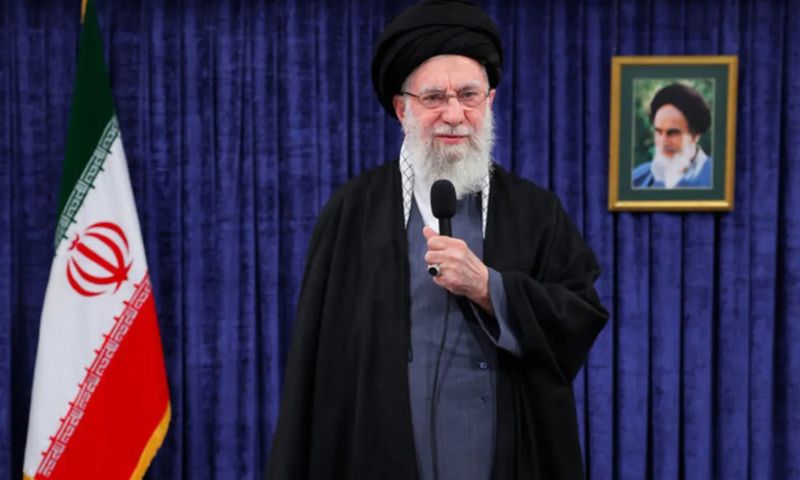
TEHRAN, Iran: Iran’s Supreme Leader Ayatollah Ali Khamenei said on Tuesday that US President Donald Trump would not succeed in destroying the Islamic republic, as Tehran and Washington began a second round of nuclear talks in Geneva.
“In one of his recent speeches, the US president said that for 47 years America has not succeeded in destroying the Islamic republic… I tell you: you will not succeed either,” Khamenei said in a speech.
Khamenei’s remarks came as Iranian and US officials kicked off second round of talks in Switzerland to ease tensions over Tehran’s nuclear programme.
The latest round follows an earlier meeting in February. Previous negotiations collapsed during last year’s 12-day Iran–Israel war.
The renewed diplomacy comes after Washington deployed an aircraft carrier group to the Gulf following protests in Iran last month over rising inflation and economic hardship.
In his speech, Khamenei warned that the US warship could be targeted.
“We constantly hear that they (the United States) have sent a warship toward Iran. A warship is certainly a dangerous weapon, but even more dangerous is the weapon capable of sinking it,” he said.
Khamenei also expressed scepticism about the prospects for progress.
“If there are to be negotiations — because there is no real room for negotiation — determining the outcome of the negotiations in advance is a mistake and madness,” he said, referring to US calls for Iran to abandon its nuclear programme.
During the June conflict between Iran and Israel, the United States briefly joined the fighting with strikes on key Iranian nuclear facilities.
Iran’s stockpile of enriched uranium remains a key sticking point.
Washington has repeatedly demanded zero enrichment and has sought to address Iran’s ballistic missile programme — issues Israel has pushed to include in the talks.
Iran insists its right to enrich uranium is non-negotiable and says discussions should focus solely on the nuclear file.
“The statements of the American president, at times threatening and at times dictating what should and should not be done, reveal a desire to dominate the Iranian nation,” Khamenei said.
Iran calls for US independence from Israel
Iran has urged Washington to assess its national interests independently of Israeli influence.
In an interview with Al Jazeera, Ali Larijani, secretary of Iran’s Supreme National Security Council, said negotiations were ongoing and that regional countries were helping to facilitate them.
Larijani said a letter outlining Tehran’s positions had been sent to Washington through Oman’s Foreign Minister Badr bin Hamad al-Busaidi, but no official response had been received.
He said Iran remained open to cooperation and supported continued dialogue.
Missile programme ‘not negotiable’
Larijani firmly ruled out including Iran’s missile programme in the talks.
“Our missile programme stands entirely separate from the nuclear one. It is a domestic matter, basically linked to our national security. As such, it cannot be part of these negotiations,” he said.
He also rejected calls to reduce uranium enrichment to zero.
“It is impractical for a country that has already mastered this technology to reduce it to zero,” he said, arguing that enriched uranium was required for peaceful purposes such as medical research and treatment.
Larijani accused Israel of attempting to undermine the talks.
“Our negotiations are exclusively with the United States. We are not engaged in any talks with Israel,” he said.
“However, Israel has inserted itself into this process, with their intent on undermining and sabotaging these negotiations.”
Reflecting on last year’s conflict with Israel, Larijani acknowledged shortcomings in Iran’s intelligence capabilities but said security measures had since been strengthened. He added that the war had fostered national unity.
IAEA engagement and mediation
Ahead of the talks, Iran’s Foreign Minister Abbas Araghchi met International Atomic Energy Agency (IAEA) Director General Rafael Grossi in Geneva, according to Hurriyet Daily News.
The meeting underscored Tehran’s effort to re-engage international oversight of its nuclear programme as both sides seek diplomatic de-escalation.
Araghchi and Grossi discussed technical cooperation and next steps for managing Iran’s nuclear activities, which have long been a source of tension with Western powers.
In a social media post, Araghchi said Iran sought a “fair and equitable deal” but would not yield to threats.