
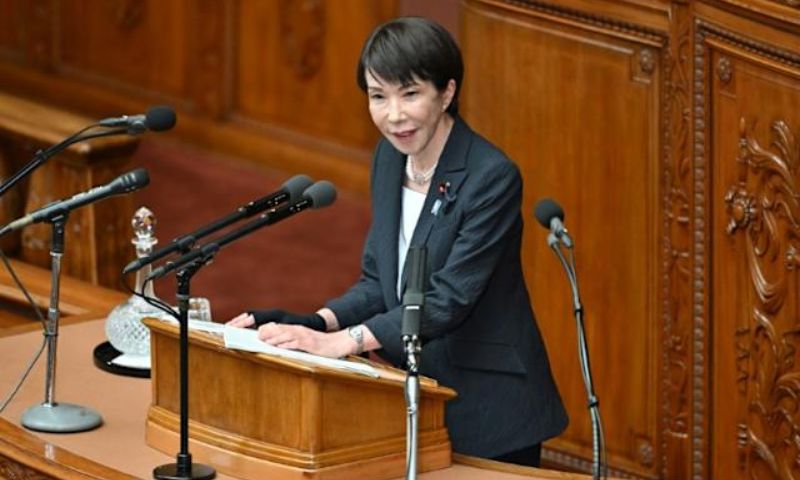



TOKYO, Japan: Prime Minister Sanae Takaichi pledged Friday to make Japan “strong and prosperous,” signaling a robust approach to both national security and economic growth following her ruling Liberal Democratic Party’s (LDP) landslide win in February 8 snap elections.
Addressing parliament, Takaichi highlighted the growing threats from China, saying the country is intensifying efforts to “unilaterally change the status quo by force or coercion” in the East China Sea and South China Sea, while expanding military activities in areas surrounding Japan.
Echoing her predecessor Shigeru Ishiba, Takaichi warned that Japan faces “the most severe and complex security environment” since World War II, citing risks not only from China but also Russia and North Korea.
In response, she announced plans to revise Japan’s three key defence policy documents this year, stressing that changes in warfare and the need to prepare for prolonged conflicts are accelerating across multiple sectors.
Takaichi also intends to accelerate discussions on further loosening Japan’s self-imposed ban on the export of lethal weapons.
“This will contribute to strengthening the deterrence and response capabilities of our allies and like-minded partners, while reinforcing Japan’s defence production base and its civilian technology foundation,” she said.
Her previous comments in November, suggesting Japan could intervene militarily if Beijing attempted to take Taiwan by force, had angered China, which regards the democratic island as part of its territory.
Beijing has urged its citizens to avoid travel to Japan, while top diplomat Wang Yi accused Japanese forces of seeking to “revive militarism” at the Munich Security Conference.
Economic agenda
On the economic front, Takaichi reassured that her fiscal policies would not be “reckless,” addressing investor concerns that her growth-boosting measures could worsen Japan’s debt situation.
She vowed to reduce Japan’s debt-to-GDP ratio while persistently “hitting the growth switch” to stimulate the economy.
She pledged to promote domestic investment in risk-management areas such as energy, health, infrastructure, and cybersecurity, alongside growth sectors including AI, semiconductor chips, and ship-building.
Government data showed Japanese inflation slowed in January, a positive development for the new prime minister.
Core consumer prices, excluding fresh food, rose 2.0 percent year-on-year, the slowest increase in two years and in line with market expectations.
Takaichi reiterated her campaign promise to consider suspending the consumption tax on food for two years to ease household burdens.
She also announced the formation of a cross-party national council to discuss taxation and funding solutions for Japan’s growing social security obligations.
Energy security is another priority. Takaichi emphasized the importance of “maximum use of decarbonised power sources” and domestically produced energy to strengthen Japan’s energy independence.
With her dual focus on robust defence and sustainable economic growth, Japan’s first female prime minister aims to steer the country toward a secure and prosperous future in a rapidly changing regional and global landscape.