
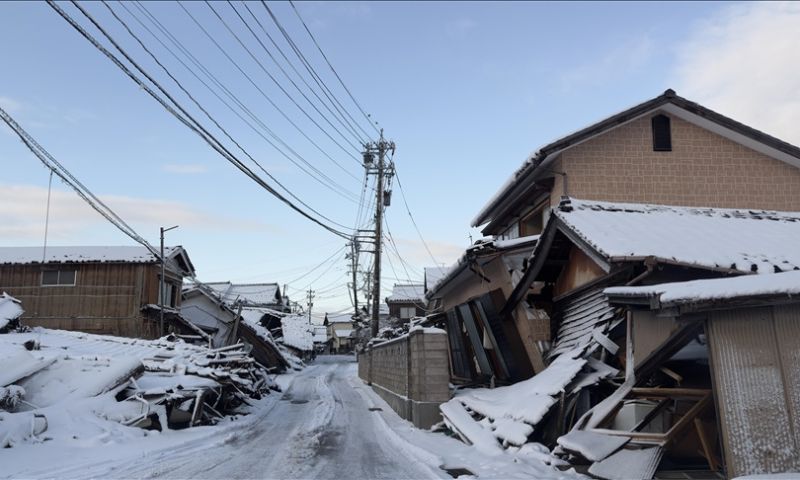



TOKYO, Japan: Japan issued a high tsunami warning on Monday after a powerful 7.6-magnitude earthquake struck off the country’s northern Pacific coast, prompting authorities to order immediate evacuations in coastal areas.
The Japan Meteorological Agency (JMA) said tsunami waves of up to three metres (10 feet) were expected to hit the northeastern coastline, including the prefectures of Hokkaido, Aomori and Iwate.
Public broadcaster NHK reported that the first waves were estimated to arrive around 11:40 pm local time (1440 GMT).
Major quake and tsunami threat
The quake struck at around 11:15 pm (1415 GMT) at a depth of about 50 kilometres (30 miles) off Aomori Prefecture, according to JMA.
The United States Geological Survey said the magnitude 7.6 quake struck at 1415 GMT off Misawa on Japan’s Pacific coast, at a depth of 53 kilometres (33 miles).
The Japan Meteorological Agency issued a tsunami warning, with one wave hitting a port in the northern region of Aomori, where Misawa is located, at 11:43 pm (1443 GMT).
Several more waves reached the coast, measuring up to 50 centimetres (20 inches), the agency said.
Public broadcaster NHK cited a hotel employee in the city of Hachinohe in Aomori as saying there had been some injuries as a result of the quake.
Live footage showed shattered glass fragments scattered across roads.
Hachinohe residents fled their homes to seek shelter in the city hall, NHK said.
The quake was also felt in the northern hub of Sapporo, where alarms rang on smartphones to alert residents.
A reporter for NHK in Hokkaido described a horizontal shaking of around 30 seconds that made him unable to keep standing as the earthquake struck.
The meteorological agency earlier warned a tsunami of up to three metres (10 feet) was expected to hit Japan’s Pacific coast.
Top government spokesman Minoru Kihara urged residents to stay in a safe place until the warning had been lifted.
“Even after an initial wave, a second or third wave of an even greater height can arrive,” he told reporters.
Evacuations and safety warnings
NHK reported that evacuation orders were issued across coastal communities. The warning covered wide areas from northern Aomori to Iwate.
Local officials urged people to stay away from beaches, ports and riverbanks.
Japan remains one of the world’s most earthquake-prone countries, sitting along the seismically active Pacific “Ring of Fire”.
Authorities began checking several nuclear-related sites for any signs of damage. Inspections were launched at nuclear fuel reprocessing plants in Aomori Prefecture, as well as facilities in Mutsu City and Higashidori Village.
The Onagawa Nuclear Power Plant in Miyagi Prefecture was also being examined, Japanese media reported.
Tokyo Electric Power Company said that monitoring posts around the Fukushima Daiichi nuclear plant — heavily damaged in the 2011 earthquake and tsunami — showed no change in radiation readings. Officials stressed that inspections were ongoing.
‘Megaquake’
Kihara said he had “received no reports yet of abnormalities” from two nuclear power plants in northern Japan, adding that probes are ongoing in other nuclear facilities.
In 2011, a magnitude-9.0 quake triggered a tsunami that left 18,500 people dead or missing and caused a devastating meltdown at the Fukushima nuclear plant.
Shortly after Monday’s quake, Tohoku Electric Power said in a post on X that the safety equipment at its Higashidori nuclear power plant in Aomori and its Onagawa nuclear plant in the Miyagi region had not shown any abnormalities.
Japan sits on top of four major tectonic plates along the western edge of the Pacific “Ring of Fire” and is one of the world’s most tectonically active countries.
The archipelago, home to around 125 million people, experiences around 1,500 jolts every year.
The vast majority are mild, although the damage they cause varies according to their location and depth below the Earth’s surface.
Quakes are extremely hard to predict, but in January a government panel marginally increased the probability of a major jolt in the Nankai Trough off Japan in the next 30 years to 75-82 percent.
The government then released a new estimate in March saying that such a “megaquake” and subsequent tsunami could cause as many as 298,000 deaths and damages of up to $2 trillion.
Recent seismic activity
The quake follows a strong offshore earthquake on 9 November, which briefly triggered tsunami advisories along the northern coastline.
That earlier tremor, initially measured at magnitude 6.9, struck off Iwate Prefecture and was followed by several aftershocks.
Small tsunami waves of 10 to 20 centimetres were recorded in several towns before the advisory was lifted roughly three hours later. There were no reports of injuries or significant damage.