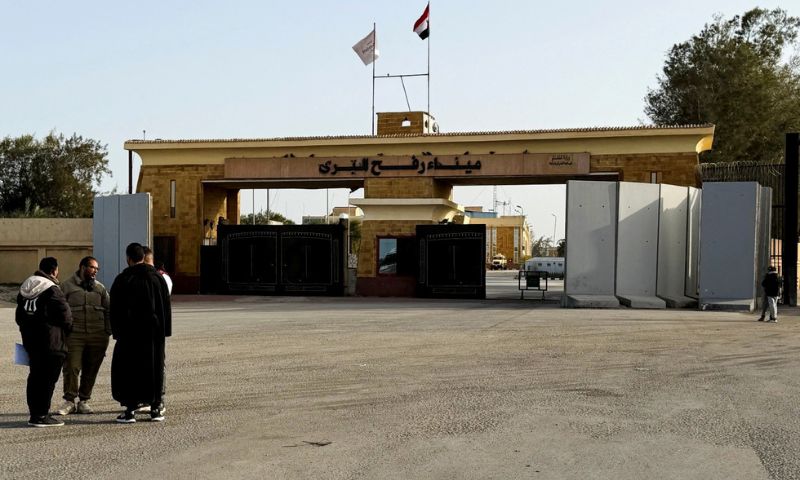



RAFAH, Palestinian Territories: Israel on Sunday partially reopened the Rafah crossing between the Gaza Strip and Egypt after months of sustained pressure from humanitarian organisations, though the reopening is limited strictly to the movement of people and does not yet include the flow of aid or commercial goods.
The move comes against the backdrop of continued violence in the Palestinian territory despite an existing ceasefire. Gaza’s civil defence agency reported that dozens of people were killed in Israeli strikes on Saturday, while the Israeli military said the attacks were carried out in response to violations of the truce.
Rafah is a critical gateway for Gaza’s civilian population and humanitarian relief. However, it has remained closed since Israeli forces took control of the crossing in May 2024 during the war with Hamas, aside from a brief and highly restricted reopening in early 2025, according to AFP.
COGAT, the Israeli defence ministry body responsible for coordinating Palestinian civilian affairs, confirmed on Sunday that the “Rafah Crossing was opened today for the limited passage of residents only.”
An official from Gaza’s health ministry, which operates under Hamas authority, said approximately 200 patients are currently waiting for permission to leave the enclave now that the crossing has partially reopened. Many of these patients require urgent medical treatment unavailable inside Gaza.
At the same time, a Palestinian official told AFP that a group of “around 40 Palestinians affiliated with the Palestinian Authority has arrived on the Egyptian side of the crossing to be allowed into Gaza and begin their work.” The official spoke on condition of anonymity.
Israel had previously insisted that the crossing would not be reopened until the body of Ran Gvili, the last Israeli hostage believed to be held in Gaza, was returned.
His remains were recovered several days ago, and he was laid to rest in Israel on Wednesday. COGAT announced the decision to reopen the crossing two days later.
According to COGAT, entry and exit through Rafah “will be permitted in coordination with Egypt, following prior security clearance of individuals by Israel, and under the supervision of the European Union mission.”
On Sunday, COGAT described the reopening as “an initial pilot phase” coordinated with the EU. It added that the relevant parties were conducting “preliminary preparations aimed at increasing readiness for full operation of the crossing.”
“The actual passage of residents in both directions will begin upon completion of these preparations,” COGAT said, noting that a wider reopening is scheduled for Monday, according to three sources at the crossing.
However, the sources added that no agreement has yet been reached on the number of Palestinians who will be permitted to enter or exit Gaza. They noted that Egypt plans to admit “all Palestinians whom Israel authorises to leave.”
‘Anxious wait’
For many in Gaza, the reopening has sparked cautious hope after months of uncertainty. “Every day that passes drains my life and worsens my condition,” said Mohammed Shamiya, 33, who suffers from kidney disease and requires dialysis treatment abroad. “I’m waiting every moment for the opening of the Rafah land crossing.”
Eighteen-year-old Safa al-Hawajri, who has received a scholarship to study overseas, also expressed anticipation. “I’m waiting in the hope of fulfilling my ambition, which is tied to the reopening of the crossing,” she said. “I hope to be able to travel as soon as it opens.”
Situated on Gaza’s southern border with Egypt, Rafah is the only crossing into and out of the territory that does not pass through Israel.
The area is currently held by Israeli forces following their withdrawal behind the so-called “Yellow Line” under the terms of the US-brokered ceasefire that came into effect on October 10.
Israeli troops continue to control more than half of the Gaza Strip, while the remainder remains under Hamas authority.
The partial reopening is expected to facilitate the eventual entry of a 15-member Palestinian technocratic body, the National Committee for the Administration of Gaza (NCAG).
The committee was established under the ceasefire agreement to oversee the day-to-day governance of Gaza’s 2.2 million residents.
The NCAG is to be supervised by the so-called “Board of Peace,” chaired by US President Donald Trump. However, the committee, headed by former Palestinian Authority deputy minister Ali Shaath, is not expected to enter Gaza on Sunday.
“The head of the committee was informed that Israel had approved the entry of the members into Gaza but has not yet set a date,” a committee member told AFP.
“We call on the mediators and the US administration to accelerate operations at the crossing and increase the number of travelers.”