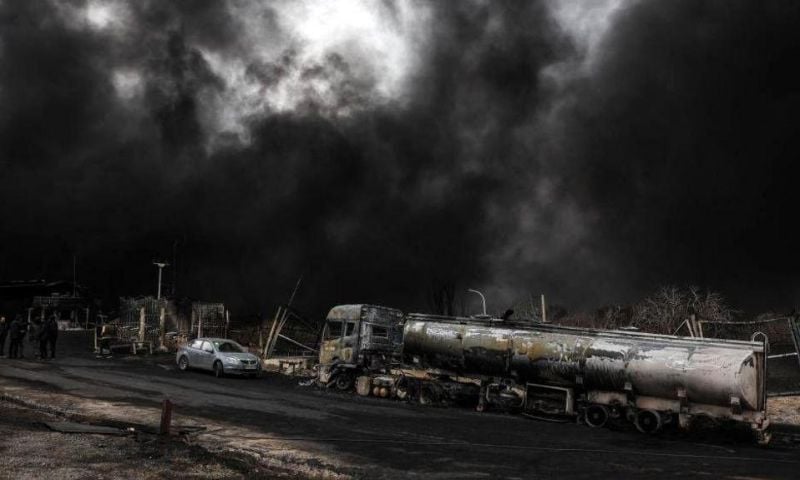



TEHRAN, Iran: Israel struck oil storage depots and refining facilities in Tehran on Sunday, sending thick black smoke across the Iranian capital, as Iran retaliated with missile and drone attacks on Israel and several Gulf states.
Thick black smoke blanketed Tehran after fresh US and Israeli strikes hit oil storage depots and refining facilities.
Residents of Tehran woke to an apocalyptic scene as massive plumes of smoke darkened the sky above the city of more than 10 million people.
“I thought my alarm clock was broken,” a driver in his fifties told AFP on condition of anonymity.
By 10:30 am local time (0700 GMT), vehicles were still using headlights along Valiasr Street, one of Tehran’s main north–south thoroughfares, as black smoke from burning fuel depots mixed with heavy grey rain clouds.
Israeli strikes target Iranian infrastructure
The Israeli military said it launched a wave of strikes across Tehran targeting facilities linked to Iran’s Islamic Revolutionary Guard Corps (IRGC).
In a statement posted on Telegram, the army said it had struck and “dismantled” the headquarters of the IRGC Space Force.
The site served as a reception, transmission and research centre linked to Iran’s space agency, the military said.
Israel military says also targeted roughly 50 bunkers storing ammunition, a compound belonging to the Guards’ ground forces and a base used by the Basij paramilitary organisation.
The military said the facility included a command-and-control centre for the Khayyam satellite, which it alleged was used to monitor Israel.
The United States has previously said the satellite could provide Iran with significant surveillance capabilities.
Explosions were also reported in Iran’s central Yazd province, according to the official IRNA news agency, which said blasts occurred on the outskirts of Yazd city.
Earlier explosions were also reported in Tehran and the central province of Isfahan.
Toxic rain warning
Iran’s Red Crescent warned residents about the risk of “toxic rain” following the strikes on fuel facilities.
The agency said contaminated rainwater could cause chemical burns to the skin and damage to the lungs.
It advised anyone exposed to such rainfall to wash their skin with running cold water.
BREAKING: Iran Red Crescent warns of toxic rain after US-Israeli attacks on fuel depots.
The agency said contaminated rain could cause chemical burns to the skin and damage to the lungs.
It also advised anyone exposed to the rain to rinse their skin with running cold water. pic.twitter.com/PzQwkPRkNo
— Middle East Eye (@MiddleEastEye) March 8, 2026
Iranian missile launches
Iran’s Revolutionary Guards said they launched a new wave of missile attacks targeting Israeli cities and a US-linked airbase in the region.
According to state television, the Guards said the “28th wave” of Operation Honest Promise 4 involved next-generation missiles fired toward the Israeli cities of Tel Aviv and Beersheva, as well as the Al-Azraq airbase in Jordan.
The Israeli military confirmed that missiles had been launched from Iran and said its air defence systems were working to intercept incoming projectiles.
Six people were wounded in central Israel following Iranian missile fire, according to Magen David Adom emergency services.
Drone attacks across the Gulf
The conflict has spread across the Gulf, with several countries reporting missile and drone threats.
Bahrain’s interior ministry said an Iranian drone strike caused material damage to a water desalination plant.
The incident came a day after Iran said the United States bombed a freshwater desalination facility on Qeshm Island in southern Iran, which Tehran described as setting a “dangerous precedent”.
In the United Arab Emirates, air defence systems intercepted 16 ballistic missiles and 113 drones, authorities said.
الدفاعات الجوية الإماراتية تتعامل مع 16 صاروخ باليستي و 113 طائرة مسيرة.
رصدت الدفاعات الجوية الإماراتية اليوم (8 مارس 2026) 17 صاروخ باليستي حيث تم تدمير 16 صاروخ باليستي، فيما سقط 1 صاروخ باليستي في البحر. كما تم رصد 117 طائرة مسيرة، حيث تم اعتراض 113 طائرة مسيرة، بينما سقطت 4… pic.twitter.com/ZH1shbAxKT
— وزارة الدفاع |MOD UAE (@modgovae) March 8, 2026
Explosions were also heard in the capital Abu Dhabi, witnesses told AFP.
Saudi Arabia said its air defences intercepted at least 15 drones aimed at the diplomatic quarter in Riyadh.
In Kuwait, officials said drones targeted fuel storage tanks at Kuwait International Airport.
The country’s military later reported intercepting three ballistic missiles that entered its airspace.
Debris from intercepted projectiles caused infrastructure damage, authorities said.
The UAE’s foreign ministry said the country “does not seek to be drawn into conflicts or escalation” but reserved the right to take all necessary measures to protect its sovereignty and national security.
The ministry said more than 1,400 ballistic missiles and drones had been launched by Iran at infrastructure and civilian sites across the region.
UAE air defences intercept 16 ballistic missiles, 113 UAVs
UAE air defences today (8th March, 2026) detected 17 ballistic missiles, of which 16 were destroyed, while 1 missile fell into the sea. A total of 117 UAVs were also detected, with 113 intercepted, while 4 UAVs fell… pic.twitter.com/BTikC5pRyd
— وزارة الدفاع |MOD UAE (@modgovae) March 8, 2026
Arab League chief condemns Iranian attacks
Arab League chief Ahmed Aboul Gheit condemned Iranian strikes on several member states as “reckless” and urged Tehran to reverse what he called a “massive strategic mistake”.
Speaking during an emergency meeting of Arab foreign ministers, Egypt’s Foreign Minister Badr Abdelatty expressed solidarity with Gulf states, Jordan and Iraq and called for dialogue to reduce tensions.
He also stressed the need to strengthen frameworks for Arab collective security, including the possible formation of a joint Arab force.
Dr. Badr Abdelatty, Minister of Foreign Affairs, International Cooperation, and Egyptian Expatriates, participated in the extraordinary ministerial meeting of the Council of the League of Arab States.https://t.co/u67cnrMTaN pic.twitter.com/5UHMXvxGaV
— Ministry of Foreign Affairs of Egypt (@MFAEgOfficial) March 8, 2026
Oman’s Foreign Minister Badr bin Hamad Albusaidi criticised military actions by all sides.
“The action taken by Israel and the US against Iran is both immoral and illegal,” he wrote on social media platform X.
“But the retaliation by Iran against its neighbours is also deeply regrettable and unacceptable.”
He called for restraint and an urgent return to diplomacy.
Pleased to join colleagues today. The action taken by Israel and the US against Iran is both immoral and illegal. But the retaliation by Iran against its neighbors is also deeply regrettable and unacceptable. I call for restraint on all sides, a ceasefire, and an urgent return to… pic.twitter.com/3jmiKl3kvB
— Badr Albusaidi – بدر البوسعيدي (@badralbusaidi) March 8, 2026
Iranian missiles cannot US
Foreign Minister Abbas Araghchi said Iran’s missiles could not reach the United States and defended attacks on US bases in the region.
“It is Americans who started this war against us,” he told NBC’s Meet the Press.
“What we can do is attack American bases and installations around us, which are unfortunately located in neighbouring countries.”
Araghchi also rejected comments by US President Donald Trump suggesting he could influence the selection of Iran’s next supreme leader.
“We allow nobody to interfere in our domestic affairs. This is up to the Iranian people to elect their new leader,” he said.
Meanwhile, Trump said that Iran’s next leader “is not going to last long” without US approval.
Energy markets and shipping disrupted
The escalating conflict has also shaken global energy markets and shipping routes.
Iraq’s oil production from its southern fields has fallen by about 70 percent to roughly 1.3 million barrels per day after exports through the Strait of Hormuz were disrupted.
Before the conflict, production stood at around 4.3 million barrels per day.
The Strait of Hormuz is one of the world’s most critical energy chokepoints, carrying about 20 percent of global oil supplies.
War enters second week
The war began on February 28 after large-scale US and Israeli strikes on Iran.
Since then, missile and drone attacks have spread across several countries including Saudi Arabia, the United Arab Emirates, Qatar, Iraq, Kuwait, Jordan and Lebanon.
Israeli strikes have also targeted Iranian commanders in Beirut.
Lebanon’s health ministry said at least four people were killed when an Israeli strike hit an apartment inside the Ramada hotel building in central Beirut.
Lebanese authorities say around 300 people have been killed in Israeli attacks since hostilities resumed.
Iran’s ambassador to the United Nations said US-Israeli strikes have killed at least 1,332 Iranians and wounded thousands.
Iranian attacks have killed 10 people in Israel, according to officials.
At least six US service members have also been killed since the war began.
Iran’s Revolutionary Guards said the country could sustain an “intense war” against the United States and Israel for at least six months.