


WASHINGTON/JERUSALEM/TEHRAN: Iran’s Supreme National Security Council announced that the country had initiated retaliation following the joint strikes, stating that its armed forces had “commenced a decisive response to these hostile acts.”
The council advised citizens to steer clear of locations within the affected zones and said authorities had made “prior arrangements” to maintain the supply of essential goods.
It also ordered the closure of schools and universities, while confirming that banks would remain open.
The United States and Israel launched coordinated strikes on Iran on Saturday, with US President Donald Trump announcing the start of “major combat operations,” vowing to dismantle Tehran’s missile and naval capabilities and signalling support for the removal of Iran’s current leadership.
Iran responded within hours by firing missiles toward Israeli territory, triggering air-raid sirens and sharply escalating tensions in an already volatile region.
Iran launched retaliatory missile and drone attacks on Israel and US-linked targets across the Gulf on Saturday after Washington and Tel Aviv began what US President Donald Trump described as “major combat operations” against the Islamic Republic.
According to updates carried by international media, Iran first fired a wave of missiles and drones toward Israel, triggering emergency alerts as the confrontation rapidly spilled across the region.
Bahrain: US 5th Fleet headquarters targeted
Bahrain said the headquarters of the US Navy’s 5th Fleet in the kingdom was targeted in a missile attack. Authorities did not immediately provide further details on the incident or report damage in the first statements.
Explosions and sirens reported in Kuwait, Qatar
In Kuwait, witnesses reported hearing sirens and explosions as the retaliation unfolded, while in Qatar, explosions were heard on Saturday amid Iran’s counterattack. There was no immediate word on damage in the first reports.
Region on edge amid escalation
The flare-up follows the joint US-Israel campaign against Iran and comes as fears grow of a wider regional conflict drawing in additional actors.
The fast-moving developments have heightened concern across the Gulf due to the concentration of US military facilities and the risk of spillover into shipping lanes and commercial hubs.
The rapidly unfolding exchange marks one of the most confrontations in years between Iran, Israel, and the United States, raising fears of a wider regional conflict with significant geopolitical and economic consequences.
In a video message posted on his social media platform, Trump said the United States was acting to eliminate what he called imminent threats from the Iranian government.
“The United States’ military began major combat operations in Iran,” he said. “Our objective is to defend the American people by eliminating imminent threats from the Iranian regime.”
Trump made clear the goal was the destruction of the Islamic Republic’s military and the toppling of the authorities in power since the 1979 revolution.
“We are going to destroy their missiles and raze their missile industry to the ground. It will be totally — again — obliterated. We’re going to annihilate their navy,” Trump said in the address from his Florida home posted to his Truth Social platform.
Speaking to Iranians, Trump said, “When we are finished, take over your government. It will be yours to take.”
“This will be probably your only chance for generations,” Trump said. “The hour of your freedom is at hand.”
Trump urged Iranian forces to surrender, including the elite Revolutionary Guards that are tasked with safeguarding the cleric-run government.
“To the members of the Islamic Revolutionary Guard, the armed forces, and all of the police, I say tonight that you must lay down your weapons and have complete immunity or in the alternative, face certain death.”
Trump justified the assault on Iran, saying: “Our objective is to defend the American people by eliminating imminent threats from the Iranian regime.”
“They attempted to rebuild their nuclear program and to continue developing long range missiles that can now threaten our very good friends and allies in Europe, our troops stationed overseas and could soon reach the American homeland,” he said.
And Trump warned ordinary Iranians that the US bombing would be large-scale.
“Stay sheltered. Don’t leave your home. It’s very dangerous outside. Bombs will be dropping everywhere.”
The attack was widely expected after Trump ordered the biggest military deployment to the Middle East in years.
He added that Washington intended to dismantle Iran’s missile infrastructure and naval power.
“We are going to destroy their missiles and raze their missile industry to the ground. It will be totally — again — obliterated. We’re going to annihilate their navy.”
Trump also addressed Iranian military personnel directly, offering what he termed “immunity” if they stood down and warning of “certain death” if they resisted.
In remarks aimed at the Iranian public, he declared that the “hour of your freedom is at hand.”
Israeli Strikes on Tehran and Other Cities
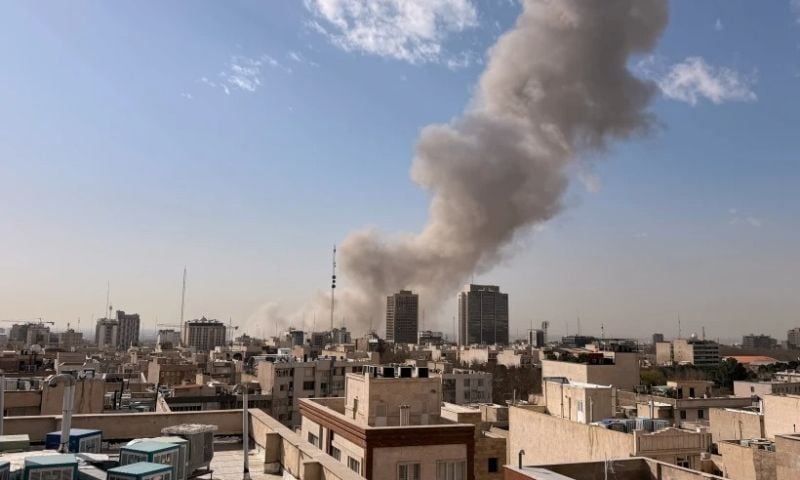
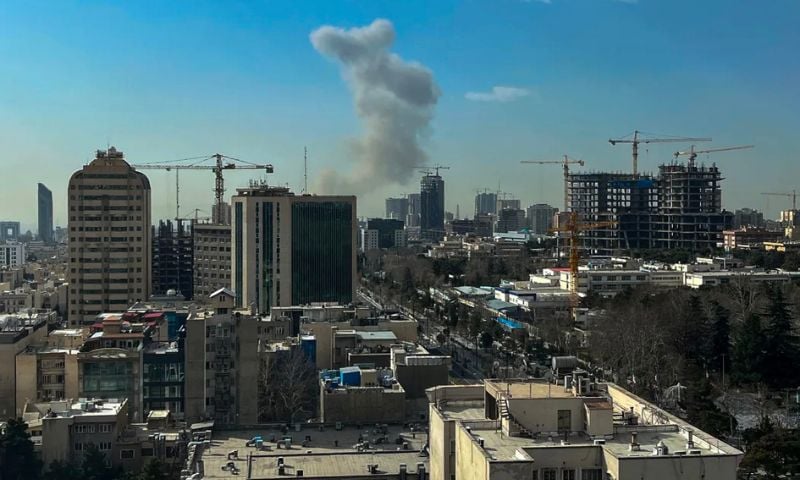
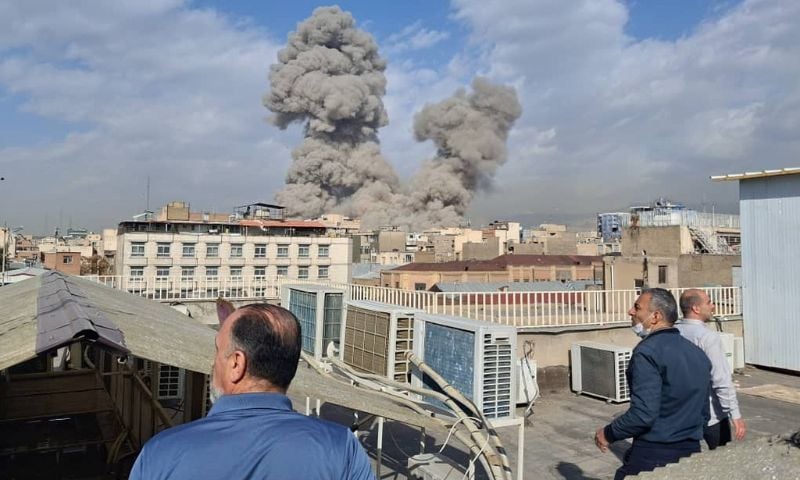
Shortly before Trump’s remarks, Israel confirmed launching what it described as preventive strikes against targets inside Iran. Thick smoke was seen rising from parts of central Tehran, including areas near offices associated with Supreme Leader Ali Khamenei, according to witnesses and local reports.
It was unclear whether the 86-year-old Khamenei was present at the time of the apparent strike. He has not appeared publicly in recent days amid intensifying tensions.
Israel’s Kan public broadcaster reported that the strikes targeted “regime and military sites, including ballistic missiles.” A ticker on the Kan 11 channel said ballistic missile facilities were among the objectives.
Explosions were also reported in several other Iranian cities, including Isfahan, Qom, Karaj, and Kermanshah, according to Iran’s semi-official Fars news agency. Iranian air defence systems were activated in multiple areas, and video circulating online showed smoke rising over parts of Tehran.
Israel’s defence minister declared a state of emergency as the operation unfolded.
Iran Launches Missiles Toward Israel
Hours after the strikes on Iranian territory, the Israeli military said it detected missiles launched from Iran toward Israel, triggering air-raid sirens across several parts of the country.
“A short while ago, sirens were sounded in several areas across the country following the identification of missiles launched from Iran toward the State of Israel,” the military said in a statement.
Emergency cellphone alerts were sent to residents urging them to seek shelter as air defence systems were activated.
Sirens were also heard in Jordan’s capital, Amman, according to witnesses, highlighting the regional spillover of the confrontation.
There was no immediate detailed statement from Iranian authorities confirming the scale of the missile launch, but Tehran had earlier warned that any attack on its territory would be met with a firm response.
US Military Role and Regional Security Measures
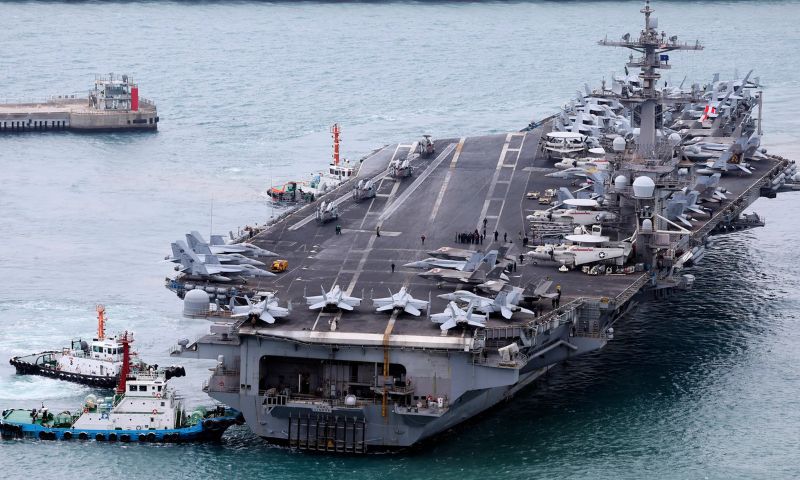
With Trump’s confirmation, the operation now appears to be a coordinated US-Israeli campaign against Iranian military assets. The Pentagon has not publicly detailed the specific assets deployed or the operational scope.
In recent weeks, Washington has increased its military presence in the region, deploying additional fighter jets and warships amid rising tensions over Iran’s nuclear programme and regional posture.
Following the strikes, US embassies in Qatar and Bahrain instructed staff to seek shelter and advised American citizens to remain in secure locations until further notice.
The United States has also begun evacuating non-emergency personnel from certain diplomatic missions in the region, reflecting concerns about possible retaliatory escalation.
Iran’s Position and Nuclear Dispute
Iran has consistently maintained that its nuclear and missile programmes are for defensive purposes and denies seeking nuclear weapons. Tehran has long accused Washington and Israel of destabilising the region and interfering in its sovereign affairs.
Iranian officials have previously warned that any direct military action against Iranian territory would draw retaliation not only against Israel but potentially against US interests in the region.
As of Saturday, Iranian authorities had not released comprehensive details on casualties or damage resulting from the strikes.
Risk of Wider Regional War
The latest exchange marks one of the most direct and dangerous confrontations between Iran, Israel, and the United States in years.
Analysts warn that sustained strikes and counter-strikes could draw in regional actors, disrupt shipping lanes in the Gulf, and rattle global energy markets — particularly if tensions spill into the Strait of Hormuz, a key artery for global oil supplies.
The activation of sirens in Israel and neighbouring Jordan underscores the cross-border implications of the escalation.
With both sides signalling resolve and no immediate indication of de-escalation, the situation remains fluid and highly volatile.
Further updates on casualties, damage assessments, and diplomatic responses are awaited as the confrontation continues to unfold.