


KEY POINTS
- Iran’s President ordered start of nuclear talks with US.
- Trump hopes for a deal but warned of consequences if diplomacy fails.
- Iran and the US are expected to resume talks in Turkiye on Friday.
- Tehran rules out talks on missile programme or its defence capabilities.
- Tehran has warned that any US military attack would trigger regional war.
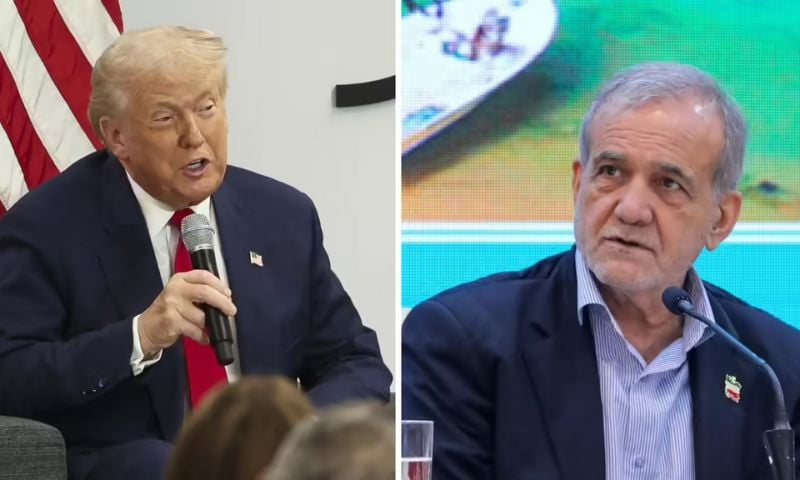
TEHRAN, Iran: Iran’s President Masoud Pezeshkian said on Tuesday he has ordered the start of talks with the United States, provided negotiations are conducted without threats, as Washington and Tehran move towards reviving diplomacy over Iran’s nuclear programme.
“I have instructed my foreign minister, provided that a suitable environment exists — one free from threats and unreasonable expectations — to pursue fair and equitable negotiations,” Pezeshkian said in a post on X.
I have instructed my Minister of Foreign Affairs, provided that a suitable environment exists—one free from threats and unreasonable expectations—to pursue fair and equitable negotiations, guided by the principles of dignity, prudence, and expediency.
— Masoud Pezeshkian (@drpezeshkian) February 3, 2026
The Iranian President added that the move followed requests from “friendly governments” in the region to respond to the proposal by the US President for talks.
On Monday, US President Donald Trump said he hopes to reach a nuclear deal with Iran but has also warned of “bad things” if diplomacy fails, while stepping up military pressure in the region.
Talks likely in Turkiye
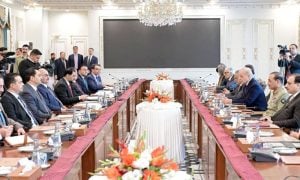
Iran has not officially confirmed the venue for the talks. However, an Arab official told AFP that a meeting is likely to take place in Turkiye on Friday, following diplomatic efforts by Ankara, Egypt, Oman and Qatar.
Iranian and US officials have confirmed that nuclear talks would resume in Turkiye, Reuters reported while citing diplomatic sources.
US Special Envoy Steve Witkoff and Iranian Foreign Minister Abbas Araqchi are expected to meet in Istanbul in an attempt to revive stalled negotiations.
A regional diplomat cited by Reuters said representatives from Egypt, Qatar and the United Arab Emirates, along with other regional countries, would take part in parallel bilateral, trilateral and multilateral meetings on the sidelines.
“Qatar, UAE and Egypt, as well as some other countries, will attend the Istanbul meeting,” the diplomat said.
Focus on nuclear issue
Iran has repeatedly stressed that any talks must focus strictly on the nuclear file.
Tehran has ruled out negotiations over its ballistic missile programme or its defence capabilities.
Iranian news agency Fars reported on Monday that Pezeshkian had formally ordered the initiation of nuclear negotiations with Washington, citing an unnamed government source.
The report said the talks would be held “strictly within the framework of the nuclear issue”.
Iran’s foreign ministry said it was finalising the framework for the negotiations, with messages exchanged through regional intermediaries.
“Several points have been addressed, and we are examining and finalising the details of each stage in the diplomatic process,” spokesman Esmaeil Baqaei said.
Regional diplomacy
Qatar’s foreign ministry said on Tuesday that diplomacy with Iran was continuing “very intensively” in coordination with regional partners.
A senior UAE official also urged Iran to rebuild ties with Washington. “I would like to see direct Iranian-American negotiations leading to understandings,” presidential adviser Anwar Gargash said, according to AFP.
Iranian Foreign Minister Araqchi told CNN on Monday that while Tehran had lost trust in Washington as a negotiating partner, a deal remained possible.
“If the US negotiation team follows what President Trump said — to come to a fair and equitable deal — I see the possibility of another talk,” he said.
Tensions after war and sanctions
Nuclear talks were abandoned last year after Israel launched strikes on Iranian nuclear and military sites in June, triggering a 12-day conflict.
The United States briefly joined the fighting, striking Iranian nuclear facilities.
Iran responded with missile and drone attacks on Israel and by targeting a US military base in Qatar.
Since returning to the office last year, Trump has reinstated his “maximum pressure” sanctions campaign against Iran.
He has also ordered a US naval buildup in the region following nationwide protests in Iran over economic hardship.
Trump said last week that Iran was “seriously talking”, while Iran’s top security official Ali Larijani said arrangements for negotiations were underway.
US demands and Iranian red lines
Iranian sources told Reuters that Washington had set three conditions for talks: zero uranium enrichment on Iranian soil and limits on Iran’s ballistic missile programme.
Iran has rejected those demands as violations of its sovereignty, though two Iranian officials said restrictions on the missile programme were seen as the most difficult obstacle.
Baqaei said sanctions relief was a priority for Tehran and stressed that “time is of the essence”.
‘Ball in Trump’s court’
An Iranian official, cited by AFP, said Tehran was open to flexibility if talks resumed without preconditions.
However, the official added that Iran wanted US military assets moved away from its borders before talks begin.
“Now the ball is in Trump’s court,” the official said.
Supreme Leader Ayatollah Ali Khamenei warned on Sunday that any US attack would trigger a “regional war”.